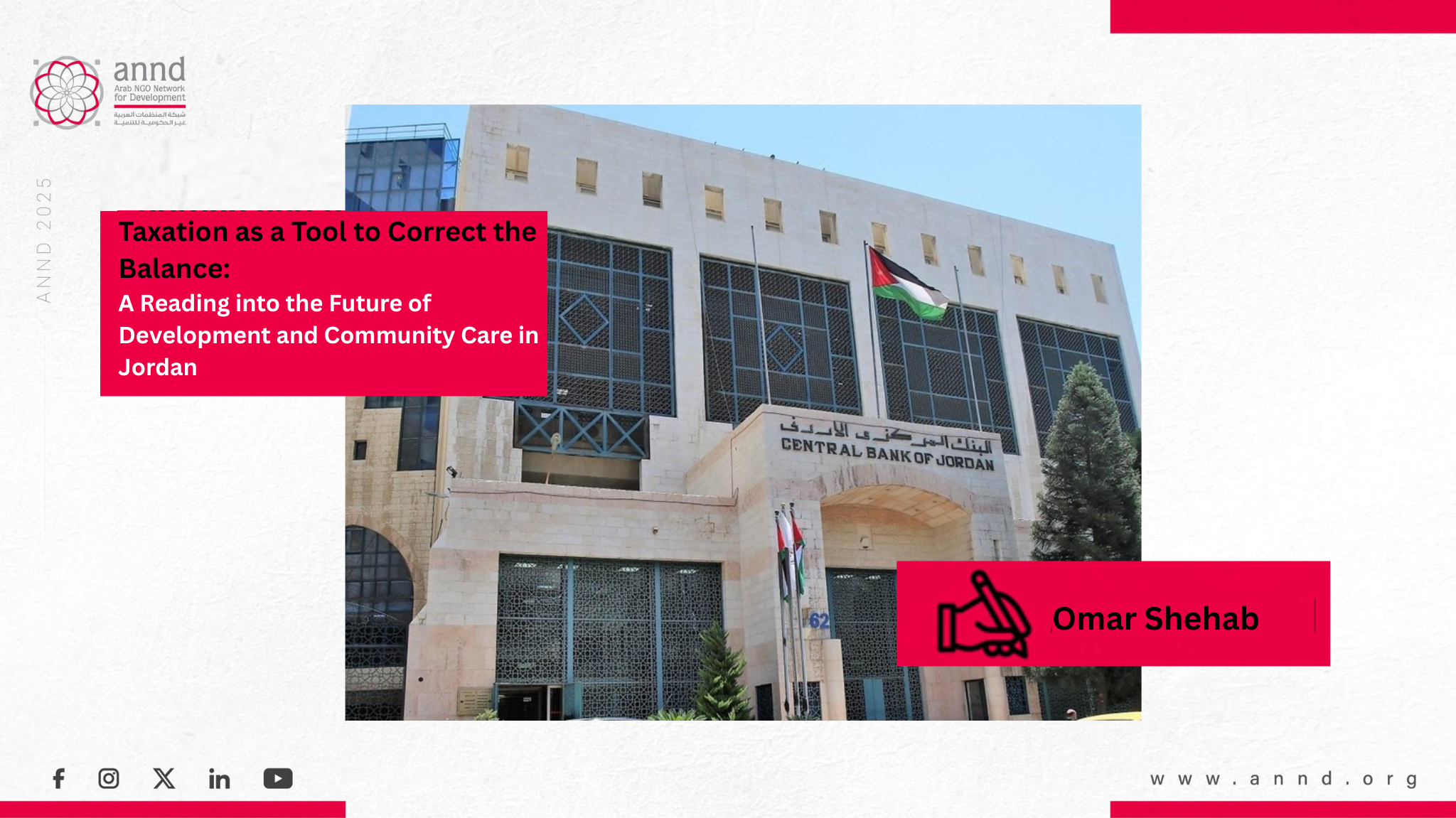
Taxation as a Tool to Correct the Balance: A Reading into the Future of Development and Community Care in Jordan – Omar Shehab
Taxation as a Tool to Correct the Balance: A Reading into the Future of Development and Community Care in Jordan – Omar Shehab
Many countries in the Global South face a range of economic
and social challenges, including the absence or weakness of tax justice
systems. Meanwhile, tax justice in developed countries stands as a fundamental
tool for achieving human development—one that is not limited to economic growth
but also encompasses the right of individuals to access essential services such
as health and education, and to adequately finance and expand these sectors.
Jordan, as a country of the Global South, faces difficulty
in securing sufficient funding for numerous sectors, including social care.
This comes in addition to the absence of legislative frameworks that recognize
care work as paid labor. Thus, shifting toward a tax system that relies more
heavily on direct taxes, rather than overwhelming dependence on indirect
taxes, becomes an important opportunity to ensure the provision of these
rights and achieve inclusive and sustainable human development.
The right to development is a comprehensive right
that guarantees every individual the opportunities and services needed to live
in dignity. These opportunities include access to quality education,
healthcare, decent work, and other rights.
Recent studies in Jordan indicate that debt servicing in
2024 reached approximately 1.96 billion Jordanian dinars, a figure that
exceeds what was spent on either education or health that same year. This
signals a declining level of investment and development in these essential
sectors year after year.
Alongside international solutions—which require cooperation
and a renewed perspective on the right to development, including restructuring
debts and their interest—there is also a need to reconsider domestic solutions
by reviewing the tax system to ensure it becomes more effective and just. This
shift would enable the state to better provide essential services, especially
as taxes in Jordan, as in many Global South countries, constitute one of the
main sources of financing for these services. Taxes form the cornerstone for
creating a fair developmental environment.
Recent figures show that tax revenues in Jordan for 2024
are approaching 6.1 billion Jordanian dinars, with a large share coming
from indirect taxes, such as the sales tax, which reached around 4.3
billion dinars, constituting nearly 70% of total tax revenues.
Meanwhile, the most recent semi-annual report issued by the
Jordanian Ministry of Finance this year shows an increase in tax revenues
resulting from a rise in the general tax on “goods and services” by 125.7
million dinars, while revenues from the general tax on “income and profits”
decreased by 56.9 million dinars.
This creates an even more complicated situation for
achieving tax justice, as indirect taxes disproportionately affect low-income
groups, deepening the economic divide among different segments of society. On
the other hand, direct taxes, such as income tax, can contribute to
creating a more equitable distribution of wealth and ensure more stable and
sustainable funding for developmental rights.
Financing the Right to Community Care: An Investment and
Development Opportunity in Jordan
Among the fundamental rights that states must guarantee is
the right to community care, which is a key component of achieving social
justice. In Jordan, however, securing funding for this right remains a major
challenge.
Financing community care through direct taxation can
serve as an important opportunity to sustainably and comprehensively fund care
programs for all citizens—especially the most vulnerable groups, such as the
elderly and children. This would also create the conditions to legally
recognize care work as paid labor through these programs.
Transitioning to direct taxes, such as progressive income
tax, and more effectively combating tax evasion would provide the state with
sustainable income sources. A share of this revenue could then be allocated to
support community care programs, such as home care for the elderly or children.
This requires reconsidering domestic care work as paid labor
and regulating it through inclusive and equitable legislative reforms. Such
reforms would enable a shared community-based approach to care work between the
state, institutions, and individuals—moving away from the current social
dynamic that places the entire burden on women who provide unpaid domestic
care, depriving many of them of the right to education or employment.
Financing community care—through integrating governmental
and private institutions and society into unified programs, and shifting from
indirect to direct taxes—is not only a rights-based obligation but also a
genuine investment opportunity.
Investment in community care improves individuals’ quality
of life, especially for women who perform care work. At the same time, it
serves as a major factor in stimulating the national economy. When governments
invest in community care and formally regulate it as paid work, they enhance
individuals’ ability to participate actively in the labor market, leading to
greater productivity, innovation, and sustainable economic growth.
This can be clearly seen in Uruguay, whose adoption
of an integrated national care system in 2015, significantly increased
women’s economic participation, created new jobs within the care sector (care
centers, caregiver training, etc.), and presented an exemplary model of
equality and social justice.
Toward Strengthening This Development Opportunity in
Jordan
To enhance this developmental opportunity, the
transformation of the tax system must be accompanied by a legislative framework
characterized by greater oversight, transparency, and accountability. This
includes activating monitoring procedures to combat tax evasion and improving
tax compliance by strengthening tax awareness among citizens.
The government should also adopt progressive tax laws
to ensure that individuals and companies with greater financial capacity
contribute more. A portion of these taxes should be allocated to funding
essential rights and community care programs, while ensuring that revenues are
used transparently and effectively within updated legislative frameworks.
Conclusion
Linking tax justice to development spending and community
care in Jordan requires a genuine shift in the philosophy of the tax system.
Strengthening direct taxation and allocating part of its revenues to fund
community care represents a long-term investment in human capital and the
national economy.
By directing these resources toward essential services,
Jordan can achieve inclusive development that guarantees citizens their rights
to health, education, decent work, and community care. However, this requires
strong political will and legislative reform aligned with social justice
principles and the challenges facing development—along with enhanced
transparency and accountability in managing public funds.
Such reforms would establish a fairer and more
sustainable development model.
Recent publications
Beyond Fiscal Stability: the Social Agenda and Good Governance at the Heart of Recovery and Reconstruction - Zahra Bazzi