Argentina and the IMF: A Long History of Financial Dependence and Social Resistance - Tomás Battaglino
Argentina and the IMF: A Long History of Financial Dependence and Social Resistance - Tomás Battaglino
Argentina’s relationship with
the International Monetary Fund (IMF) is one of the clearest examples of how
the global financial architecture operates in the Global South—imposing policy
conditionalities, enforcing austerity, and subordinating domestic priorities to
the interests of international creditors. Since the mid-20th century, every
intervention by the IMF has coincided with moments of rapid indebtedness, deep
recession, and social deterioration. These are not isolated episodes or
technical errors. What emerges, instead, is a persistent historical pattern: a
recurring mechanism through which the IMF shapes public policy, restructures
entire economies, and erodes national sovereignty. In Argentina, this dynamic
repeats itself with striking regularity. And yet, in the very places where
dependency takes root, a powerful tradition of social resistance also
emerges—one grounded in civic organization, social movements, public education
and collective dignity.
A Pattern That Transcends Governments And Eras
When Argentina signed its first agreements with the IMF in
the late 1950s, the formula was already familiar: reductions in public
spending, currency devaluation, abrupt trade liberalization, financial
deregulation, and falling real wages. The promise was always the same:
stability in exchange for sacrifice. But what followed was a succession of debt
and adjustment cycles that weakened the national productive structure, expanded
poverty, and constrained the state’s capacity to pursue development strategies
of its own.
During the 1970s and 1980s, this framework hardened under a
wave of financial liberalization that encouraged speculative inflows and
massive capital flight. Private debts—later absorbed by the state—multiplied
Argentina’s external liabilities. The economy was trapped in a vicious cycle:
short-term capital inflows, rapid outflows, new loans to “stabilize” the
situation, and finally, austerity programs that triggered recession and social
conflict.
By the 1990s, this logic
reached its peak. Under IMF supervision, sweeping privatizations, trade
openness, and financial deregulation transformed the country’s economic
landscape. Strategic public assets were sold, domestic industries faced
overwhelming foreign competition, and the financial system became increasingly
exposed to global volatility. The 2001 collapse—one of the most severe in
Argentina’s contemporary history—was the ultimate expression of that model:
uncontrolled indebtedness, multi-year recession, bank failures, and poverty
levels unlike anything seen before.
Today’s Debt Crisis: Unprecedented Depth And Speed
Two decades later, Argentina faces a new chapter in this
long cycle. The 2018 loan—the largest in the IMF’s history—left the country
with extraordinarily high obligations on an unmanageable timeline. The pace of
borrowing was so extreme that there was no chance for those funds to be
channeled into productive investment, infrastructure, or export capacity.
Instead, most of the money exited the country within months, fueling capital
flight, portfolio dollarization, and short-term speculative operations.
Rather than stabilizing the economy, the loan sharply
increased Argentina’s vulnerability. With depleted reserves and surging prices,
the country once again fell under IMF oversight. The recommendations were no
surprise: rapid fiscal consolidation, cuts in education, health, and science
budgets, contraction of social spending, pension revisions, devaluations, and
new openings for imports.
The social consequences are
profound. In recent years, fiscal adjustment has been directed almost entirely
toward servicing external debt, while investment in public education has
dropped dramatically. Thousands of students are forced to abandon their studies;
teachers’ salaries lose purchasing power; university buildings deteriorate; and
scholarship programs fail to keep pace with inflation. In a country where
public higher education has long been a source of scientific and cultural
strength, these trends weaken not only individual rights but also collective
development capacities.
Debt as a Democratic Struggle
One distinctive element of the Argentine case is that debt
has never been viewed solely as a technical matter. Civil society, social
movements, unions, and universities have long questioned the legitimacy of debt
arrangements and demanded democratic participation in decisions that shape the
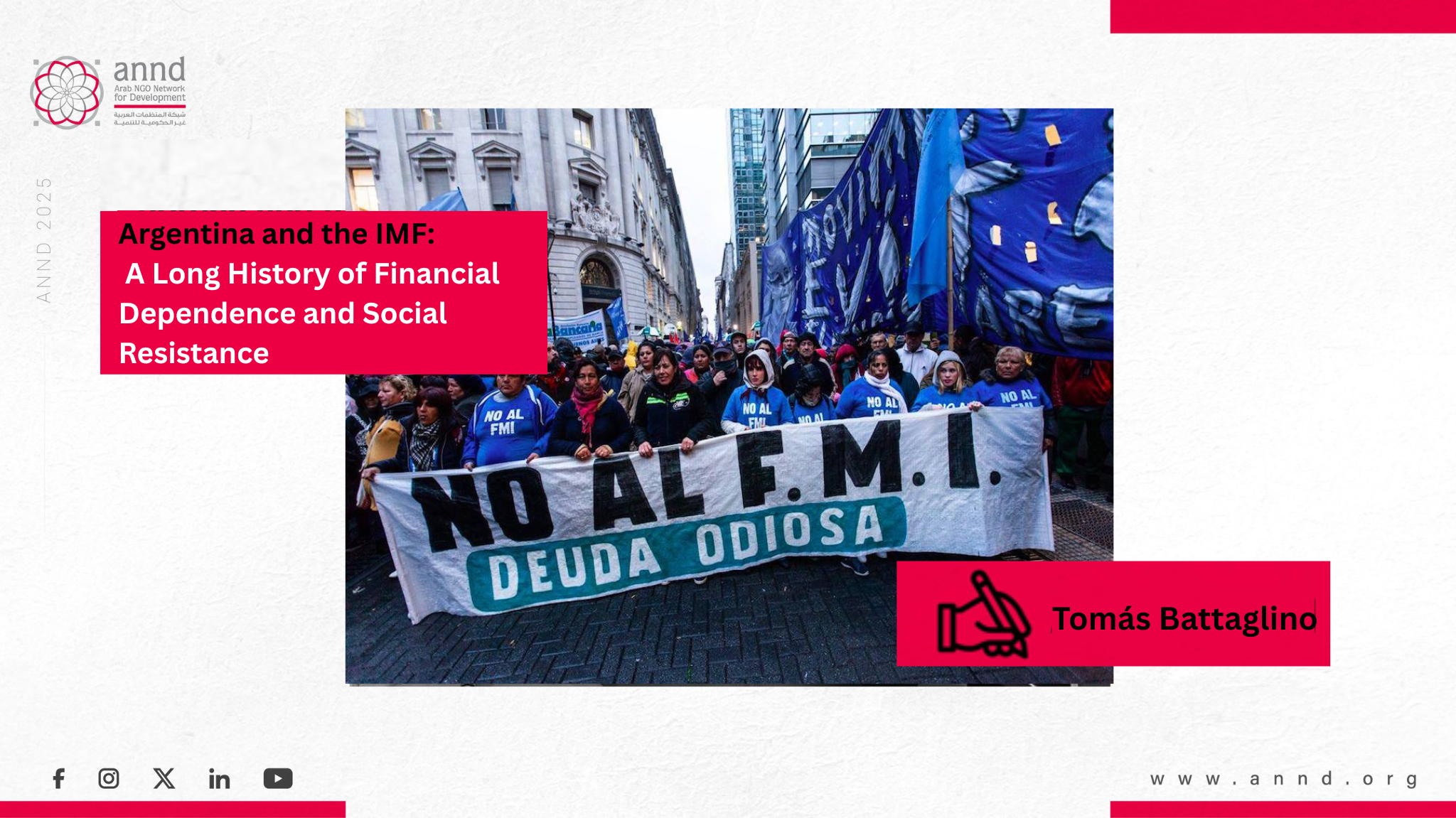
nation’s future. In 2022, a grassroots popular consultation held by Movimiento
Libres del Sur gathered over one million signatures calling for any IMF
agreement to undergo public debate. It was a significant gesture: citizens
asserting their right to decide on obligations that will weigh on future
generations.
In 2024, the student movement led the largest
education-related mobilization in decades. Public classes, open assemblies, and
massive demonstrations filled the streets in defense of the public university
system. The message was clear: there can be no talk of development, innovation,
or future if public resources are drained to repay foreign creditors. Defending
public education became inseparable from defending national sovereignty.
This civic engagement is not a
detail—it is a political force. It shows that, even in the face of structural
and recurring crises, organized society is capable of producing diagnoses,
exposing injustices, and articulating alternative paths. In Argentina, debt is
a democratic question: who decides, who benefits, who pays, and who bears the
cost.
An Institution That Changes Its Language, Not Its Logic
While the IMF frequently modernizes its discourse—speaking
of “inclusive growth,” “social sensitivity,” or “green transitions”—its
interventions in practice remain unchanged. The conditionalities imposed on
Argentina reproduce the same logic applied across the Global South: austerity,
state retrenchment, devaluations, regressive labor reforms, and an overriding
priority on external debt repayment. What evolves is the rhetoric; what
persists is the underlying structure of power.
Instead of acting as a
stabilizing force, the IMF functions as a device of economic discipline that
strengthens creditors, restricts national policy autonomy, and entrenches a
model of financial dependence that perpetuates inequality between the North and
the South.
Looking to the South: Building a Different Horizon
Despite the severity of the situation, there is space for
hope. Argentine history shows that every cycle of crisis has been met with a
cycle of resistance. From the neighborhood assemblies of 2001 to the recent
student mobilizations and popular consultations, society has repeatedly
defended rights, questioned prevailing models, and imagined alternatives.
Today’s global context also opens new possibilities:
regional currencies, South-South development banks, debt audits, cooperative
financial arrangements, and sovereign production models that do not rely on
external borrowing as the backbone of stability.
The way out will not come from the same system that created
the crisis. It will emerge from the political, economic, and social creativity
of the Global South—from its ability to build alliances, defend autonomy, and
design its own institutions. If Argentina’s long history teaches anything, it
is that “dependence is not destiny; it is a structure that can be transformed”.
In a world searching for new forms of balance and global justice, Argentina has an opportunity. And that opportunity, as generations of students, workers, and community organizations have already understood, does not lie with the IMF. Because in the end, only the South will save the South.
Recent publications
Beyond Fiscal Stability: the Social Agenda and Good Governance at the Heart of Recovery and Reconstruction - Zahra Bazzi