Between the Militant Memory and the Questions of the Present Moment - Bouchra Belhaj Hmida

Between the Militant Memory and the Questions of the Present Moment
The 8th of March each year, which coincides with “International Women’s Day”, represents a symbolic moment for feminist activists, organizations defending women’s rights, as well as some governments concerned with women’s conditions, to assess the progress achieved toward reducing gender inequalities in all areas of rights. It is also an opportunity to shed light on the obstacles that still hinder the path toward full gender equality, or at least toward achieving the goals set out in various plans in this direction.
Despite the intellectual differences among feminist movements in the Arab region, shaped by differing social and legislative contexts, these movements have recognized since their inception that the issue of equality cannot be addressed in isolation from a comprehensible societal project. The obstacles to achieving equality and ending discrimination are closely linked to the consolidation of public and individual freedoms, to a rational approach to the religious question by keeping it separate from political conflicts, and to the liberation of our countries from forms of external domination.
Therefore, women's struggles in the region have historically been connected to the broader struggle for democracy, social justice and national sovereignty. There is no doubt that the past decades have witnessed significant struggles waged by women and civil society actors. In several Arab countries, and others close to our region, women have made enormous sacrifices for their freedom, and at times, for their very lives.
However, the pace of reform has remained slow and uneven from one country to another. This confirms that the path to equality still requires a clearer and more courageous political will, broader society involvement, and a comprehensive social project. Only then, can scattered gains evolve into a comprehensive structural transformation that enshrines justice and effective equality and puts an end to the patriarchal system that reproduces discrimination in new forms whenever contexts change.
How do we commemorate this anniversary today?
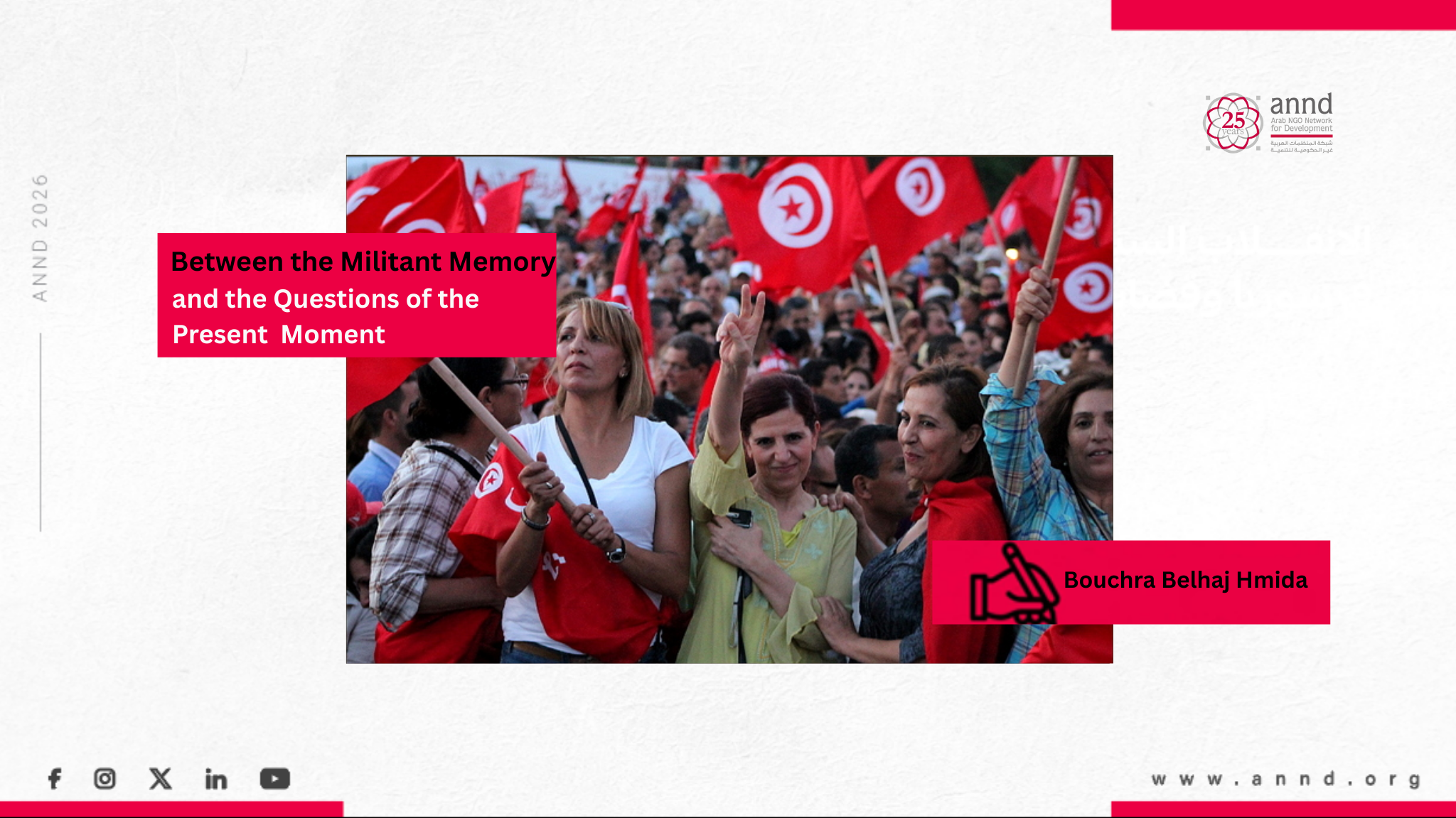
This year, March 8th raises an urgent question: How do we commemorate this anniversary amidst the political transformations sweeping our region and the world? And how do I commemorate it, as a Tunisian woman and feminist activist who contributed to the rise of the feminist movement in Tunisia and chaired the Association of Democratic Women for six years?
How can I commemorate it when I am, for the fourth consecutive year, barred from my country on this occasion by an unjust and arbitrary political decision that I never imagined, even in the darkest periods before the Tunisian revolution.
Nor did I imagine that I would see so many Tunisian women imprisoned, forcibly displaced, or prosecuted for exercising their legitimate right to access public space -a space we have always considered our natural domain, and for which we have fought long and hard to break down the walls that blocked our access to it. However, this access often appeared conditional on loyalty to the regime, as public spaces were denied to those who were not loyal.
This shock, which I experienced like many other activists who were affected by this oppression, stems from the fact that since independence, we have lived under the Tunisian state, which, although authoritarian, was considered a ‘feminist’ state as it had made women's rights one of its official priorities.
In fact, this issue was raised in isolation from other issues, and the “protection of women's rights “was used to justify political repression and the restriction of freedoms. Ironically, Tunisia, the country where the first independent feminist movements in the region emerged, has witnessed a feminist movement that is almost constantly in opposition to the authorities, despite the advanced legislative gains it has achieved compared to other countries. Perhaps this is not an irony, but rather a paradoxical reality experienced by women who have lived and grown up with the Personal Status Code.
That is why our attachment to Tunisia and our determination to preserve its achievements may explain why we are often more critical of our state, because we feel that equality is a legitimate issue and not a taboo. Despite the state's insistence on monopolizing it, we believed that equality is not a purely official matter, nor solely a state issue, but rather a fundamentally societal one.
The state does not have the right to decide alone when and how we move forward on this path. It is obligated to listen to civil society and open spaces for free and calm dialogue, away from boastful rhetoric claiming that Tunisia has definitively achieved equality, while discrimination persists in various forms.
This boastful rhetoric has contributed to creating a feeling among part of society that Tunisian women enjoy "privileges" exceeding those of men, and that there is an "excess" of rights. These voices grew louder after the revolution, and we see them even more prominent today in a political context characterized by the absence of a clear official discourse supporting equality. Indeed, these voices have been liberated from all constraints, especially given the almost complete exclusion of the feminist movement and all components of civil society from the media, which has often reverted to the climate that prevailed before 2011, characterized by smear campaigns and judicial prosecutions.
Lessons from the Tunisian experience and the challenges for the future
The Tunisian experience has confirmed that there can be no equality and no guarantee of its durability without a democratic system and a free and just society. Achievements, however important, remain fragile and susceptible to reversal if they are not firmly rooted within the society itself. It is true that we have achieved significant gains since the revolution and have had opportunities for pluralistic and calm dialogue, but the absence of deep structural reforms, along with the dominance of political discourse based on partisan and personal interests, have prevented the construction of a solid democratic state and a unified society within a framework of pluralism and diversity.
In a world witnessing the rise of extreme right-wing populist movements and increasing conflicts and wars, as we see today in complex regional contexts, it seems that universal human rights values are being severely tested. However, the lessons of history confirm that there can be no security without freedom, no freedom without equality, and no sovereignty without national unity in confronting all forms of aggression.
Therefore, the commemoration of 8 March this year cannot be merely a symbolic celebration. Rather, it must be an act of peaceful resistance and a renewal of commitment to the values of equality and justice.
For me, despite my forced absence, this day remains an occasion to affirm that the feminist struggle in Tunisia has never been a sectoral or narrow demand, but has always been, and continues to be, an integral part of a broader democratic and liberationist project.
Equality is not a gift granted by authority, nor a slogan to be raised only when needed and on special occasions. It is a long process that requires political courage, social awareness, and cross-border solidarity. In the face of regression, all we can do is hold on to hope and continue working towards making a better world possible — a world that recognizes that security cannot exist without freedom, that freedom cannot stand without equality, and that there can be no equality, justice or freedom without sovereignty grounded in the unity of a people imbued with the highest human values.
Recent publications