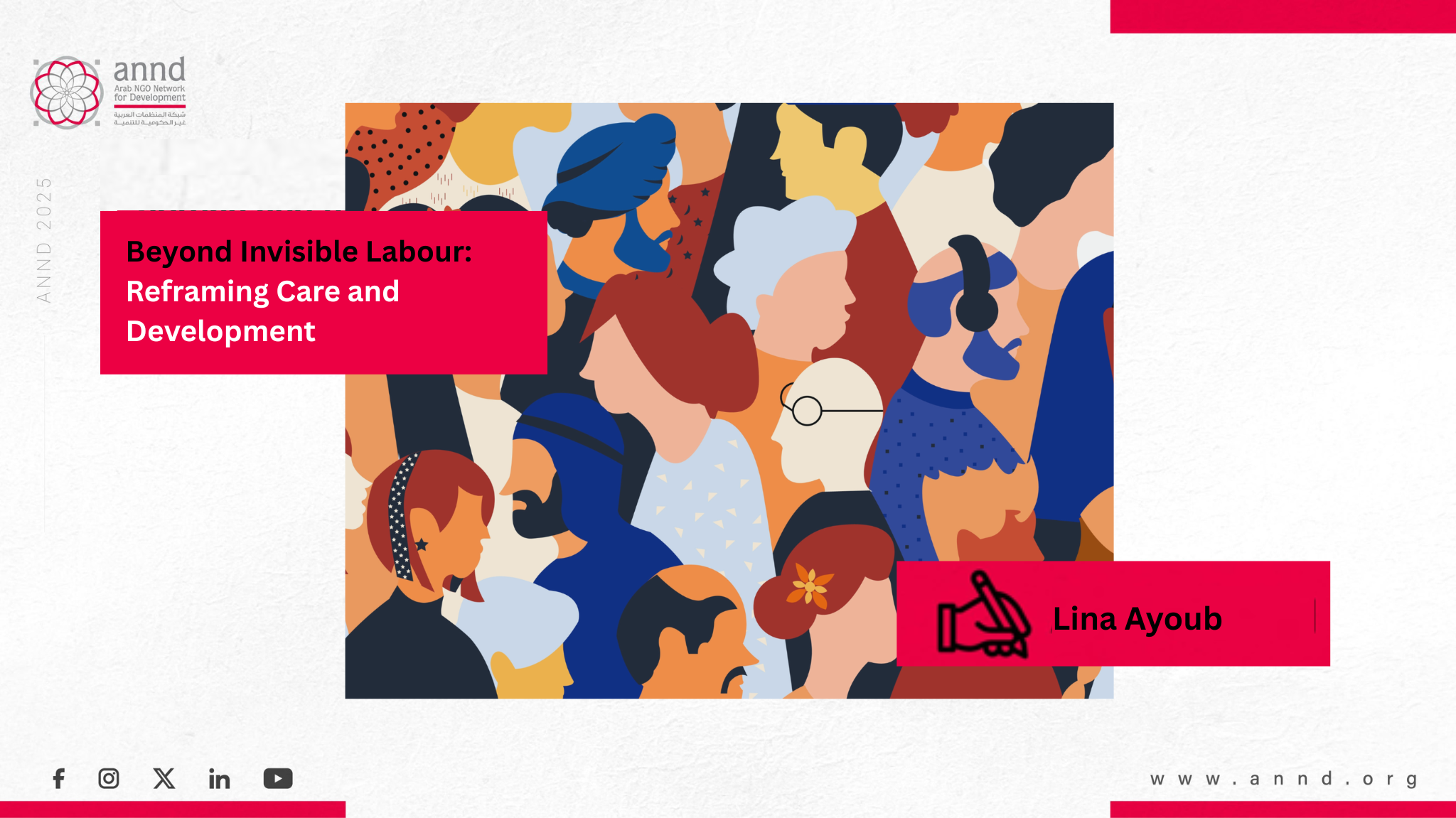
Beyond Invisible Labour: Reframing Care and Development - Lina Ayoub
Care has always been humanity’s first profession. Before
states, markets, or formal economies took shape, it was care that fed, healed,
comforted, raised, and sustained life. It formed the silent architecture on
which societies were built. Yet across centuries, this architecture was pushed
into the private sphere, feminised, and treated as an endlessly renewable
resource rather than a foundational system. What was once recognised as the
labour that makes all other labour possible became naturalised, invisible, and
taken for granted.
Globally, this paradox persists. Oxfam estimates that women
perform 12.5 billion hours of unpaid care work every day, labour worth at least
$10.8 trillion annually if valued at minimum wage. The International Labour
Organization warns of a deepening global care crisis: demographic shifts,
rising chronic illness, widening inequality, austerity, and climate change are
expanding care needs faster than states and markets can respond. The burden
falls unevenly, shaped by gender, class, geography, and the historical ways
societies have organised social reproduction.
Tunisia sits firmly within this global landscape, yet its
pressures are distinct. Behind political volatility and economic stagnation
lies a quieter crisis: the country’s entire development model rests on a deeply
gendered system of care and social reproduction. Tunisian women, especially in
rural regions and low-income households, carry the triple responsibility of
income generation, caregiving, and community maintenance. Their labour fills
the gaps left by shrinking public services, austerity-driven policy choices,
and widening regional inequalities. This work sustains households and stabilizes
communities, yet it remains uncounted, unsupported, and structurally
undervalued. It is neither peripheral nor accidental; it is the hidden engine
of Tunisia’s economy.
Feminist economics and social reproduction theory help
illuminate this reality with clarity. Care is not auxiliary to the economy; it
is its invisible infrastructure. Social reproduction encompasses the labour of
raising children, supporting elders, sustaining households, nurturing emotional
and social bonds, and preserving cultural knowledge. While some of this work
occurs through public institutions, the majority takes place within households
and relies overwhelmingly on women’s unpaid time. Conventional economic
indicators- GDP, employment rates, productivity metrics - consistently exclude
this labour and thereby exclude women’s contributions. Each hour spent on
unpaid care is an hour subtracted from paid work, skill-building, or rest. This
“time poverty” is one of the most persistent and least acknowledged drivers of gender
inequality.
Tunisia embodies this tension vividly. Women perform more
than four times the unpaid care work of men, averaging 17 hours per week
according to UN Women ,and far more in rural settings where services are
scarce. The consequence is visible in labour-force statistics: despite high
levels of education, Tunisian women’s employment remains among the lowest in
the region. The barrier is not a lack of willingness to work; it is the
structural impossibility of reconciling paid employment with the unrecognised
labour required for daily survival. Talent is not the constraint; time is.
Assigning monetary value to care can help illuminate its
magnitude, but care cannot be fully captured by wages or GDP. It is relational,
emotional, rooted in kinship, community, and interdependence. At the same time,
paid work is no longer a matter of luxury or aspiration for women. Across
Tunisia and much of the Global South, economic pressures make women’s income
indispensable for household survival, even as they carry this dual burden with
the least institutional recognition.
Tunisia’s care crisis is shaped by several intertwined
forces. Childcare remains limited, expensive, or poorly regulated. Eldercare
and disability services are fragmented and unevenly distributed, with interior
regions facing the widest gaps. Rural families navigate long distances to
healthcare, chronic shortages of transportation, and the daily work of
compensating for absent services- all dynamics that intensify unpaid care
responsibilities. Climate change adds new layers: rising heat, water scarcity,
and agricultural shocks increase the time required to secure basic needs, often
forcing women and girls to absorb even more unpaid labour. Meanwhile, fiscal
consolidation and austerity continue to reduce public investment in health,
education, and social protection, shifting responsibility back to households.
In this context, Tunisia’s labour market is quietly
organised around care. Women cluster in informal or flexible sectors not
because these jobs are desirable, but because they offer the only possible
reconciliation with caregiving: seasonal agricultural work, home-based
production, informal services, and micro-enterprises. These forms of labour
lack security, social protection, and any real prospects for upward mobility.
The economy therefore reproduces gender inequality through the very structure
of available work. Low female labour participation is not a personal choice; it
is a systemic outcome.
The consequences extend beyond households. Care-driven
absenteeism and attrition reduce productivity across both public and private
sectors. National GDP suffers. A country that cannot mobilise half its human
capital, despite high education levels, will inevitably limit its own
development potential. The constraint is not capability but time, and the
system that organises it.
Yet, if care is the invisible foundation of the economy, it
can also be the foundation of a different development model. Investing in care
is not a social burden but a strategic opportunity. The ILO shows that
care-sector investment creates more jobs than traditional infrastructure and
that these jobs are more resilient during crises.
A care economy is not merely a list of services; it requires
institutional willingness. Tunisia needs community-based childcare, subsidised
and regulated preschool options, day centers and respite services for elders,
rehabilitation and support for persons with disabilities, and a strengthened
primary healthcare system capable of reducing the unpaid care load on
households. Without such pillars, care continues to collapse back into the
private sphere, reinforcing time poverty and structural inequality.
Legal clarity is also essential. Domestic care work in
Tunisia remains largely excluded from the Labour Code, and enforcement of
contracts or social protections is minimal. Ratifying ILO Convention 189 on
decent work for domestic workers would signal a shift toward recognising care
as labour deserving rights, dignity, and regulation. Integrating domestic and
community-based care workers into social security, clarifying employer
obligations, and simplifying registration systems would gradually move this hidden
sector into formality. No care economy can be built on invisible labour; rights
are the entry point for recognition.
From this perspective, the most
meaningful recommendations are those rooted in Tunisia’s structural realities,
not imported templates. A national care strategy must begin with measurement:
regular time-use surveys, care dependency ratios, and gender-responsive
budgeting that reflects real household dynamics. Labour-market policies need to
recognise time as a resourcethrough flexible arrangements, parental leave for
both parents, and stronger enforcement against workplace discrimination.
References
International Labour
Organization (ILO).
ILO
(2018). Care Work and Care Jobs for the
Future of Decent Work.
Oxfam International.
Oxfam
(2020). Time to Care: Unpaid and
Underpaid Care Work and the Global Inequality Crisis.
UN Women.
UN
Women (2020). In Tunisia: Towards
Recognizing, Reducing and Redistributing Unpaid Care Work.
Friedrich Ebert Stiftung (FES).
FES
(2024). Social Reproduction in Tunisia:
Gendered and Regional Dimensions.
World Bank.
World
Bank (2024). Female Labour-Force
Participation Rates and Labour-Market Indicators.
GIZ – Deutsche Gesellschaft
für Internationale Zusammenarbeit. GIZ (2023). Tunisia Climate Vulnerability Assessments.
UNDP – United Nations
Development Programme.
UNDP (2021–2023). Gender, Resilience, and Social Protection in the Arab States.
Recent publications
Who Enters the Age of Electricity? And Who Pays the Price? - Habib Maalouf