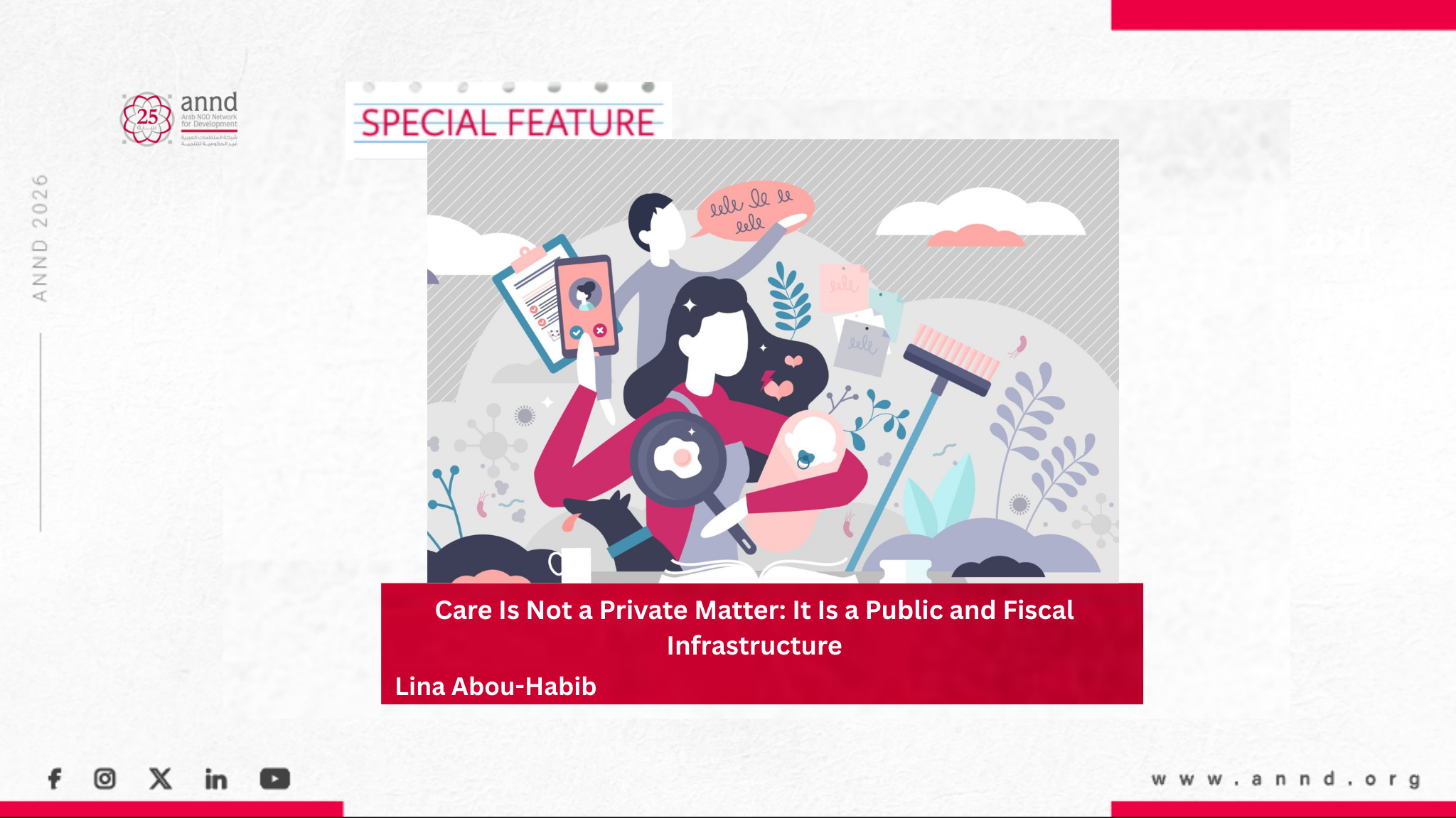
Care Is Not a Private Matter: It Is a Public and Fiscal Infrastructure – Lina Abou-Habib

Care Is Not a
Private Matter: It Is a Public and Fiscal Infrastructure – Lina Abou-Habib
Care work
sustains societies. It feeds children, supports older people, enables paid
employment, and holds communities together in times of crisis. Yet it is still
treated as “help,” “love,” or a “natural female duty” rather than what it is:
labor that requires time, skill, and endurance. This misrecognition is intentional.
It represents a political choice with
economic consequences.
Unpaid care and
domestic work remain largely invisible in public policy and national budgeting.
Many women still say, “I don’t work,” because only waged labor is counted as
real work. The persistence of the “housewife” category, without any male
equivalent, reveals how deeply gendered our economic definitions remain. What
is not counted is not recognised, and hence, is not funded, protected, or
recognized as a right.
Feminist
movements have long proposed a practical framework for addressing this
injustice: recognition, reduction, redistribution, and increasingly, reward and
representation.
Recognition
means acknowledging care as work and measuring the time and effort it requires.
Care is not sentimental; it is an obligation imposed by social norms and
sustained by policy neglect. Without recognition, care remains excluded from
national accounts, public investment, and labor rights.
Reduction aims
to lessen the time and energy women spend on care through public services and
infrastructure, childcare, eldercare, healthcare, transport, and accessible
administration. But reduction becomes deeply unjust when it is achieved by
shifting the burden onto poorer or migrant women. Outsourcing care through
exploitative labor arrangements reproduces inequality rather than solving it.
Redistribution
is the political turning point. Care must be shared among households,
employers, communities, and the state. This also requires challenging gender
norms that stigmatize men who provide care and normalize women’s double
workdays. Care is not biological, nor is it feminine by nature. It is social
labor that anyone can and should perform.
This logic has
already shaped policy innovations. Some countries have adopted rights-based
care systems, recognizing care as a public responsibility rather than a private
family issue. Others have reorganized cities around time justice, clustering
essential services within walking distance so women can reclaim time for work,
study, rest, or participation in public life. The goal is not to prescribe how
women use their time, but to end the assumption that it is endlessly available.
At the heart of
these approaches is a paradigm shift: when care is a right, the state becomes a
duty-bearer. Ministries of finance, labor, health, and education can no longer
pretend that care is “someone else’s problem.”
The greatest
obstacle to care-centered policy is not feasibility. It is austerity. Austerity
depends on one unspoken assumption: that unpaid care work will absorb the shock
of economic collapse, service cuts, and crisis management. When public services
shrink, women fill the gap, by working more at home, leaving paid employment,
or sacrificing their own well-being. The result is a double penalty: job losses
in social sectors and rising unpaid workloads at home.
This is why
care is not only a gender issue; it is a fiscal justice issue. Claims that care
is “too expensive” ignore mounting evidence that investing in care generates
strong economic returns. Care creates jobs, boosts labor participation, and
produces higher tax revenues, often with a greater multiplier effect than
traditional infrastructure spending. Care is not a cost to be minimized; it is
productive social infrastructure.
If care policy
is to be transformative rather than cosmetic, several principles are essential:
·
Treat care as a right, not a charity or
emergency measure.
·
Build universal systems, introduced
progressively but designed for expansion.
·
Formalize care and domestic work with labor
protections, social security, and enforceable standards.
·
End legal and economic arrangements that enable
the exploitation of migrant care workers.
·
Recognize care in family law, pensions, and
social protection systems.
·
Finance care through solidarity-based fiscal
choices, not household sacrifice.
Care determines
who has time, income, mobility, and political voice. As long as it remains
privatized, women’s participation in public life will remain conditional.
Treating care as public infrastructure is not radical; it is overdue.
Care is not a
private matter. It is one of the clearest measures of whether a society values
human life over convenient accounting.
Recent publications