What Comes After the Failure of the Antalya Negotiations? - Habib Maalouf

What Comes After the Failure of the Antalya Negotiations?
From the Limitations of the Paris Agreement to the Need to Change the Climate Conference Agenda
Habib Maalouf
Editorial Summary: Habib Maalouf examines the failure of climate negotiations at COP31 in Antalya, the limitations of the Paris Agreement, and disagreements over climate finance, fossil fuels and international trade. He explores competing national interests, Arab negotiating positions and the challenges facing COP32 in Addis Ababa, calling for a fundamental reassessment of negotiation rules and the models of development, production and consumption that drive the climate crisis.
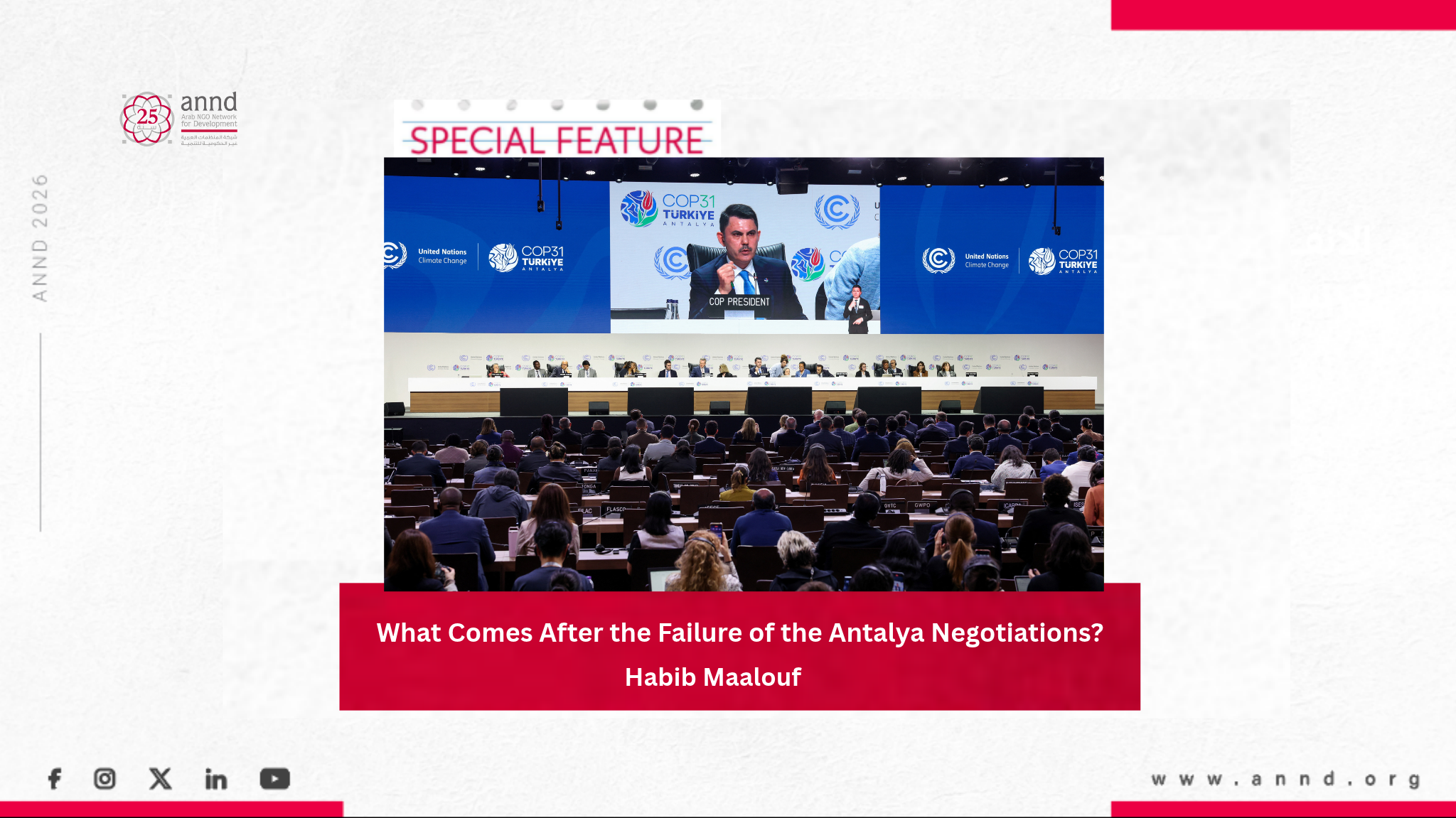
The failure of the 31st Conference of the Parties on climate change (COP31) in Antalya came as no surprise. Its negative outlook was evident from the outset, to the extent that even the adoption of a final statement would not have significantly altered the nature of the expected outcome. Such a statement would either have been incomplete, comprehensive but devoid of substance, or filled with ambitious language unaccompanied by mechanisms for implementation and accountability. In all cases, it would have remained constrained by the nature of an international climate system that produces pledges falling short of the commitments required.
What makes Antalya's failure so resounding, however, is not merely the inability of countries to agree on a comprehensive political decision, despite extending the negotiations by two additional days, making it the longest summit in the history of climate conferences. Rather, this failure once again exposed the impossibility of addressing a global crisis of such magnitude through a negotiating mechanism that avoids confronting its political, economic and civilizational roots.
The summit did not adopt the “Antalya Pact” proposed by the Turkish and Australian presidencies, following objections from more than thirty countries to its final wording. This does not mean, however, that the conference failed to adopt any decisions. Separate decisions were adopted across several negotiating tracks, while the major political issues remained unresolved. Herein lies the paradox: partial progress on the details, but an inability to agree on the essence of the problem.
The Problem Began in Paris
I was among the early critical voices that opposed the Paris Agreement in 2015, arguing that the world had come together around an agreement that enjoyed broad acceptance but was limited in substance. I argued that the world had agreed on an agreement devoid of substantive commitments, requiring countries to submit contributions rather than binding emissions reduction targets determined through international negotiations. It left each country to determine its contribution nationally, instead of subjecting it to criteria proportionate to its historical responsibility and capabilities.
The objection was not to the importance of establishing a target for limiting temperature increases, but rather to the gap between the declared objective and the political, legal and economic means necessary to achieve it.
It is true that the Paris Agreement contains procedural obligations relating to the submission, updating and reporting of nationally determined contributions. However, it does not require countries to achieve internationally determined emissions reduction targets, nor does it include a punitive mechanism to ensure their implementation. Countries could thus agree on an ambitious global objective while retaining the freedom to determine their own contributions, even when those contributions were insufficient to achieve that very objective.
The subsequent years failed to address the fundamental contradiction between the historical responsibility of industrialized countries and the right of developing countries to development, or the deeper question concerning the nature of the development model that everyone seeks to universalize.
The Problem Lies in the Distribution of Responsibilities and the Model We Seek to Universalize
A deeper issue has been absent from the negotiations: developing countries are not merely demanding their right to development. In most cases, they also seek to universalize a consumerist, industrial development model that is resource- and energy-intensive, pioneered by developed countries through which they accumulated their wealth.
Yet it is this very model that has brought the world to its current environmental and climate crisis.
How can we demand that developing countries refrain from repeating the path taken by industrialized countries without demanding that the latter move away from the patterns of production, consumption and accumulation that produced the crisis? And how can we speak of a just transition without reconsidering the very concept of economic growth and the relationship between wealth, consumption and nature?
This is the issue that climate conferences fail to discuss seriously. They negotiate emissions levels, finance, technology and carbon markets, but avoid examining the civilizational and economic foundations that make the continuation of the crisis an integral part of the logic of the existing system.
Countries' Positions: Conflicting Interests Beyond the North–South Divide
Antalya revealed that divisions are no longer confined to developed and developing countries. They have become more complex, shaped by interests related to energy, trade, technology and finance.
The European Union, together with the United Kingdom, Norway, Panama, island states and other countries vulnerable to climate risks, refused to adopt a statement that contained no reference to fossil fuels or transitioning away from them. Approximately 126 countries supported the demand to restore this reference to the final text. However, this European position does not absolve industrialized countries of their historical responsibilities or the contradictions in their trade, economic and energy policies.
In contrast, Saudi Arabia led resistance to the inclusion of any explicit reference to fossil fuels and defended the retention of carbon capture and storage among the recognized solutions. Russia also rejected references targeting fossil energy sources, while China's positions did not necessarily coincide with those of European countries or island states. Despite its global leadership in clean energy industries, China remains the largest consumer of coal and one of its largest producers. Its industrial and commercial interests also make it a central player in reshaping the global energy system.
Small island states, such as the Marshall Islands, Vanuatu and Tuvalu, rejected a compromise that ignored fossil fuels, because they are negotiating the future of their territories and communities, rather than abstract emissions figures.
The position of the African Group was more complex. Ghana, speaking on behalf of the group, acknowledged significant shortcomings in finance, loss and damage, and the just transition, but did not object to the proposed consensus or stand in its way. This reveals the tension between African countries' urgent demands for finance and equity and their desire to preserve multilateralism and prevent the collapse of the negotiating process.
Developing countries, meanwhile, were not united across all issues. The Like-Minded Developing Countries (LMDCs), along with India and China in certain negotiating tracks, defended the principle of historical responsibility and rejected the imposition of new international guidance that would restrict the nationally determined nature of contributions. Conversely, some developing countries most exposed to disasters demanded a faster transition away from fossil fuels, provided that finance and alternatives were made available.
The Arab Group deserves particular scrutiny. Saudi Arabia's position, expressed on behalf of the League of Arab States, defended carbon capture and keeping all technological solutions on the table. However, this position should not be allowed to reduce all Arab interests to a single perspective. Arab countries are not equal in their production or consumption of oil, their responsibility for emissions, or their capacity to address them. Some are energy producers and exporters, others are importers, while others suffer from water scarcity, desertification, rising temperatures, wars and economic collapse.
These differences should have served as a starting point for building an independent Arab position that connects the right to development, sovereignty over resources and climate justice, rather than allowing the Arab position to become a reflection of the interests of oil-producing countries alone. This reflects the weakness of non-oil-producing countries, particularly Lebanon, which failed to present an official position paper comparable, at the very least, to that prepared by civil society. Nor did the Ministry of Environment organize national meetings to explain and discuss its position before participating in such important international conferences. Even the issue of the impact of wars was not addressed professionally, although something should have been presented at the meetings of the Arab negotiating group as a follow-up to what had been raised at the climate summit in Azerbaijan.
Finance and Trade: Another Dimension of the Conflict
Disagreement over fossil fuels was not the sole cause of the failure. Negotiations also stalled over climate finance.
African and developing countries demanded clarification of developed countries' responsibility to provide public finance, rather than replacing this responsibility with expectations concerning private sector investments or contributions from developing countries themselves. In contrast, developed countries rejected the introduction of new financial commitments, preferring to focus on mobilizing finance from multiple sources and facilitating access to existing funds.
No agreement was reached on establishing a clear baseline for the target of tripling adaptation finance, which, under one of the proposals put forward, was expected to reach USD 120 billion annually by 2035. Disagreements also emerged over trade measures, particularly the European Carbon Border Adjustment Mechanism (CBAM), which developing and African countries fear could become a new instrument of trade pressure under the banner of climate action.
It thus became clear that the climate conflict is no longer solely about oil and gas, but also about clean technology markets, critical minerals, supply chains and the terms of international trade. Technology presented as a means of saving the climate could become a new instrument for monopolizing resources and markets.
What Comes After Antalya? Postponing Issues or Changing Course?
Not all negotiations reached a dead end. A decision was adopted to extend the Just Transition Work Programme for three additional years and begin operationalizing its mechanism in stages, with arrangements to be completed at COP32. Work also continued on the 59 adaptation indicators adopted in Belém and on developing technical assistance for countries affected by loss and damage.
However, the fundamental issues remained unresolved. The Mitigation Work Programme, the formal negotiating track dedicated to reducing emissions, stalled, and further discussions were postponed until the Bonn meetings in June 2027. Neither the provision of additional guidance on nationally determined contributions nor the future of the periodic review of the long-term climate goal was settled. Disagreements also persisted over adaptation finance, trade measures and cooperation among the three Rio Conventions.
The finance-related work programme will continue until 2028, without Antalya having provided a substantive solution to the disagreement over developed countries' responsibilities. It was also decided that discussions on certain agriculture and food security issues would resume at the Bonn meetings, in preparation for submitting their outcomes to COP32.
We are therefore faced with more postponed issues than solutions. This means that Addis Ababa will inherit a heavy negotiating legacy from Antalya, with no guarantee that it will be able to resolve it.
Addis Ababa: Can Africa Become the Centre of a Changing Agenda?
COP32, scheduled to take place in Addis Ababa from 8 to 19 November 2027, assumes exceptional importance because it will be the first climate summit hosted by Ethiopia, on a continent that bears a significant share of the impacts of climate change despite its limited historical contribution to emissions.
However, Africa's hosting of the summit does not automatically mean that its interests will become central to decision-making. The challenge lies in transforming geographical hosting into genuine negotiating and political influence.
Addis Ababa faces five major tests. The first is to bring developed countries' responsibility for public finance back to the negotiating table and secure the resources necessary for adaptation and loss and damage. The second is to reopen the discussion on fossil fuels, but from the perspective of Africa's right to development, industrialization and universal access to energy, rather than requiring it to relinquish its resources without equitable alternatives. The third is to complete the just transition mechanism so that it encompasses the rights of workers and communities, as well as sovereignty over resources and technology. The fourth is to address the impacts of unilateral trade measures on developing economies. The fifth, and most difficult, is to reconsider the negotiating rules that allow decisions to be obstructed whenever they approach major vested interests.
Addis Ababa should not become merely another stop for postponing issues until COP33, during which the second Global Stocktake of the Paris Agreement will also be completed in 2028. That assessment will test what has been achieved since the agreement, but it will not substitute for the political decisions that negotiations lack today.
From Holding Governments Accountable to Holding the System Accountable
Accountability after Antalya must not be limited to industrialized countries, despite their greater historical responsibility. Oil-producing countries that obstructed the inclusion of fossil fuels in the political decision, governments that failed to submit serious plans or provide adequate finance, and corporations defending their interests within official delegations must all explain their positions to their societies.
Non-governmental organizations that have become part of formal negotiating mechanisms must also be held accountable, particularly as some have lost their critical independence. Civil society participation is meaningless if it cannot monitor governments and corporations and hold them accountable.
Reforming consensus rules alone will not be sufficient, just as shifting to majority voting will not automatically resolve economic and political power imbalances. What is needed is a reconsideration of negotiating rules and alliances, alongside the development of forms of cooperation among countries willing to pursue change, so that the fate of climate action does not remain hostage to the parties least willing to undertake it.
Moving from Managing the Crisis to Changing the Model
The United Nations Secretary-General stated that there is no ambiguity in the scientific facts. This is true. However, the problem has never been the ambiguity of science, but rather the interests that govern decision-making.
Countries do not disagree that rising temperatures threaten life, economies and ecosystems, or that fossil fuels are the primary driver of global warming. They disagree over who pays the price, who relinquishes their interests, who loses markets and influence, and who controls new sources of energy and technology.
We therefore cannot continue to treat the crisis as a scientific and technical problem awaiting consensual solutions. It is, above all, a political, economic and civilizational crisis.
The continuation of a model based on unlimited growth, expansion and consumption, and on transforming nature into an open reservoir serving financial accumulation, renders any energy transition limited and susceptible to reproducing the crisis in new forms.
Antalya demonstrated that the problem is not the failure to agree on scientific facts, but the unwillingness to confront the interests that conflict with them.
Addis Ababa should therefore mark the beginning of a comprehensive reassessment, rather than merely an attempt to salvage the lost consensus. Climate conferences must move from negotiating how to manage the crisis to questioning the model that produces it, and from distributing responsibilities on paper to changing the conditions of production, consumption, trade and control over resources.
The most important question is no longer: how do we save climate negotiations? Rather, how do we change the world that makes the failure of these negotiations an almost inevitable outcome? The world does not need a new agreement as much as it needs a genuine willingness to change. Nor does it need more pledges as much as it needs to change the conditions that make their implementation impossible.
Disclaimer: The views and opinions expressed in this article are those of the author and do not necessarily reflect the official position of the Arab NGO Network for Development (ANND).