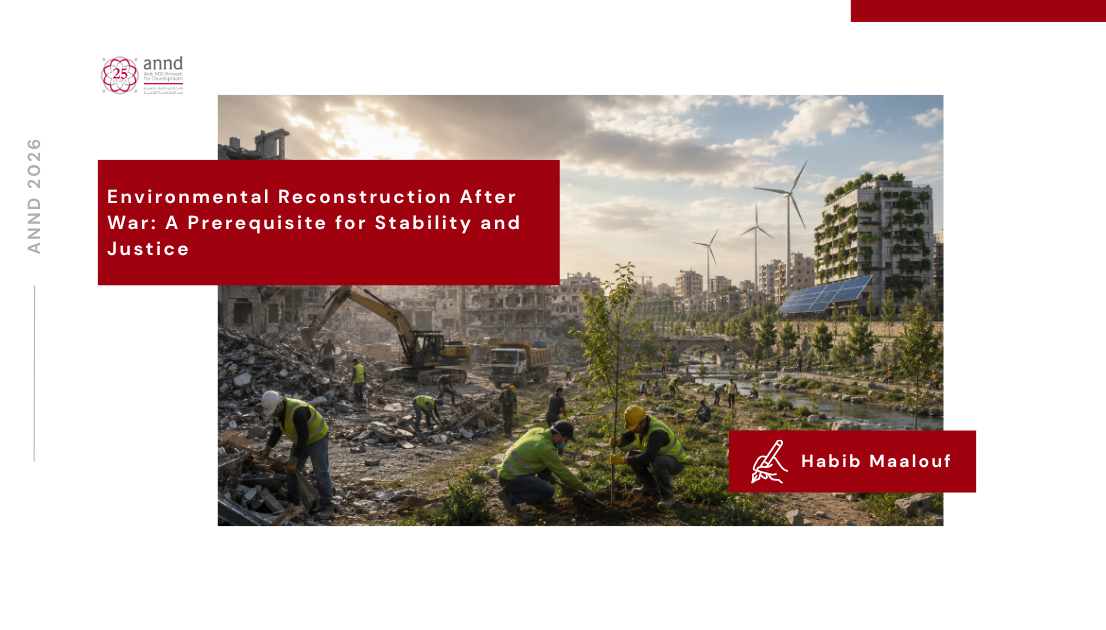
Environmental Reconstruction After War: A Prerequisite for Stability and Justice - Habib Maalouf

Environmental Reconstruction After War: A Prerequisite for Stability and Justice
When wars end, attention usually turns to rebuilding homes, bridges, roads, electricity grids, and water networks. Yet one of the most important aspects of reconstruction, and one with the greatest long-term impact, often remains marginalized: the environmental dimension. War does not only destroy cities and infrastructure. It also leaves behind a legacy of pollution, depletion of natural resources, and degradation of ecosystems that may persist for decades after military operations have ceased.
Modern warfare has become a major driver of environmental degradation. Bombardment and attacks on industrial facilities, oil installations, and power plants release enormous quantities of pollutants into the air, soil, and water. The destruction of sewage networks, wastewater treatment plants, and desalination facilities further increases the risks of pollution and disease outbreaks. In many contemporary conflicts, large-scale population displacement has placed additional pressure on natural resources, including water, forests, agricultural land, and biodiversity. At the same time, weakened environmental oversight during wars has contributed to increased poaching, deforestation, unsustainable exploitation of resources, and the proliferation of uncontrolled waste dumps.
It is impossible to speak of genuine reconstruction if it is limited to rebuilding physical structures while neglecting the environment in which people live. Environmental reconstruction is a fundamental prerequisite for achieving social, economic, and public health stability. This process primarily includes the safe removal of debris and military waste, the remediation of pollution in soil, groundwater, and rivers, the rehabilitation of damaged industrial areas and the proper management of construction and demolition debris, the restoration of forests and vegetation cover, the protection of biodiversity and natural habitats, and the rebuilding of environmental monitoring and management systems.
Most relevant reports indicate that the environmental impacts of war often persist for decades after the conflict ends. These include soil contamination with heavy metals, chemicals, and unexploded ordnance, contamination of surface and groundwater resulting from the destruction of sewage systems and industrial facilities, declining biodiversity and the destruction of natural habitats, and increased greenhouse gas emissions generated by military operations and the reconstruction process itself. The United Nations Environment Programme has described the environment as the "silent casualty of war" because its impacts are not only immediate but also extend to future generations.
Ignoring these issues may result in continued public health risks, declining agricultural productivity, and higher development costs in the future.
In recent years, international thinking has shifted from the concept of traditional reconstruction to the concept of "green recovery" or "building back better." This approach seeks to use the post-war period as an opportunity to transition toward a more sustainable and resilient economy.
Instead of rebuilding cities according to conventional planning models, a green city approach can be adopted. Instead of reconstructing large, centralized power plants dependent on fossil fuels, investment can be directed toward clean, decentralized renewable energy. Instead of replicating fragile urban patterns, green building standards, energy efficiency, and sustainable water management can be embraced. Numerous experiences have demonstrated that integrating environmental considerations into reconstruction creates new employment opportunities, reduces future operating costs, and strengthens communities' capacity to adapt to climate change.
Arab countries emerging from conflict face compounded challenges. Many are already among the world's most climate- and water-vulnerable regions. Consequently, any reconstruction process that fails to account for water scarcity, rising temperatures, and desertification will likely prove unsustainable over the long term.
Financial crises and political pressures also sometimes drive governments to prioritize rapid, improvised responses at the expense of environmental sustainability. This results in reproducing the very problems that existed before the war, and in many cases exacerbates them.
The post-war phase also raises questions of environmental justice. Who should bear the cost of remedying environmental damage? Should the burden fall solely on affected states and communities, or should responsibility also extend to the parties and states that contributed to the war and destruction? How can local communities that have lost their livelihoods because of environmental degradation be compensated?
These questions have become an increasingly important part of international discussions concerning state responsibility for transboundary environmental damage and the concept of "loss and damage," which has gained significant prominence in global climate negotiations. How these responsibilities will be determined remains an open question, particularly given that the historical role of the United Nations has generally been limited to assessing damages rather than assigning responsibility. One notable exception was when the United Nations General Assembly adopted several consecutive resolutions explicitly holding Israel responsible for the "environmental disaster" and calling on it to compensate Lebanon with more than USD 856 million for the massive oil spill caused by Israeli air strikes during the July 2006 war. Another relevant precedent concerns the Gulf War and Iraq's invasion of Kuwait.
Reconstruction is not merely an engineering or economic process. It is a project to rebuild the relationship between people and their environment. Countries emerging from war face two choices: either reproduce a fragile development model that deepens existing environmental crises, or transform the recovery phase into an opportunity to build economies and societies that are more sustainable, more equitable, and more resilient. In a world simultaneously facing climate, energy, water, and food crises, the environmental dimension of reconstruction is no longer a secondary consideration. It has become one of the essential conditions for achieving peace and sustainable development.
Reconstruction in the twenty-first century is no longer simply about rebuilding what has been destroyed. It has become closely linked to climate, energy, water security, food security, and environmental and climate justice, particularly when the underlying drivers of many of these wars involve access to primary energy resources and control over local and global economic pathways.
The wars in the Arab region have not yet ended, making it premature to fully assess their environmental damage and costs. Ukraine represents one of the most prominent recent examples of the environmental costs of war. According to estimates by the Ukrainian government, reconstruction needs have exceeded hundreds of billions of dollars, while Ukraine's Ministry of Environment has estimated environmental damage at tens of billions of dollars. The damage includes widespread contamination of agricultural soils, extensive forest fires, and damage to power stations, dams, and freshwater resources resulting from the destruction of water infrastructure. This has prompted the European Union to adopt the concept of "green reconstruction," linking rebuilding efforts with carbon neutrality and renewable energy goals.
Whatever the outcomes in the Arab region, it is no longer possible to separate reconstruction from climate action. The world is currently confronting two parallel challenges: recovering from the impacts of war while reducing emissions and adapting to climate change. This has given rise to the concept of "building back better," which includes constructing more energy-efficient buildings, relying on renewable energy, improving water management, regulating consumption, promoting conservation and reuse, expanding green spaces, particularly public parks, developing and expanding sustainable transport services, strengthening the circular economy through recycling debris and construction waste, integrating environmental impact assessments into all reconstruction projects, and reaffirming respect for the principles of environmental justice during reconstruction while assigning responsibility to those who caused the damage.
These measures are of particular importance in the Arab region, which is among the areas of the world most vulnerable to the impacts of climate change.
The environmental dimension is often viewed as an additional burden on reconstruction efforts. Yet environmental investment can serve as a driver of economic growth and contribute to creating new employment opportunities. Recycling building debris, restoring degraded land, developing renewable energy projects, and rehabilitating ecosystems are all sectors capable of attracting investment and generating broad employment opportunities, particularly for young people. Reducing energy and water consumption also lowers financial burdens on governments and households while strengthening long-term economic security.
Reconstruction also raises the issue of environmental justice. Communities affected by war often bear severe environmental costs for which they are not responsible. This debate is becoming increasingly significant amid growing international calls to recognize environmental damage resulting from armed conflicts as part of the losses that require accountability and compensation, and as part of global emissions for which responsibility should be assumed. This dimension is expected to become increasingly prominent in international law over the coming years, particularly as global attention to the relationship between security, the environment, and climate continues to grow.
The post-war period is not merely a moment of recovery. It represents a rare opportunity to redefine the relationship between society, nature, the economy, and the state. Countries emerging from conflict can either reproduce development models that have already proven fragile or seize this moment to build a more sustainable and equitable model. In a world facing interconnected crises related to climate, energy, water, and food, the success of reconstruction can no longer be measured solely by the number of buildings rebuilt. It must be measured by the ability of societies to create a future that is safer, more resilient, and more sustainable. More broadly, genuine peace is achieved not only by silencing the guns, but also by restoring the environment that forms the foundation of life and development, and by recognizing the essential resources of life as a shared historical heritage of all humanity that transcends borders and requires cooperative management among states without domination or exploitation. Without integrating environmental and climate considerations together with the principles of comprehensive environmental justice into reconstruction plans, the end of war may become nothing more than the beginning of new crises that are more complex and longer lasting.
Disclaimer:
The views and opinions expressed in this article are those of the author and do not necessarily reflect the official position of the Arab NGO Network for Development (ANND).
Recent publications