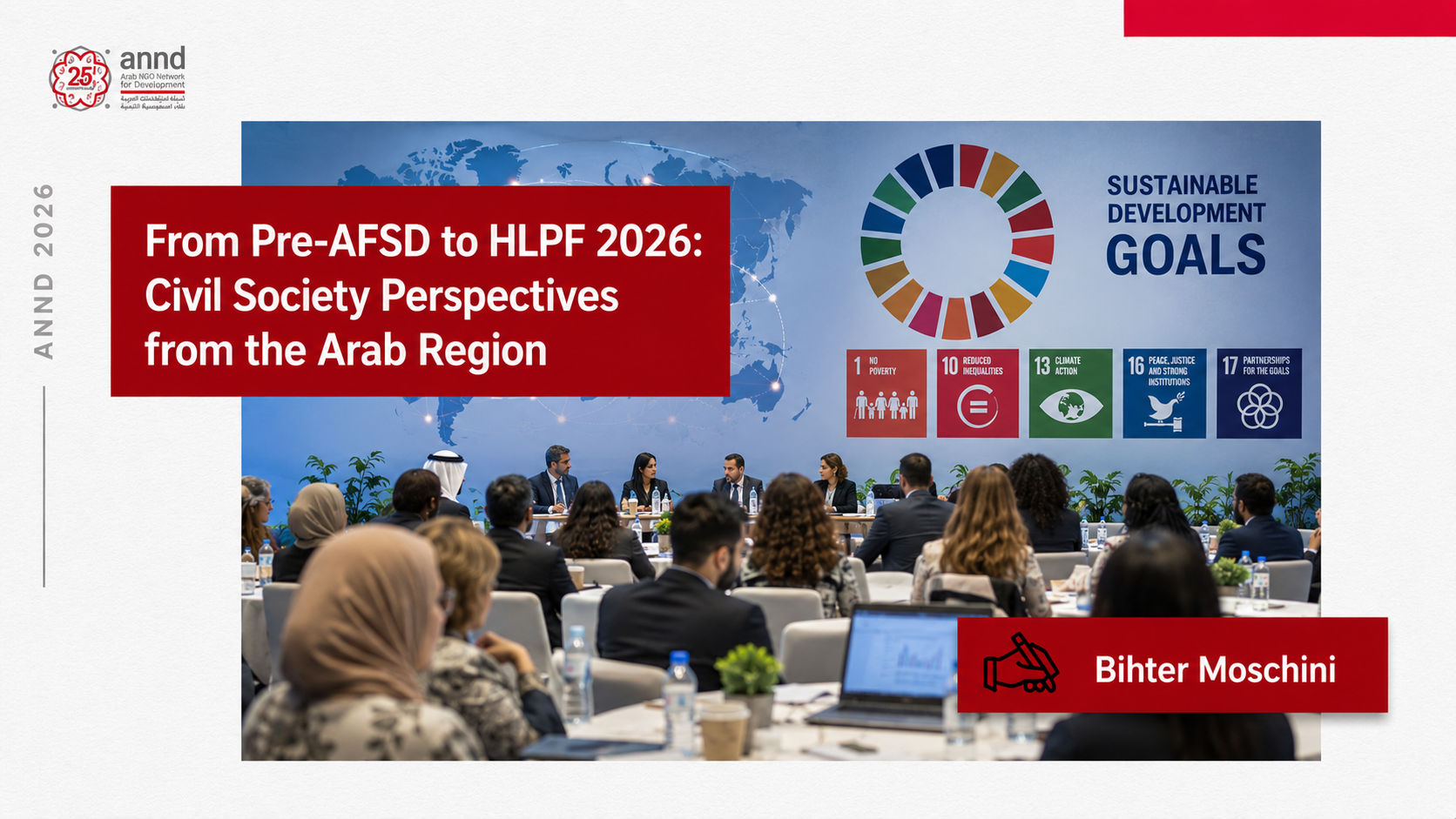
From Pre-AFSD to HLPF 2026: Civil Society Perspectives from the Arab Region - Bihter Moschini
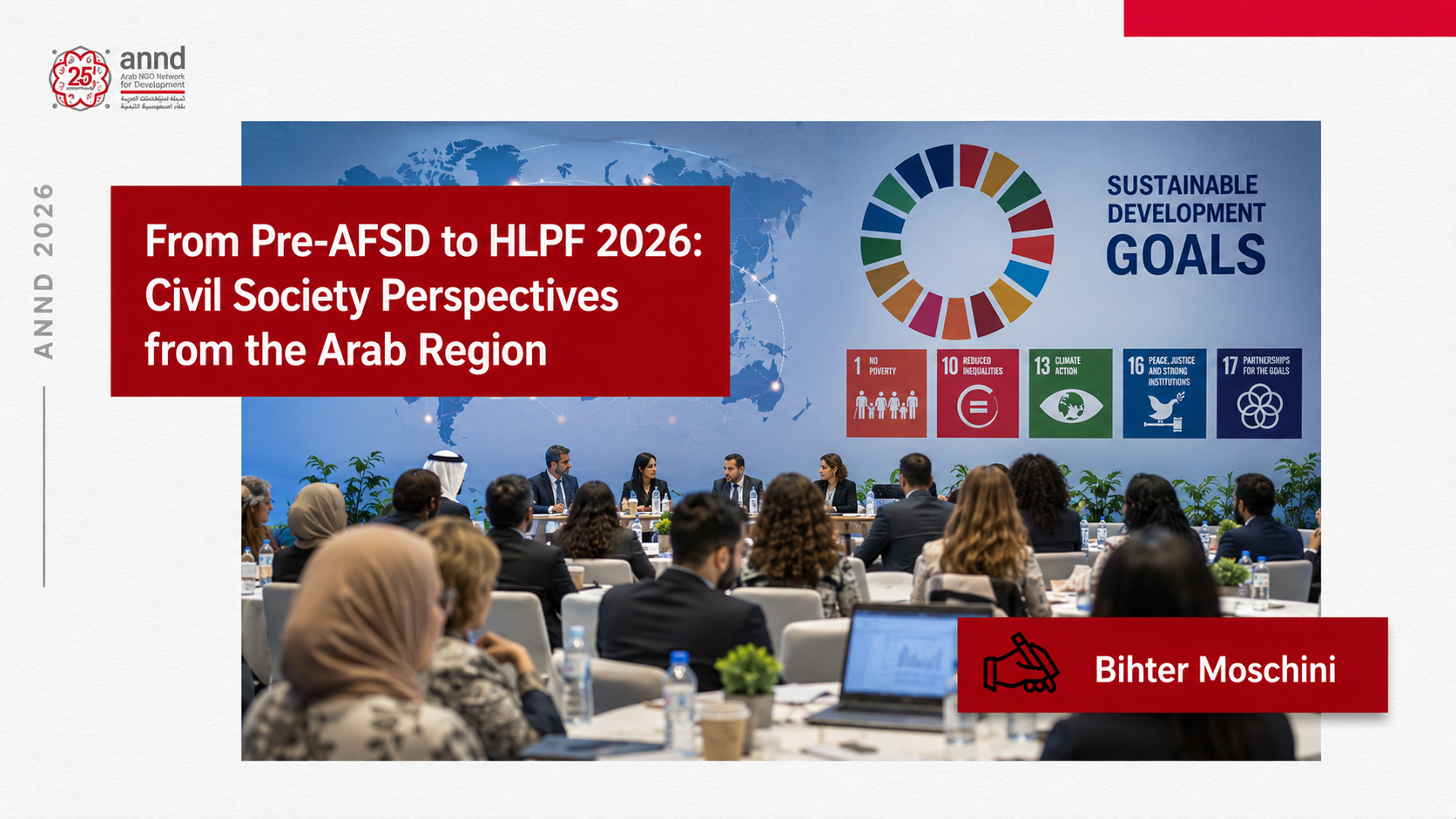

From Pre-AFSD to HLPF 2026: Civil Society Perspectives from the Arab Region
While discussions on UN reform continue, post-2030 scenarios evolve, and preparations advance toward the 2026 High-level Political Forum on Sustainable Development (HLPF), more than 100 civil society representatives from across the Arab region convened on the occasion of the Regional Civil Society Forum on Sustainable Development (pre-AFSD). Organized through four complementary webinars addressing multilateralism and geopolitics, as well as economic, social, and climate justice, the pre-AFSD provided an important space for civil society actors to assess the structural challenges facing the region and formulate key recommendations to address them.
One of the central reference points throughout the discussions was the Preamble of Agenda 2030, which affirms that [the] Agenda is a plan of action for people, planet and prosperity. It also seeks to strengthen universal peace in larger freedom. We recognise that eradicating poverty in all its forms and dimensions, including extreme poverty, is the greatest global challenge and an indispensable requirement for sustainable development. In all sessions reflections, including from the civil society representatives of Yemen, Syria and Palestine made it clear that sustainable development remains impossible under conditions of war, occupation, impunity, structural violence, and exclusion. Participants emphasized that development, peace, climate justice, social protection, economic justice, and democratic governance are inseparable and mutually reinforcing. This requires moving beyond fragmented approaches toward comprehensive and integrated policy frameworks capable of addressing the structural roots of injustices and inequality.
Moreover, exchanges among the participants acknowledged that the crises facing the Arab region cannot be understood as isolated or temporary challenges. Rather, they are deeply interconnected to the structural inequalities embedded within prevailing global and regional political, economic, financial, and governance systems. At the global level, the growing paralysis of multilateral institutions, the persistence of unequal power relations within global governance systems, and the failure to reform the international financial architecture or establish a fair and equitable trading system have further weakened the ability of states and societies to pursue sovereign, inclusive, and rights-based development pathways. Meanwhile, discussions on the implementation of the Agenda 2030, reaffirmed the evident and central role of the developmental state in fulfilling and protecting rights, delivering public goods, regulating markets, reducing inequalities, and rebuilding the social contract.
On the other hand, discussions around multidimensional poverty, social and economic justice emphasized that sustainable development cannot be reduced to economic growth alone, nor measured solely through GDP-centred approaches. These limited approaches continue to sideline the realities of inequality, unpaid care work, environmental degradation, and social well-being. In parallel, the increasing prioritization of securitized and crisis-management approaches over structural transformation continues to divert public resources away from development, social protection, public services, environmental sustainability, and long-term peacebuilding.
With a set of recommendations developed for advocacy at Arab Forum on Sustainable Development, civil society organizations emphasized the need to strengthen regional and global solidarity, expand civic participation in decision-making processes, and ensure that future multilateral reforms respond to the lived realities and aspirations of peoples across the Global South. Looking ahead to HLPF 2026 and broader post-2030 discussions, participants stressed that the coming period represents a critical opportunity to adopt a transformative paradigm shift toward development models centred on peace, social justice, equality, human rights, redistribution, democratic governance, sustainability and accountability.
The reflections and analyses featured throughout this newsletter further explore many of the questions raised during the pre-AFSD discussions. From the role of international financial institutions and the implications of debt and austerity policies, to feminist organizing and shrinking civic space, the contributions in this issue examine how current global and regional dynamics continue to shape development trajectories across the Arab region. Together, they reaffirm the urgent need to place rights, justice, accountability, and people-centered development at the heart of ongoing debates on multilateral reform, economic governance, and the future of sustainable development.
Recent publications
ANND's Position Paper: Lebanon’s 2027 Budget: Towards Public Finance for Recovery and Social Justice