From the Nuclear File to the Buffer Zone: War on Iran or the Re-engineering of the Middle East? - Ziad Abdel Samad

From the Nuclear File to the Buffer Zone: War on Iran or the Re-engineering of the Middle East?
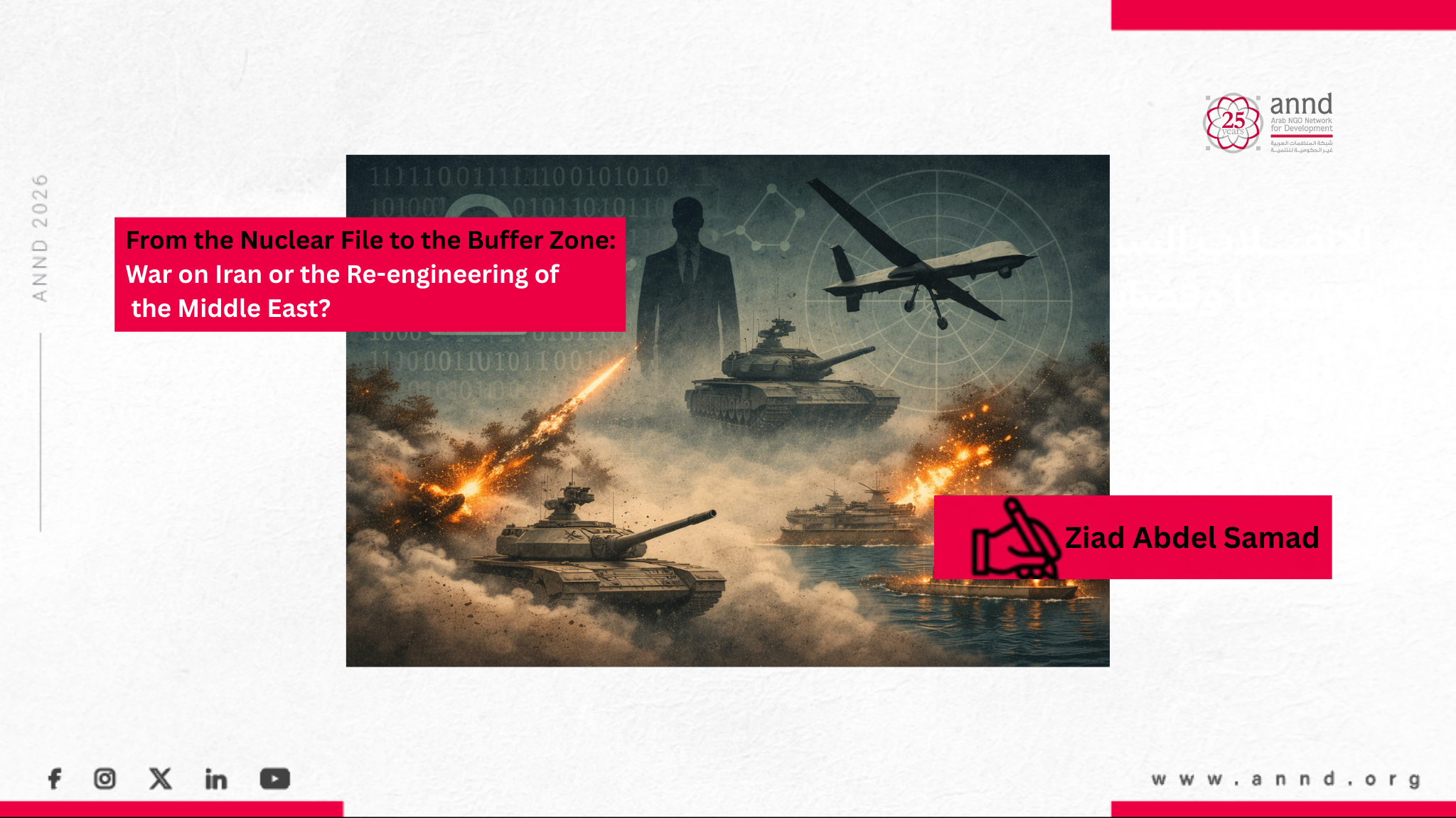
What began as a war with a clearly defined title—the Iranian nuclear program, uranium enrichment, missile platforms, and ballistic capabilities—is gradually evolving into a confrontation that extends beyond the nuclear file to encompass the very structure of the regional order, and by extension, the contours of the international system itself.
The declared objective of military operations against Iran is to prevent it from reaching the nuclear weapons threshold and to dismantle its missile infrastructure. Yet rapid developments suggest that the conflict is no longer merely technical or military; it has become profoundly political and strategic.
For Israel and the United States, Iran’s possession of advanced enrichment capabilities alongside a long-range missile system fundamentally alters the balance of power. For the Iranian regime, however, these capabilities are not simply instruments of regional influence; they constitute guarantees of survival and deterrence within a hostile regional and international environment. From Tehran’s perspective, relinquishing them would amount to undermining the very essence of the regime.
Transition in Tehran… Under Fire
The assassination of the Supreme Leader did not lead to the collapse of the system. Instead, Iran swiftly activated its constitutional mechanisms through the Assembly of Experts, resulting in the appointment of Mojtaba Khamenei in what appeared to be a pre-arranged transition—reflecting the institutional-security nature of the regime.
However, this transition has not settled internal debates. The appointment of the new Supreme Leader has raised questions about his political and psychological capacity to fully command decision-making structures, despite his first official statement signaling complete continuity with his father’s approach, both on the nuclear file and in managing regional confrontation.
The more consequential development, however, was the assassination of Ali Larijani, widely regarded as one of the regime’s foremost strategic minds and a key political figure close to the center of power. Coupled with the killing of military and security leaders from the Revolutionary Guard and the Basij, serious questions arise regarding the regime’s ability to maintain operational cohesion under wartime conditions.
Estimates suggest that military strikes have significantly degraded Iran’s air and naval capabilities, leaving its missile system as the primary remaining military tool for deterrence and retaliation.
The Gulf Enters the Heart of the Conflict
Iran’s response is no longer confined to Israel or traditional fronts. Strikes have extended into the Gulf, targeting facilities and sites in the United Arab Emirates and Kuwait, as well as hitting Saudi Arabia, Qatar, and Oman.
Available data indicate that, at certain stages, the scale of attacks on some Gulf states has exceeded direct strikes on Israel. This suggests that Tehran is seeking to send a message to the global economic system: if Iran is choked, it can disrupt the global economy itself.
The closure of the Strait of Hormuz and threats to the Bab el-Mandeb Strait have led to sharp increases in energy prices and significant disruptions in global markets.
However, the use of oil as a weapon also exposes Iran to considerable risks—particularly amid growing speculation about the potential targeting or even occupation of Kharg Island, the regime’s primary oil lifeline. Any strike on the island could constitute a strategic blow directly affecting the state’s financial capacity.
In this context, Europe has adopted a cautious stance. While aligned with Washington, European states have refused direct military involvement, emphasizing that any potential action would be limited to safeguarding maritime security and supporting Gulf defenses.
Major Powers: On the Sidelines of Fire… or at the Core of Reordering?
While the closure of strategic waterways pressures the West, it simultaneously threatens China’s interests, given its status as Iran’s leading economic partner and its heavy reliance on Gulf energy flows.
Despite its strategic partnership with Tehran, Beijing has made clear it will not engage militarily. Direct involvement would risk its global commercial interests. It is therefore likely to continue exerting diplomatic pressure to prevent the collapse of maritime routes, while also seeking to avoid Iran’s complete downfall due to its implications for global balance.
Russia’s calculations are more complex. While it appears unwilling to engage in direct confrontation, it views any regional vacuum as an opportunity to reassert its political and military presence.
In this regard, discussions have emerged about a potential Russian role in southern Lebanon, particularly as the mandate of the United Nations Interim Force in Lebanon approaches its expiration at the end of the year. Should renewal under current conditions prove unfeasible, an expanded Russian role within new security arrangements may be considered—though this remains contingent on international and regional acceptance.
Turkey, directly affected by security spillovers, has emphasized restraint while closely monitoring any emerging arrangements that may redraw influence maps in the Levant and Eastern Mediterranean.
While it may be premature to draw definitive conclusions, these questions are being raised with increasing urgency, as the positions of major and middle powers have become decisive in shaping the trajectory and outcomes of the war.
Lebanon: From Deterrence Arena to Arena of Decision
In Lebanon, escalation has entered a new phase with Hezbollah resuming rocket fire and Israel responding with intensified strikes and threats of a limited ground incursion.
The most significant domestic development, however, has been the Lebanese government’s decision to ban the party’s military and security activities and to require the handover of its weapons, tasking the Lebanese Army with implementation under broad political cover.
This decision marks a pivotal moment of sovereignty, as for the first time in decades a near-consensus has emerged that the continuation of dual arms authority threatens the very existence of the Lebanese state.
Hezbollah has rejected the decision and continued launching rockets, shifting the conflict into an internal confrontation between the logic of the state and that of a regional armed actor.
From Limited Incursion to Buffer Zone
Israel’s threat of a limited incursion may not remain limited. Lebanon’s past experience shows that buffer zones often evolve into long-term realities.
The key difference between previous border strip experiences and the current proposal lies in geography and demography. While the former occupation involved populated areas, the current vision appears to rely on mass displacement and the emptying of villages—making the return of residents and reconstruction a national priority.
Delays in extending full state authority north of the Litani River provide Israel with further justification for any incursion, framed as filling a security vacuum.
Lebanon Enters Negotiation
In a highly sensitive development, President Joseph Aoun has launched an initiative to open direct negotiations with Israel under international sponsorship.
This path, however, faces significant obstacles. Speaker Nabih Berri insists on a ceasefire and Israeli withdrawal as a precondition, while Hezbollah rejects the process entirely, viewing it as a direct threat to internal balance.
Israel, for its part, has shown initial political willingness by appointing a senior delegation close to decision-making circles, but conditions any cessation of hostilities on Hezbollah’s disarmament.
Maritime Borders Return to the Forefront
Another notable development is the reopening of the maritime agreement file.
Israel is seeking to revisit certain provisions, while Lebanese debate continues over Line 23 and Line 29—making this issue a likely component of any broader negotiations.
Where To?
We are facing a pivotal moment shaped by three intersecting tracks:
- the nuclear–military track
- the Lebanese track
- the regional–economic track
The decisive question is no longer merely who has the capacity to strike, but who has the capacity to halt escalation before instability becomes a permanent condition.
What is unfolding is no longer simply a confrontation between two regional projects, but an open international test that may lead to a redistribution of influence across the Middle East.
Wars that begin with a defined objective often end by redrawing entire political maps. And engineering under fire rarely produces stable peace; more often, it yields fragile balances awaiting the next round.
Recent publications