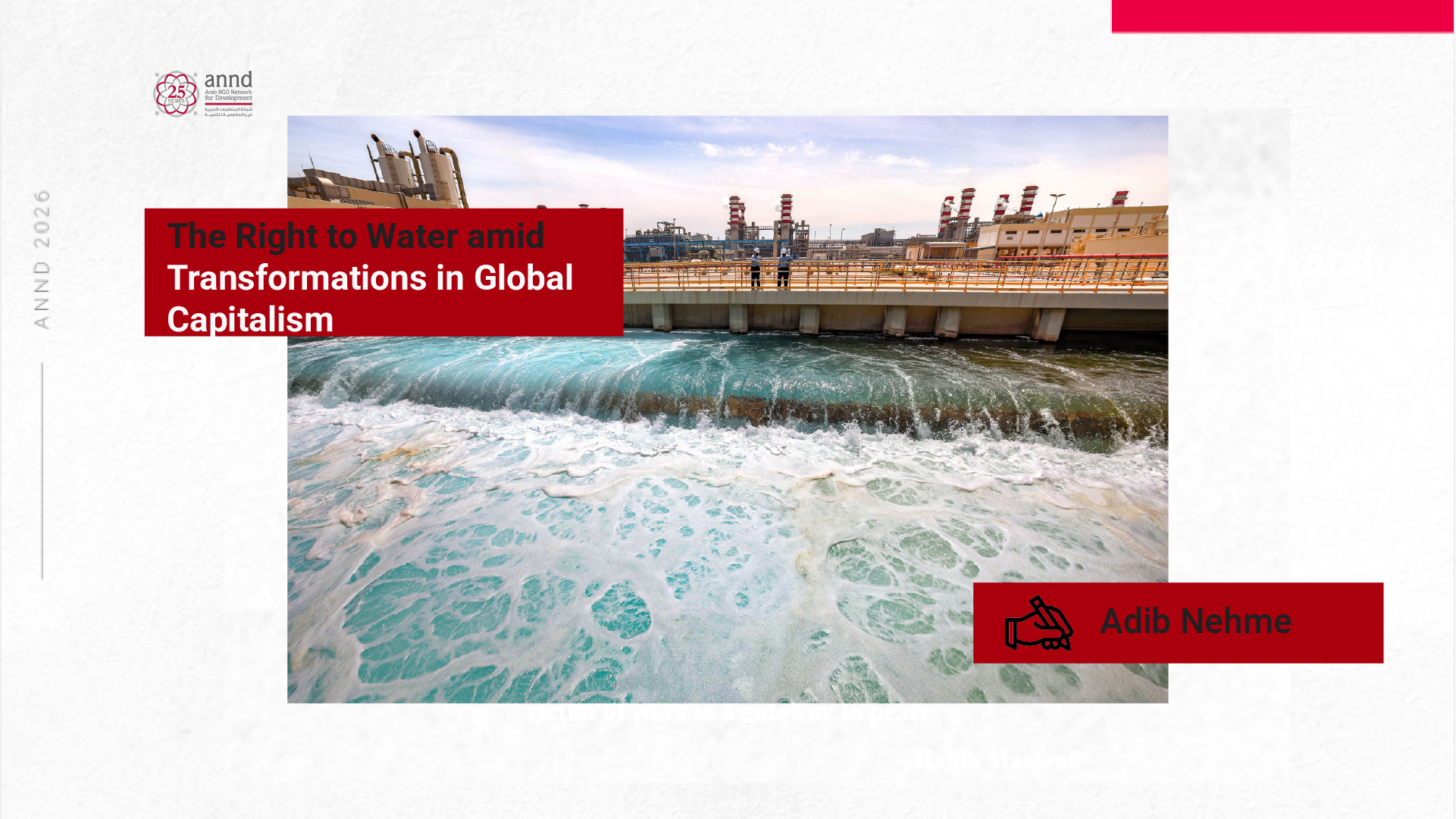
The Right to Water amid Transformations in Global Capitalism - Adib Nehme
Adib Nehmeh

Transformations in Global Capitalism and the Right to Water
Adib Nehme
No one disputes the strength of the causal interconnection between developments and phenomena that may appear to belong to distant fields. The right to water is one of the clearest examples of this.
My intervention, presented during the launch of the Arab Watch Report in the first week of July 2026 in Amman, addressed three ideas that demonstrate this interconnection: the first concerns transformations in global capitalism and the form of globalization; the second addresses the environmental question in general, including climate change; and the third concerns the right to water specifically.
“Water, when understood as a right, is a source of civilization, communication, participation, and solidarity. When treated as a commodity, it may reinforce inequality and deprivation or become a spark for conflict.”
1. Transformations in Global Capitalism and Globalization
We are currently experiencing a dual transformation at the global level. Its first dimension is a transformation in the nature of the global economic system, which has been dominated by the neoliberal doctrine since the beginning of the 1980s.
Its second dimension is a transformation in the nature of the global governance system and its principal instrument—the United Nations—which took shape after the Second World War.
This transformation includes:
How, then, should we understand the deeper dynamics of global and regional transformations?
First, we should note that neoliberal globalization, in the form that took shape from the beginning of the 1980s, has today reached its historical limit and entered a crisis of disintegration beginning with the 2007–2008 crisis.
It is true that the struggles of peoples and civil society organizations contributed over several decades to confronting and perhaps weakening this globalization.
However, the decisive factor that delivered the final blow was its own founding champions, led by the United States of America, for reasons primarily related to the emergence of the Chinese economic giant and its unprecedented global trade expansion through its use of neoliberal globalization.
Two Economic and Geopolitical Trajectories
Two trajectories—one economic and the other political and geopolitical—have brought us to this point:
In my view, this project is historically destined to fail, and signs of crisis and failure have already begun to emerge, although at an enormous cost to humanity, peoples, and the planet.
2. How Do We Approach the Environmental Question and Climate Change?
The prevailing view within right-wing and conservative decision-making circles does not recognize the existence of an environmental issue. Rather, it views the matter as one of limited resources over which actors compete through violence and war.
This tendency is an inherent feature closely associated with the former neoliberal order and continues in its newly emerging savage imperial form.
It is therefore unsurprising that the first clash with, and first departure from, the global legal system occurred in the environmental field: withdrawal from international environmental agreements because such agreements undermine the leading role of this state or these states in the global economy.
From our perspective, there is a genuine environmental issue. Its most prominent elements, from our development and rights-based perspective, are:
Environmental Justice Is Broader Than Climate Justice
We seek environmental justice in the same way that we seek economic, social, political, and legal justice, among others.
We do not reduce it to climate justice in the narrow sense, which is one component of comprehensive environmental justice rather than a substitute for it.
With regard to the climate change crisis, if we were to summarize the substance of the major choices by using global agendas and their terminology, most recently the 2030 Agenda, we would say that achieving Sustainable Development Goal 13—combating climate change—is impossible without curbing the mechanisms that produce it.
In other words, it cannot be achieved unless Sustainable Development Goal 12—the transition towards sustainable patterns of production and consumption—is also achieved.
What global decision-making circles are attempting to do, including through the series of Conferences of the Parties, or COPs, is to circumvent Goal 12 and reduce the environmental issue and climate change to technologies, financing, and ineffective palliatives.
3. How Do We View the Question of the Right to Water?
We approach the right to water on the basis of the following considerations:
Water as a Right or a Commodity
Water, when understood as a right, is a source of civilization, communication, interaction among people, participation, and solidarity.
Water, when treated as a resource and a commodity, may become the basis for policies and practices that reinforce inequality and deprivation, or the spark for conflict or wars.
Responsibility for either of these choices ultimately rests, first and foremost, with decision-makers.
Resisting the wrong choices is our responsibility as peoples and civil society, alongside the people and for their benefit.
Beirut, 24 July 2026
Recent publications