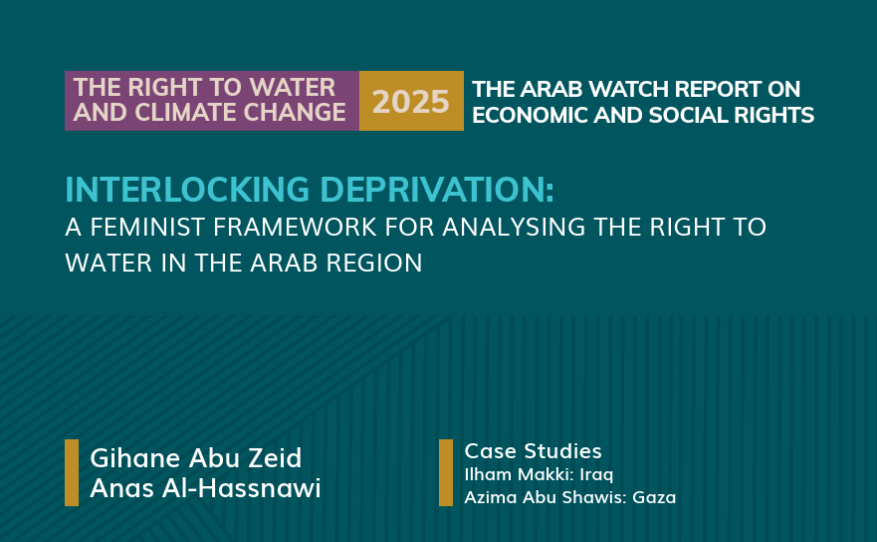
Interlocking Deprivation: A Feminist Framework for Analysing the Right to Water in the Arab Region

Interlocking Deprivation: A Feminist Framework for Analysing the Right to Water in the Arab Region
Gihane Abu Zeid and Anas Al-Hassnawi
This paper examines the right to water in the Arab region through a feminist political ecology framework. Rather than approaching water scarcity solely as a technical or environmental challenge, it examines the power structures that determine who controls water, who shapes its distribution and policies, and who bears the costs when access to water is restricted or disrupted.
The paper introduces the concept of “interlocking deprivation” to analyse how different forms of inequality reinforce one another. It explores how water scarcity intersects with gender, poverty, exclusion from governance and unequal access to resources, producing burdens that are experienced differently across societies and within households.
A Feminist Political Ecology Approach
The analysis traces power relations across four interconnected levels: global, national, local and family. It examines how international financing and extraction policies, national water and agricultural policies, local governance and resource-use patterns ultimately translate into everyday burdens within households, including time, health and unequal responsibilities.
Across these levels, the paper centres three questions: Who controls water and shapes its policies? What burdens do women bear? And how do they resist? In doing so, it approaches women not only through the burdens they experience, but also as actors, witnesses and leaders responding to water deprivation.
Four Dimensions of Water Deprivation
The paper develops its analysis through four interconnected themes: the commodification of water and the feminization of the burden; political violence and the weaponization of water; rural poverty and water deprivation; and the global extractivist model and the appropriation of water resources.
Drawing on experiences from across the Arab region, the analysis examines cases from Palestine, Iraq, Yemen, Morocco, Egypt and Jordan. Iraq features across the different dimensions of the analysis, while dedicated case studies by Ilham Makki and Azima Abu Shawis provide further perspectives from Iraq and Gaza.
Recent publications
Lebanon’s Reform Moment: From Fiscal Repair to Rebuilding the State - Lamia Moubayyed