Jan 13, 2026
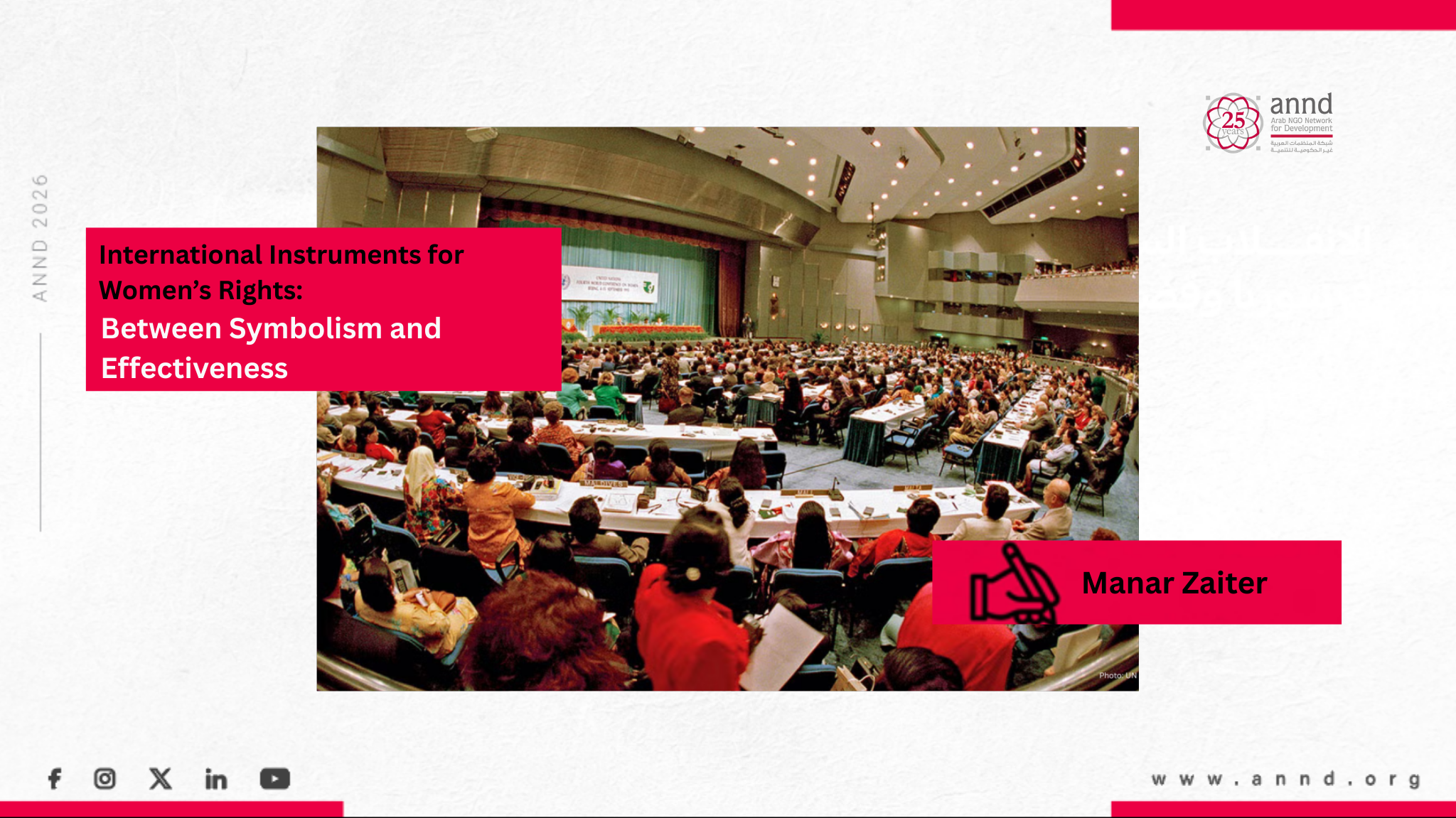
International Instruments for Women’s Rights: Between Symbolism and Effectiveness - Manar Zaiter

International Instruments for Women’s Rights: Between Symbolism and Effectiveness - Manar Zaiter
Are we living in times marking the end of the civilizational project? Why should we trust international human rights law? These and other questions have been repeatedly raised on many occasions over the past two years. They are posed by young women and men who are well acquainted with international resolutions and conventions, and who may have even participated in drafting reports about them, yet still feel that the system is distant, selective, and incapable of protecting them.
Today, these questions gain renewed urgency amid open attacks on international law driven by the policies of Trump and Israel. They accompanied me throughout 2025, coinciding with the passage of decades since the adoption of UN Security Council Resolution 1325 and the Beijing Declaration. What does it mean to celebrate anniversaries when texts turn into rituals and commitments into diplomatic language stripped of impact? And how are women living under conflict and occupation, struggling with poverty, the absence of social protection, and violence, expected to trust these international instruments?
Certainly, these standards constituted pivotal milestones in the history of institutionalizing and codifying women’s rights. They were not imposed from above through political decree, but rather emerged as the result of decades of feminist struggle led by women’s rights activists, alongside engagement by political actors within the United Nations system. Thus, I do not start from a rejection of the international system or a nostalgic turn toward local alternatives, but from a more complex position: a feminist critique that seeks to question international standards and dismantle the power relations governing them, so they may become more capable of confronting the real challenges faced by women under occupation, conflict, and persistent poverty. In this context, these instruments constitute a field for reflection and analysis, as many of the transformative feminist demands that led to their creation have been emptied of their substance in political practice. While institutional recognition was a necessary step, implementation often reflects compromises, selective interpretations, and persistent gaps.
Today, the need is growing for a critical rethinking of international instruments—not only to review their effectiveness, but also to reimagine concepts of equality and justice in a rapidly changing world. This is particularly important for women in our region who suffer from ongoing conflicts and occupation, face violence despite all laws and strategies, experience symbolic representation in decision-making positions, endure economic structures that deepen their poverty, and confront an organized assault on women’s rights discourse, a major rollback of feminist gains, and restrictions on civic space.
The need for reflection is also heightened by a discourse dominated by feminist conceptions that are often imposed on what is referred to as the “majority world” without sufficient local engagement, ignoring the political, economic, social, cultural, international, and national contexts shaping women’s issues. This assumption—that all women face the same problems or require the same solutions—is misleading.
Within these conceptions, women’s rights are presented as an international discourse aimed at protecting the most vulnerable groups. While conventions and judicial bodies provide a symbolic framework and a platform for mobilization, this symbolic power does not translate into the ability to redistribute resources or dismantle discriminatory social, economic, political, and cultural structures. When the language of “women’s empowerment” is used in isolation from an analysis of power relations, it becomes part of a form of feminism that is mobilized in service of political and economic projects, rather than a tool to hold them accountable. Thus, international standards turn into a symbolic platform for expression and celebration, rather than a mechanism for redistributing resources or dismantling structures.
In this context, we cannot understand today’s gap between symbolism and effectiveness in international standards for women’s rights without reference to feminist critiques that argue that international law has historically contributed to reinforcing what many feminists from the Global South describe as a feminism shaped in colonial contexts, through the depoliticization of women’s issues. According to this view, women were not recognized as political actors engaged in resisting discrimination and violence at the local level and within dominant international policies. Instead, their issues were reduced to neutral technical frameworks that strip feminist struggle of its transformative dimension. This helps explain why many women in contexts of occupation, conflict, and resource exploitation feel that these standards address them through an abstract global discourse, without genuinely siding with their political and lived realities.
The picture is therefore complex and shaped by rapid political, economic, and cultural transformations, as the global human rights project faces a profound crisis, and the effectiveness of international laws and institutions is challenged by the absence of sufficient accountability and democracy. The question of the effectiveness of international law and our trust in it is not limited to legal aspects alone, but extends into a deep political and cultural dimension. Accordingly, engagement in this debate requires a critical understanding that seeks to question these instruments and re-embed them in our local contexts, while experimenting with new approaches. Practical experience shows that international human rights law is not a rigid tool, but a dynamic framework that can contribute to improving the lives of individuals and communities, provided it is applied with contextual awareness and an understanding of local and global challenges. Thus, the challenge does not lie in abandoning international instruments, but in re-politicizing them through an intersectional framework that links women’s rights to grassroots struggles—transforming these standards from celebratory rituals into instruments of political and social struggle capable, even if partially, of making a tangible impact on women’s lives.
Recent publications
Oct 07, 2026
Who Enters the Age of Electricity? And Who Pays the Price? - Habib Maalouf
Sep 28, 2026