
Just Reconstruction Under Occupation in Lebanon
By Soha Mneimneh
Over the past few days, the Lebanese government signed a trilateral Framework Agreement with Israel under U.S. mediation, claiming to establish a roadmap to end the war and implement a gradual Israeli withdrawal from occupied Lebanese territory. The agreement envisages the creation of pilot zones, where Israeli forces would progressively withdraw and be replaced by the Lebanese Armed Forces, as a “confidence-building mechanism” for the broader implementation of the ceasefire and UN Security Council Resolution 1701. Although some view this as a political breakthrough, the Israeli Occupation Forces (IOF) continue to bomb towns across South Lebanon, while drones remain active over Lebanese cities and towns, including Beirut and its southern suburbs. The continued attacks, widespread destruction, and forced displacement of civilians confirm that the ongoing military campaign is indeed a strategy of ethnic cleansing in southern Lebanon.
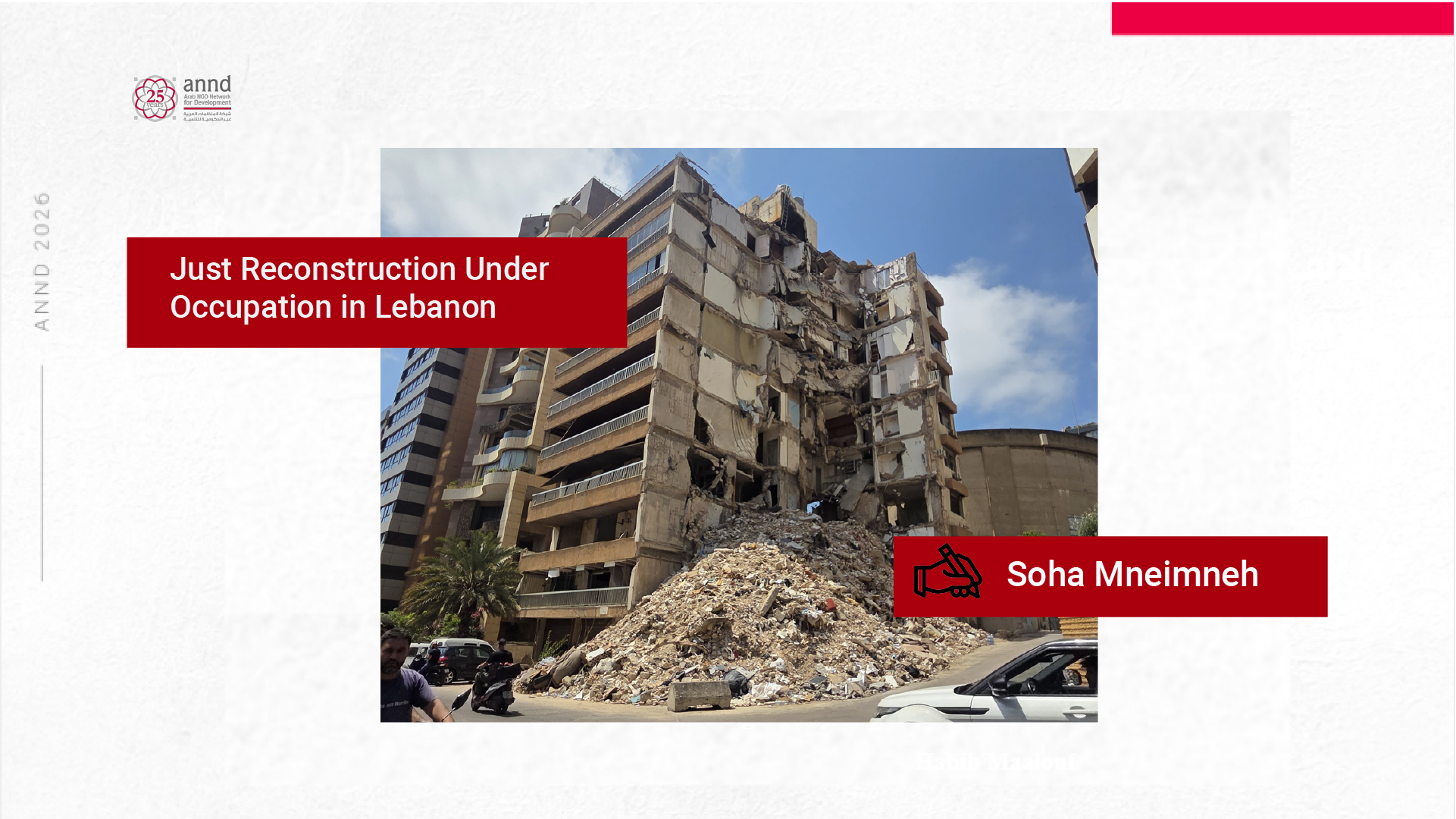
Since the escalation of the war in 2026, thousands of families have been displaced, repeatedly moving between their homes, shelters, and tents as ceasefire agreements are announced, then violated. So far, the IOF has turned 66 towns to rubble and occupied 6% of Lebanon’s territory. Besides these numbers, the IOF aggressively destroyed generations of memories and identity held in homes, businesses, agricultural lands, streets, and public spaces.
As urban planners, we must prepare for the day when the war comes to a definitive end, and the IOF fully withdraws from Lebanese territory. Reconstruction is far more than rebuilding cities; it is an opportunity to redefine the relationship between people, place, and the state. The challenge is not simply to rebuild what was destroyed, but to build back more just, inclusive, resilient, and sustainable communities rather than reproducing the inequalities and vulnerabilities of the past.
Lebanon enters this phase with weak state institutions, competing actors seeking to shape reconstruction priorities, and a legacy of unresolved social, economic, and territorial inequalities. While reconstruction alone cannot solve the country's political dilemmas, it can address some of the conditions that have historically marginalized communities by improving access to adequate housing, services, infrastructure, social protection, and economic opportunities.
This moment requires learning from previous reconstruction experiences while recognizing that Lebanon has never faced destruction, displacement, and occupation on this scale. The challenge is not simply to rebuild what was lost but to build back better by adopting integrated urban planning, improving housing and public services, strengthening resilience to future crises, and creating more equitable and sustainable communities. Ultimately, any discussion of reconstruction must confront a fundamental question: Can reconstruction be truly just while occupation endures, or are liberation, sovereignty, and lasting peace indispensable prerequisites for rebuilding societies, not merely infrastructure?
Although this question cannot be easily answered, this article seeks to contribute to the debate on just reconstruction by examining three interconnected dimensions: the need for a fair and inclusive assessment of damages and needs; the importance of justice for land and the environment; and the role of existing legal and institutional frameworks in either enabling or constraining a more equitable reconstruction process.
A Fair Inclusive Assessment
Just reconstruction processes begin with fair assessments of damages and needs. Currently, the primary focus has been on housing units in areas completely wiped out by the IOF. Due to the massive scale of destruction in several cities and towns, little attention has been given to other sectors, areas where comparatively few buildings were destroyed, and areas that were not directly affected by the war but have suffered for years from state neglect (e.g., Tripoli, where buildings have recently been collapsing). The argument here is not about prioritizing these sectors, areas, and buildings over others. It is about not leaving anyone behind in assessments of damages and needs required to achieve a fair recovery process.
Reconstruction requires a holistic lens, capable of capturing and assessing the needs of all sectors to build back better and allow a smooth return to life. The return to normal life will depend on restoring livelihoods, including small and medium-sized enterprises (SMEs), agriculture, and local economic activities, alongside the rehabilitation of critical infrastructure, particularly water and electricity networks, healthcare facilities, agricultural land, and other essential public services. According to interviews with residents affected by the war, this is a problem not only in neighborhoods that have been completely wiped out but also in areas where buildings were targeted, even in places that were not heavily bombed by the IOF.
“We opened our business, but I no longer have clients because people are scared to come here. The whole building does not have water because the pipes were destroyed, and no one in the building is fixing them. I also installed solar panels on the balcony because the building’s electricity system was destroyed,” says a business owner in a building that was partially damaged by a strike in Municipal Beirut.
This quote further shows that a just assessment has to include these targeted buildings for reconstruction and compensation, in addition to the surrounding units that have been partially damaged. From field visits in Beirut, it is clear that some people have repaired these apartments; however, others continue to live in their damaged homes because they cannot afford to fix them or move elsewhere.
Justice for Land and Nature
Just reconstruction is just towards land and nature. The current Lebanese planning and land management systems prioritize the exchange value of land (how much financial profit can be extracted from it) and are increasingly neglecting land's natural ecosystems. This has materialized in urban sprawl in several rural areas in South Lebanon. These systems have to change to preserve and protect land and the environment: Land rezoning measures and re-establishing property ownership in areas that have suffered total destruction, while protecting property rights. This will require an end to granting exceptions to build in areas zoned as unbuildable or agricultural, a common practice of the Directorate General of Urban Planning. Besides ending these longstanding practices, new approaches can be introduced to preserve land, such as providing incentives to farmers, especially those engaged in agroecological practices, supporting reforestation initiatives in areas destroyed by the IOF, or incorporating renewable energy systems.
Addressing Pre-existing Structural Injustices
Reconstruction in Lebanon is situated within a context of long-standing social, economic, and spatial inequalities that have shaped access to housing, services, infrastructure, and land. If reconstruction does not address these inequalities, it risks reproducing them and repeating exclusionary practices that deepen these injustices. This challenge extends to include new forms of inequality created by the war and the widening gaps between neighborhoods and communities. To ensure a just reconstruction process, policies should address future displacement through rent stabilization, provide protection against speculative evictions, and create fair compensation mechanisms. Public land can also be used for affordable and low-income housing for families that have deeply suffered from the war and cannot afford shelter. To further connect communities between areas that were vs were not affected by the war and reduce spatial inequalities, reconstruction should prioritize public transportation. This not only provides access for deprived communities to major cities, but also diffuses the territorial boundaries created by sectarian groups and parties.
Rebuilding Without Forgetting
Ultimately, reconstruction cannot be separated from justice. Beyond rebuilding homes, schools, hospitals, and infrastructure, it must recognize the immense human suffering endured by Lebanese communities. Israel has so far killed more than 4,000 civilians—including women, children, and the elderly—while entire communities have been displaced and livelihoods destroyed. Return to life requires not only reconstruction but also truth, accountability, and justice for victims. This includes proper investigation of alleged war crimes and violations of international humanitarian law, ensuring accountability for those responsible, addressing the environmental damage inflicted on agricultural land and ecosystems, and guaranteeing that reconstruction becomes a process of restoring rights, dignity, and hope, not merely rebuilding what has been destroyed.
Recent publications
Who Enters the Age of Electricity? And Who Pays the Price? - Habib Maalouf