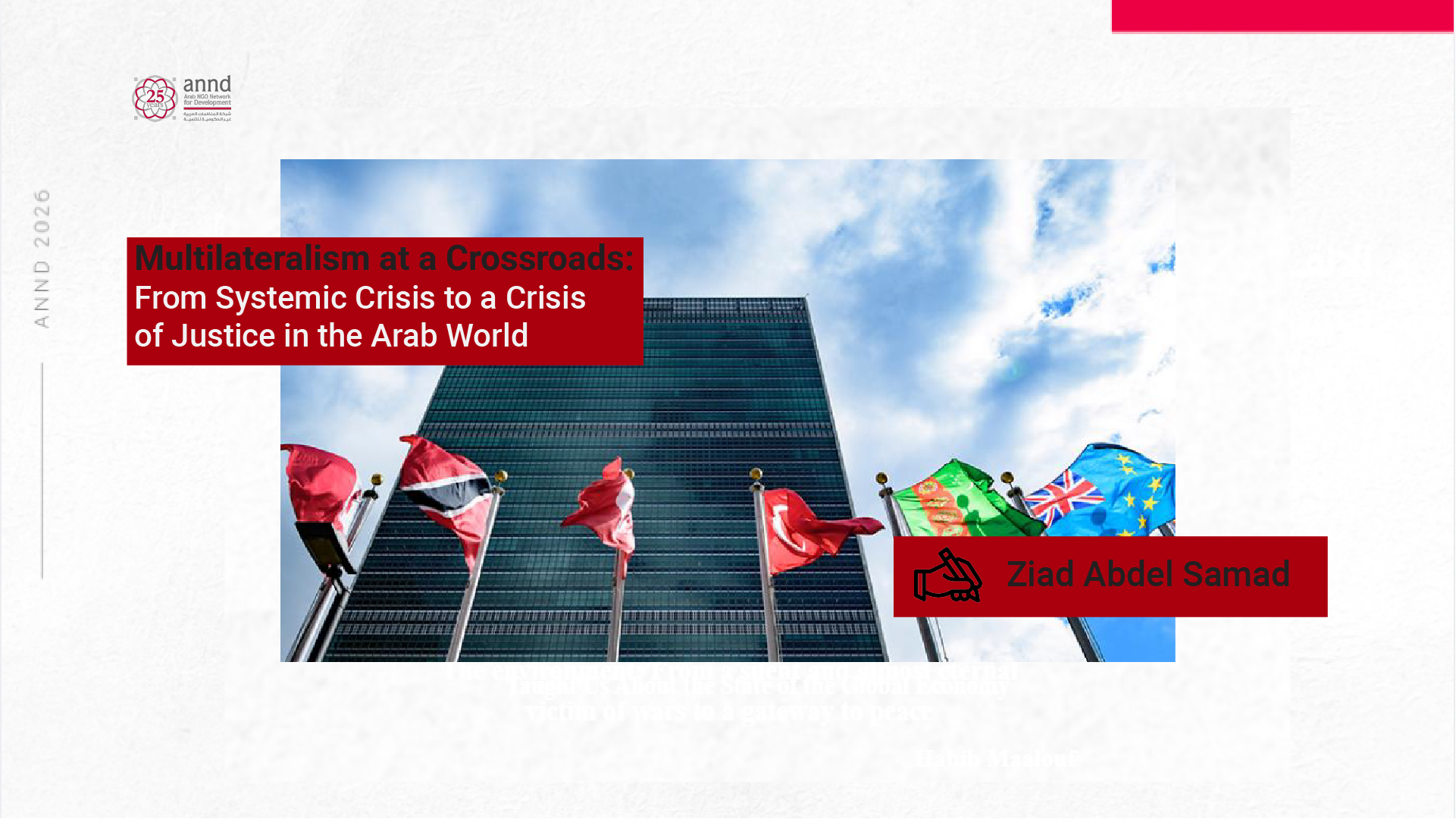
Multilateralism at a Crossroads: From Systemic Crisis to a Crisis of Justice in the Arab World - Ziad Abdel Samad
Multilateralism at a Crossroads: From Systemic Crisis to a Crisis of Justice in the Arab World
The crisis facing multilateralism today is no longer a technical question of institutional efficiency or procedural effectiveness. What we are witnessing is something far deeper—a crisis of legitimacy and justice. Nowhere is this more starkly visible than in the Arab world, where overlapping conflicts, economic dependency, and weakening governance converge with the international system’s failure to respond adequately.
Talking about “gaps” in the multilateral system is no longer sufficient. The very foundations of that system are eroding, even as the need for it grows more urgent.
Double Standards and the Erosion of Trust
One of the clearest symptoms of this crisis is the selective application of international law and global standards. While the international order is ostensibly built on equal rules, reality tells a different story, one marked by glaring inconsistencies in how conflicts are addressed and how principles such as human rights and accountability are enforced, even by the highest international institutions and courts.
This double standard does more than undermine trust between states. It erodes public confidence and makes the idea of a “rules-based order” ring hollow. The handling of sensitive regional issues, including Gaza, offers a stark illustration of this structural failure.
Yet despite its deep flaws, multilateralism remains the only viable framework for addressing transnational challenges which no country can address alone, whether regulating global trade, managing financial crises, tackling climate change, or maintaining international peace and security. These challenges, by their nature, transcend national borders and require coordination and shared responsibility that only collective frameworks can provide.
For the Arab world in particular, multilateralism takes on added importance amid global power imbalances. Even with its limitations, it provides a platform for negotiation, coalition-building, and the defense of shared interests. It also offers, at least in principle, tools for accountability, however unevenly they may be applied.
The challenge, therefore, is not to abandon multilateralism, but to reclaim and reshape it as an instrument of justice rather than a system that perpetuates existing inequalities.
A Growing Gap Between Commitments and Reality
Despite global commitments to the SDGs, the Arab region remains far from achieving them. In fact, poverty and inequality indicators, including those related to environmental and climate sustainability, have worsened in several countries, particularly in contexts marked by conflict and fragility.
This points to a fundamental imbalance: an abundance of initiatives and rhetoric, and a shortage of real commitments and tangible outcomes. Development in this context is not merely stalled. It is constrained and shaped by political and economic forces beyond the control of individual states.
Debt and Dependency: Constraints on Development Choices
Many Arab countries face severe fiscal constraints. Public debt across the region exceeds $1.5 trillion, with debt servicing consuming up to 40% of public spending in some cases.
These figures are not just economic indicators. They reflect a reality in which public policy is shaped by external pressures, whether through lending conditions or global market volatility. Under such constraints, development ceases to be a sovereign choice and becomes a tightly managed process, often at the expense of social justice.
Conflict as a Structural Barrier to Development
The Arab region is among the most conflict-affected in the world. Over 20 million people are displaced, and in several countries poverty rates exceed 80%.
In such conditions, development becomes nearly impossible. Conflicts do not merely destroy infrastructure. They reshape national priorities, diverting resources toward security, militarization, and survival rather than investment in people. The absence of peace and self-determination further constrains countries’ ability to chart their own development paths.
The Political Economy of Conflict and Corruption
In conflict settings, corruption is not just a byproduct. It becomes embedded in the system itself. Weak oversight, emergency funding flows, and concentrated power create what can be described as a “political economy of conflict,” where parallel economies expand at the expense of the real economy, benefiting a narrow elite at the cost of the majority.
This dynamic not only hinders development but also undermines the possibility of building institutions grounded in trust and accountability.
Civil Society: A Marginalized Actor
Despite its critical role, Arab civil society remains largely excluded from decision-making processes, both nationally and internationally. Participation is often tokenistic, influence is limited, and restrictions on civic space are increasing in several countries.
This paradox—where those closest to lived realities are sidelined—leads to policies that are disconnected from actual needs and helps explain the limited effectiveness of many development interventions.
Rethinking Multilateralism
Addressing these challenges requires more than technical reform. It calls for a fundamental rethinking of the multilateral system’s structure and purpose. This includes:
| ● | Strengthening accountability by linking commitments to measurable outcomes |
| ● | Redistributing power within the international system to reflect global shifts |
| ● | Reforming global financial and trade systems to address debt and inequality |
| ● | Protecting civic space as a prerequisite for inclusive development |
| ● | Integrating peace and development as inseparable objectives |
| ● | Incorporating local knowledge into global policymaking |
Conclusion: From Managing Crises to Confronting Them
What we are witnessing today is not simply a malfunctioning multilateral system, but a crisis in its ability to deliver justice. If it continues to ignore structural imbalances and apply standards selectively, it will not only fail to achieve development, but will steadily lose its legitimacy.
The real challenge is not to tweak the existing system, but to rebuild it on foundations that are more just and inclusive. Otherwise, we will remain trapped in a cycle of crisis management rather than genuine resolution.
Recent publications