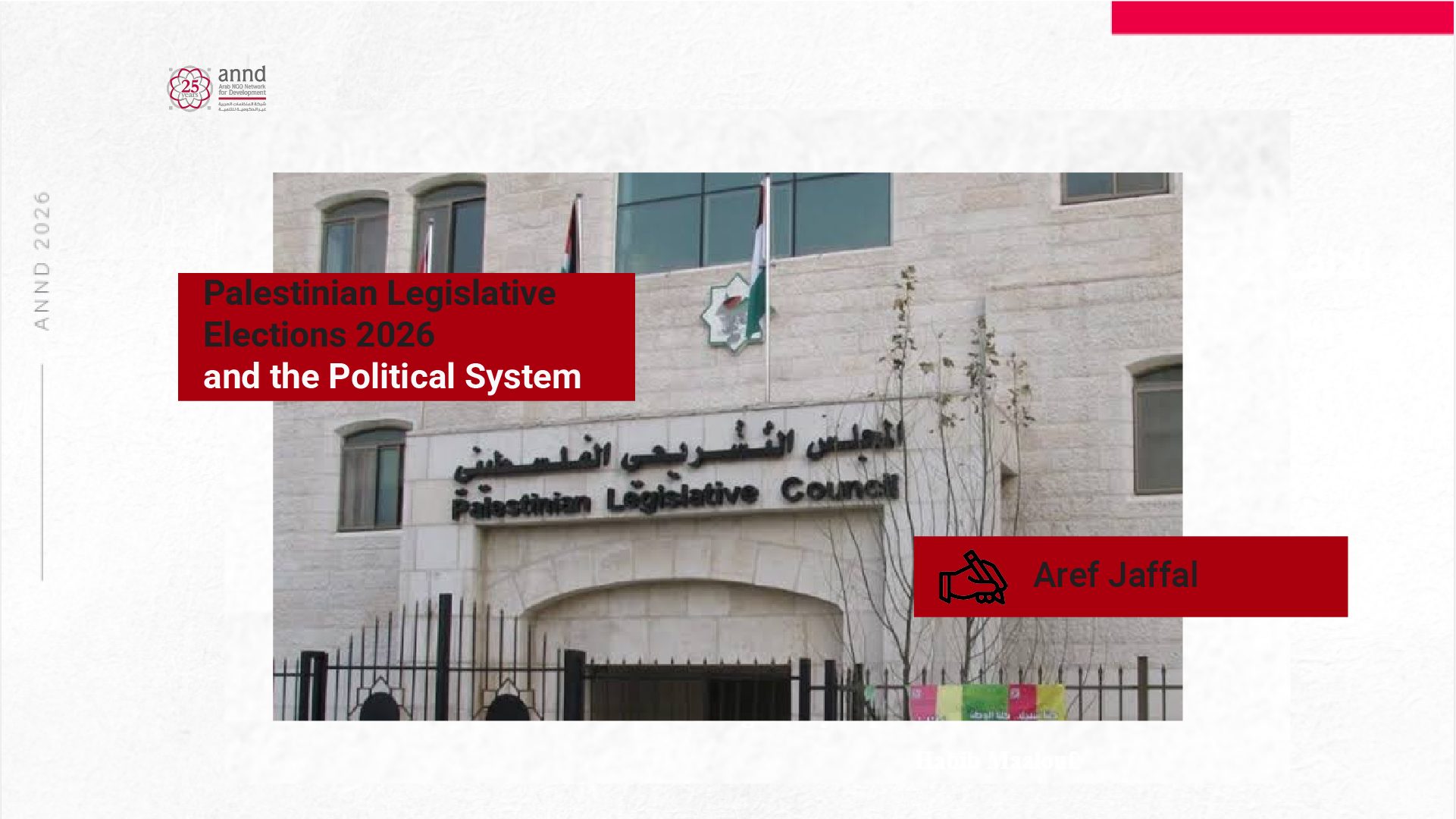
Palestinian Legislative Elections 2026: Between Commitments to the International Community and Rebuilding the Palestinian Political System
Palestinian Legislative Elections 2026: Between Commitments to the International Community and Rebuilding the Palestinian Political System
The Palestinian legislative elections scheduled for 2026 come within a complex political context marked by internal division, the prolonged absence of elections, the erosion of the legitimacy of political institutions, and growing international demands concerning the reform and renewal of the Palestinian political system.
The decision to hold elections cannot therefore be viewed solely as a procedural or constitutional matter. It is closely connected to a broader political debate over the future of Palestinian institutions, the restoration of political legitimacy, the representation of different social and political forces, and the Palestinian leadership’s commitments toward the international community.
Legislative elections have not been held since 2006. This prolonged interruption has affected the functioning of the Palestinian political system and has deprived successive generations, particularly young people, of the opportunity to participate in choosing their representatives through legislative elections.
Over this period, the political landscape has undergone significant changes. New generations have entered public life, social and economic priorities have shifted, and political division has become deeply embedded in Palestinian institutions and society. At the same time, confidence in existing political structures has been affected by the absence of regular electoral processes and the limited possibilities for political participation and renewal.
Against this background, the 2026 elections raise questions that go beyond who will win seats in the Legislative Council. They concern the extent to which elections can contribute to rebuilding the political system, renewing its institutions, widening participation, and restoring public confidence in political representation.
Elections and International Commitments
The call for legislative elections also comes within the framework of commitments made by the Palestinian leadership to the international community regarding political and institutional reform. Elections have increasingly become part of international discussions concerning the governance of Palestinian institutions and their future role.
This international dimension creates a particular challenge. Elections are, first and foremost, an internal political and constitutional right for Palestinians and should not be reduced to a requirement intended to satisfy external actors. At the same time, the Palestinian political system operates within an international environment in which financial support, diplomatic recognition, institutional reform, and political legitimacy are closely interconnected.
The central issue is therefore whether the elections will become a genuine mechanism for rebuilding political life from within or whether they will be approached primarily as a means of fulfilling international commitments without addressing the deeper problems affecting the political system.
Restoring Institutional Legitimacy
One of the most important issues surrounding the elections is the question of legitimacy. The prolonged suspension of legislative elections has weakened the representative character of Palestinian institutions and created a growing gap between the formal political system and Palestinian society.
Regular elections are not sufficient on their own to resolve the structural problems of a political system. Nevertheless, they remain one of the principal mechanisms through which citizens can participate in choosing representatives, holding political actors accountable, and renewing institutions.
The legislative elections could therefore provide an opportunity to restore a degree of institutional legitimacy, provided that they are conducted within a framework that guarantees political pluralism, genuine competition, transparency, and respect for the results.
Political Division and the Electoral Process
The continuing Palestinian political division remains one of the most significant challenges facing any electoral process. Elections cannot be separated from the institutional and political consequences of this division, which has shaped Palestinian governance for years.
The ability to hold elections across the Palestinian territories, ensure participation by the various political forces, recognize the results, and enable elected institutions to function effectively will all depend on the political environment surrounding the process.
Without political understandings capable of ensuring that the electoral process is respected before and after voting takes place, elections could reproduce existing divisions rather than contribute to overcoming them.
Youth and Political Participation
The long absence of legislative elections has had a particularly significant impact on young Palestinians. A large segment of the population has never had the opportunity to vote in legislative elections, despite having reached voting age many years ago.
This makes youth participation one of the central dimensions of the 2026 elections. Young people are not merely a voting bloc; they represent generations whose political experiences have been shaped by division, occupation, economic difficulties, restrictions on movement, changing forms of activism, and the growing role of digital platforms in political and public debate.
Their participation raises questions about whether existing political parties can respond to their priorities, whether electoral lists will provide meaningful opportunities for younger candidates, and whether elections can create channels for political engagement beyond the traditional structures that have dominated Palestinian politics.
Jerusalem and the Right to Participate
The participation of Palestinians in Jerusalem constitutes another fundamental issue. Previous Palestinian elections included arrangements that allowed Jerusalemites to participate, and the question of their participation remains politically and nationally significant.
Any restrictions on the participation of Palestinians in Jerusalem would affect not only the inclusiveness of the electoral process but also the broader political meaning of holding Palestinian elections.
For this reason, the issue of Jerusalem cannot be treated merely as a technical electoral matter. It is directly connected to questions of political representation, national rights, and the geographical and political scope of Palestinian institutions.
Political Parties and Independent Lists
The elections will also test the ability of Palestinian political parties to reconnect with society after years without legislative electoral competition. Established political movements continue to possess organizational structures and historical influence, but they also face questions concerning public confidence, internal renewal, political programs, and their capacity to represent changing social priorities.
At the same time, independent lists may provide a space for political and social actors who do not identify with the traditional party system. Their participation could broaden the range of choices available to voters and create opportunities for new voices to enter formal political institutions.
From another perspective, the elections represent an opportunity to bring new blood into the political system and an opportunity for party and independent lists to participate in public affairs, which have been closed to opportunities for participation because of the absence of elections.
Beyond Election Day
The importance of the 2026 legislative elections will ultimately not be determined by election day alone. Their significance will depend on whether they contribute to rebuilding a functioning political system and whether the institutions emerging from them are able to exercise their constitutional and political roles.
The challenge is therefore not merely to organize elections after a prolonged interruption, but to ensure that the electoral process becomes part of a broader process of political renewal. This includes strengthening representation, restoring institutional roles, expanding public participation, and creating mechanisms through which citizens can hold their representatives accountable.
The elections also present an opportunity to reconsider the relationship between Palestinian society and the political system. Years without legislative elections have contributed to a widening gap between citizens and formal institutions, while political participation has increasingly taken place through other channels, including civil society, grassroots initiatives, protest movements, and digital platforms.
Rebuilding confidence will therefore require more than opening polling stations. It will require ensuring that participation has political meaning and that elected representatives are able to exercise real functions within institutions that are accountable to the public.
In this sense, the 2026 legislative elections stand at the intersection of several questions: Palestinian commitments toward the international community, the legitimacy of political institutions, internal political division, the participation of Jerusalem, the role of young people, and the possibility of renewing political representation.
Whether the elections can contribute to rebuilding the Palestinian political system will depend not only on their organization, but also on the political conditions surrounding them, the extent of participation, respect for the results, and the ability of elected institutions to function afterward.
Recent publications