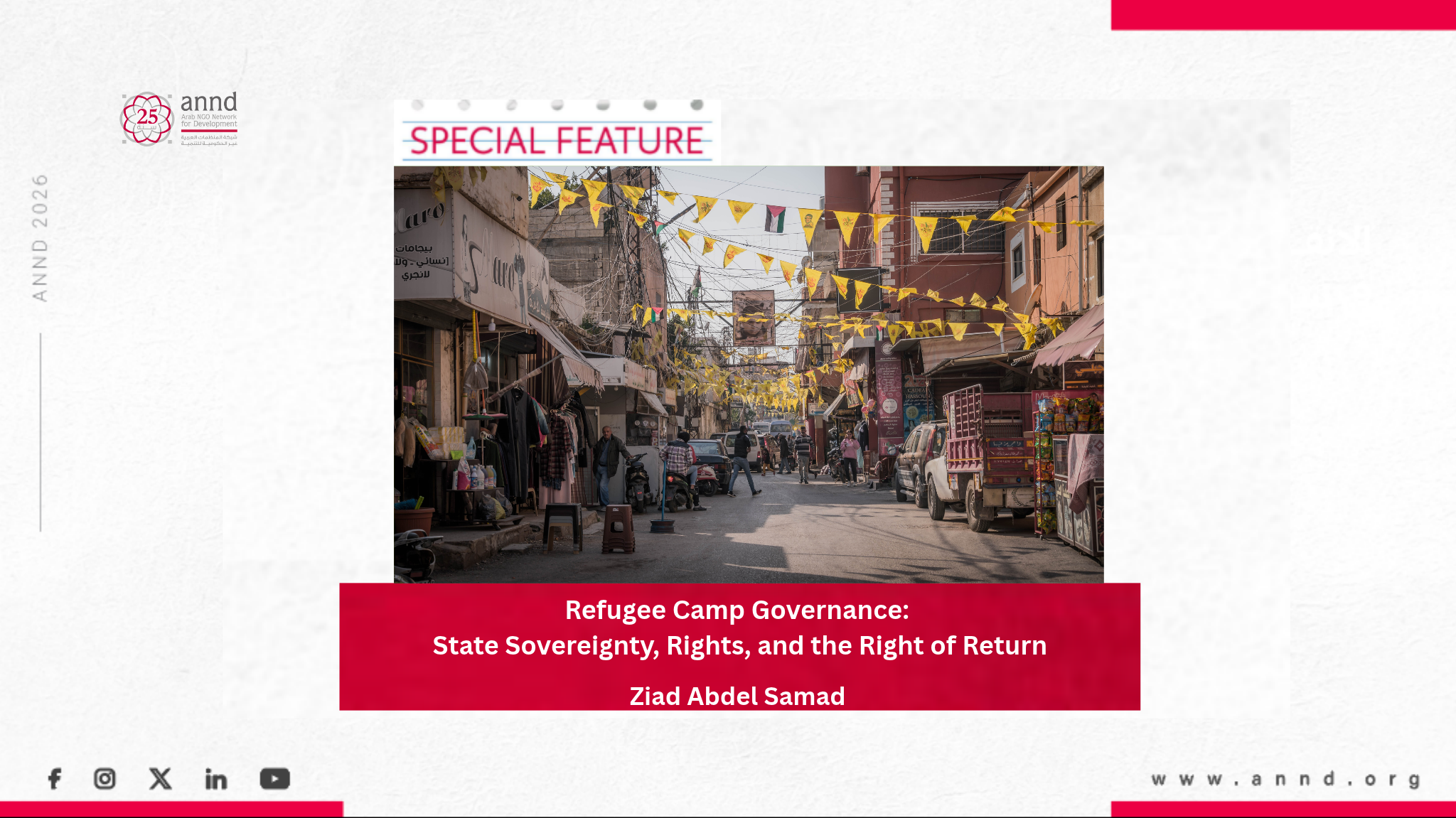
Refugee Camp Governance: State Sovereignty, Rights, and the Right of Return - Ziad Abdel Samad
Refugee Camp Governance: State Sovereignty, Rights, and the Right of Return
Ziad Abdel Samad
Ziad Abdel Samad examines the consultations on Lebanon's national plan for governing Palestinian refugee camps, emphasizing the importance of combining state sovereignty and the rule of law with the protection of refugees' civil and social rights, without compromising their right of return or paving the way for permanent resettlement. He calls for legislative and institutional reforms, meaningful participation by camp residents, and continued responsibility on the part of UNRWA and the international community.
The launch of consultations on the national plan for the governance of Palestinian refugee camps in Lebanon presents an opportunity to address an issue that has long been subject to postponement, overlapping responsibilities, and piecemeal solutions. The importance of this initiative lies in its potential to reorganize the relationship between the Lebanese state and Palestinian refugees on a basis that combines state sovereignty and the effective functioning of its institutions with the protection of rights and human dignity, while upholding the right of return and rejecting permanent resettlement and displacement.
This is the framework emphasized by Prime Minister Nawaf Salam in his remarks at the launch of the consultations. He affirmed that the camps are subject to Lebanese sovereignty and law, and stressed the need for state institutions to establish a clear and regular presence within them, through an approach encompassing security, the judiciary, public administration, and social, economic, and urban conditions. He also linked improvements in refugees' living conditions to Lebanon's national interest and underscored the importance of developing comprehensive legislation governing their rights and obligations, while safeguarding the right of return, preserving UNRWA's role, and maintaining the responsibility of the international community. (pcm.gov.lb)
This approach deserves support because it places the state's responsibility within its full scope. Sovereignty encompasses the enforcement of the law, the exclusive control of weapons, and the protection of security. It also includes ensuring justice, organizing services, and safeguarding the dignity of all residents. The proper functioning of institutions requires clearly defined powers and responsibilities, access to justice, and accountability for public administration and security agencies. The more fairly and effectively the state performs these functions, the greater the public's trust in its institutions and their capacity to provide protection.
However, moving from principles to implementation requires seriously addressing concerns on both sides. Some Lebanese fear that expanding refugees' rights could consolidate their presence and gradually transform their refugee status into permanent resettlement. Palestinians, meanwhile, fear that security and administrative measures may advance while their fundamental rights remain postponed, and that they may be asked to trust new arrangements without sufficient guarantees of protection and participation.
These concerns should not be reduced to bad faith or resistance to reform. Palestinian collective memory carries experiences of restrictions, violations, and deprivation. Lebanese concerns, meanwhile, are linked to the country's history, social and political composition, and successive crises, as well as fears that Lebanon may be forced to bear the consequences of regional settlements over whose formulation it has little influence. Public policy must address the underlying causes of these fears rather than allow them to reinforce one another.
The regional context further complicates the issue. Settlement expansion, forced displacement, and the deterioration of living conditions for Palestinians make fears of prolonged displacement and the entrenchment of refugee status increasingly urgent. United Nations reports have documented forced displacement in the West Bank, including East Jerusalem, and raised concerns about ethnic cleansing in Gaza and the West Bank. The future of refugees in Lebanon therefore cannot be discussed separately from the policies that obstruct their return and push more Palestinians away from their land. (un.org)
Likewise, Lebanon's need to end Israeli attacks, secure Israeli withdrawal, and pursue reconstruction raises concerns that these needs could be used to exert pressure on the country in other areas, including the refugee issue. Such risks call for vigilance, transparency, and oversight of any commitments, without treating possibilities as established facts or assuming the existence of conditions that have not been demonstrated.
This is where the significance of Salam's position becomes apparent. It combines the rejection of imposed solutions at the expense of Lebanon or Palestinian national rights with the state's acceptance of responsibility for refugees' legal, humanitarian, and social conditions. This position provides the foundation for a clear policy: protecting Lebanon against imposed permanent resettlement, protecting Palestinians against displacement and continued deprivation, and safeguarding their right of return. (pcm.gov.lb)
This requires distinguishing civil and social rights from citizenship and political settlements concerning the refugee question. Access to employment, healthcare, education, social protection, and decent housing does not automatically mean naturalization, nor does it constitute a relinquishment of the right of return. Continued deprivation of Palestinians does not bring them closer to their homeland. Rather, it deepens poverty, vulnerability, and dependence on assistance, while increasing social and security pressures on the camps and their surrounding communities.
At the same time, this legal distinction alone is insufficient to address Lebanese concerns. Reforms must be accompanied by clear political guarantees preventing them from being used as a substitute for resolving the refugee question or as a pretext for ending international responsibility. Improving people's lives where they currently reside does not give anyone the right to close the question of their displacement from their homeland.
For this reason, preserving UNRWA's role is particularly important. Strengthening the presence of the Lebanese state and organizing its responsibilities must complement the agency's continued fulfillment of its mandate and the international community's commitment to financing it. Governance must not become a mechanism for transferring burdens to Lebanon, nor should funding shortages become a justification for leaving refugees without services or protection.
At the domestic level, the credibility of the initiative requires a clear legislative process addressing restrictions on employment, social security, housing conditions, and identity documentation. This process must include refugees living both inside and outside the camps, and must identify the procedures, responsible authorities, and timelines necessary to ensure that rights do not remain unfulfilled promises.
This process should advance in parallel with the restoration of security and the enforcement of the law. Fundamental rights must not be granted as a reward for completing security arrangements, just as state sovereignty is not a matter for bargaining. Ramez Dimashkieh, Chairman of the Lebanese-Palestinian Dialogue Committee, expressed this principle clearly when he affirmed that rights are not the price of surrendering weapons and that the exclusive control of weapons is not negotiable. (refugeesps.net)
For the state's presence to become a source of reassurance, it must be accompanied by practical guarantees: effective access to justice, reliable complaints mechanisms, accountability for violations, and protection for camp residents and neighboring communities. Trust develops when people experience the fairness and continuity of institutions and know that their rights do not depend on intervention by a political or security authority.
Governance also requires meaningful participation by camp residents. Consultations with official representatives and Palestinian factions alone are insufficient. Women, young people, associations, and independent actors must also be involved, drawing on their experience to identify needs and priorities. The powers of any new administrative body, its relationship with Lebanese government departments, municipalities, Palestinian authorities, and UNRWA must also be clearly defined, with its decisions and budgets subject to accountability.
The consultations must produce an actionable implementation plan that can be monitored, with clearly identified financing and indicators measuring improvements in security, services, and rights. The measure of success is not the number of meetings held or the completion of administrative structures, but residents' ability to access healthcare, employment, and justice, as well as improvements in living conditions and relations with surrounding Lebanese communities.
The governance initiative offers an opportunity to translate the position announced by the Prime Minister into sustained institutional practice: a state that exercises its authority and fulfills its responsibilities; refugees whose dignity, rights, and national identity are protected; and an international community that remains accountable for its commitments.
Protecting Lebanon from permanent resettlement, safeguarding Palestinians' right of return, and ensuring that they can live in dignity until that right is realized are objectives that can be brought together within a single policy. The success of such a policy requires fair, transparent, and capable institutions that transform sovereignty into protection, rights into reality, and commitment to the right of return into a political obligation that is not used to postpone people's lives.