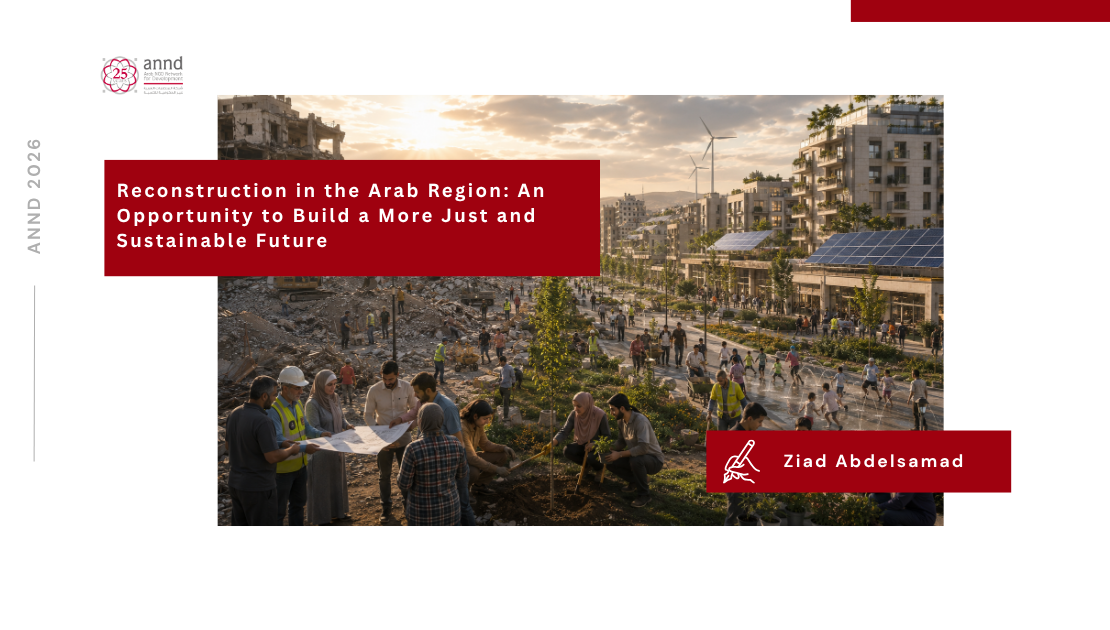
Reconstruction in the Arab Region: An Opportunity to Build a More Just and Sustainable Future

Reconstruction in the Arab Region: An Opportunity to Build a More Just and Sustainable Future
The Arab region is currently experiencing one of the most complex periods in its modern history. After years of wars, conflicts, occupations, and economic and financial crises, reconstruction has become a central topic in national, regional, and international debates. Yet the question is no longer limited to how to rebuild what wars have destroyed. It has also become a question of the kind of societies and states we seek to rebuild.
Reconstruction is not merely an engineering or financial process, nor is it simply a series of projects to restore roads, bridges, housing, electricity grids, and water networks. It is a political, economic, social, environmental, and cultural process that reshapes the relationship between the state and society, defines development priorities, redistributes resources and opportunities, and outlines the contours of the social contract for decades to come. Consequently, the way in which the reconstruction phase is managed is no less important than the resources allocated to it.
This issue is of particular importance in the Arab region, where several countries face similar challenges despite their different contexts. In the Gaza Strip, society is confronted with an unprecedented humanitarian catastrophe and destruction that raise fundamental questions about the Palestinian people's right to reconstruction and their right to determine their future free from siege and occupation. In Lebanon, reconstruction comes amid an unprecedented economic and financial collapse and a profound crisis of confidence in state institutions, making reconstruction an opportunity to reform the state rather than reproduce the causes of the crisis. Syria, meanwhile, continues to face enormous challenges related to linking reconstruction with a political solution, the return of refugees, the lifting of sanctions, and the restoration of national institutions. In Iraq, there remains an urgent need to address the consequences of decades of conflict, promote balanced development, combat widespread corruption at all levels, and rebuild trust between the state and its citizens.
Despite the differences among these experiences, they all share one central question: Will reconstruction become a pathway toward development and justice, or will it reproduce the patterns of marginalization, inequality, and corruption that contributed to the outbreak of these crises?
Numerous experiences have demonstrated that reconstruction can become an opportunity to reinforce political patronage networks, expand public debt, privatize public services, and deepen social and regional disparities if it is not guided by the principles of transparency, accountability, and public participation. Conversely, it can represent a historic opportunity to rebuild more efficient and independent institutions, more productive economies, and societies that are more just and inclusive.
For this reason, reconstruction cannot be viewed in isolation from the Sustainable Development Goals, international human rights commitments, or the need to reform governance and strengthen the rule of law. Rebuilding physical infrastructure must go hand in hand with rebuilding institutions, restoring trust between citizens and the state, expanding democratic participation, and ensuring that all groups have access to essential services and social protection.
Reconstruction also cannot ignore those groups that bear the greatest burden of conflict. Women should not be confined to humanitarian response alone, but must be partners in decision making, planning, and implementation. The same applies to persons with disabilities, whose needs are often overlooked in the design of cities, infrastructure, and public services, despite the Convention on the Rights of Persons with Disabilities emphasizing the necessity of adopting an inclusive and accessible approach for all. Children and young people are not only victims of war, but also represent the most important investment in building peace and development.
The environmental dimension is assuming an increasingly prominent place in reconstruction debates. Wars do not only destroy buildings. They also contaminate soil, water, and air, destroy ecosystems, and increase the vulnerability of communities to climate change. Consequently, the concept of "building back better" must go beyond slogans and become a practical framework that links reconstruction with environmental justice, climate action, and the sustainable management of natural resources.
Reconstruction cannot be complete without giving the cultural dimension the attention it deserves. Wars do not only leave physical destruction. They also create deep divisions within the social fabric, fuel fear and mistrust, and intensify hate speech and exclusion. Rebuilding societies therefore requires fostering a culture of dialogue, respect for diversity and pluralism, acceptance of differences, protection of freedom of opinion and expression, and the promotion of the values of citizenship and human rights. Genuine recovery is achieved not only by rebuilding cities, but also by rebuilding trust among individuals and communities, rejecting all forms of discrimination and incitement, and establishing a culture of peace and tolerance as fundamental pillars of stability and sustainable development.
The financing of reconstruction is no less important than its substance. The Arab region faces high levels of public debt, declining social spending, and mounting financial pressures at a time when development assistance is decreasing while military expenditures continue to rise at both the regional and global levels. This calls for the exploration of fair and sustainable financing models based on mobilizing domestic resources, reforming tax policies, combating corruption and illicit financial flows, and securing international support that respects national priorities and does not transform reconstruction into an instrument of political or economic influence.
This issue demonstrates that the success of reconstruction should not be measured by the amount of funding allocated or by the number of buildings reconstructed, but by its ability to build societies that are more just, states that are more accountable, economies that are more productive, environments that are more sustainable, and a peace that is more enduring.
The articles in this issue address these questions from multiple perspectives by analyzing the experiences of Lebanon, Syria, Iraq, and the Gaza Strip, while examining the economic, social, and environmental dimensions of reconstruction, the role of civil society, the rights of women and persons with disabilities, financing mechanisms, governance, and accountability.
Reconstruction is not simply the end of war. It is the beginning of another battle of equal importance: the battle to build a just state, a productive economy, a cohesive society, a healthy environment, and a new social contract that places people, their rights, and their dignity at the heart of the development process. The future is not built with concrete alone. It is also built through institutions, justice, participation, and sustainability. This is the central message that this issue seeks to advance.
Recent publications