Feb 04, 2026
Civil society statement - Stop the war, support impacted countries and cancel the debt
Civil society statement - Stop the war, support impacted countries and cancel the debt
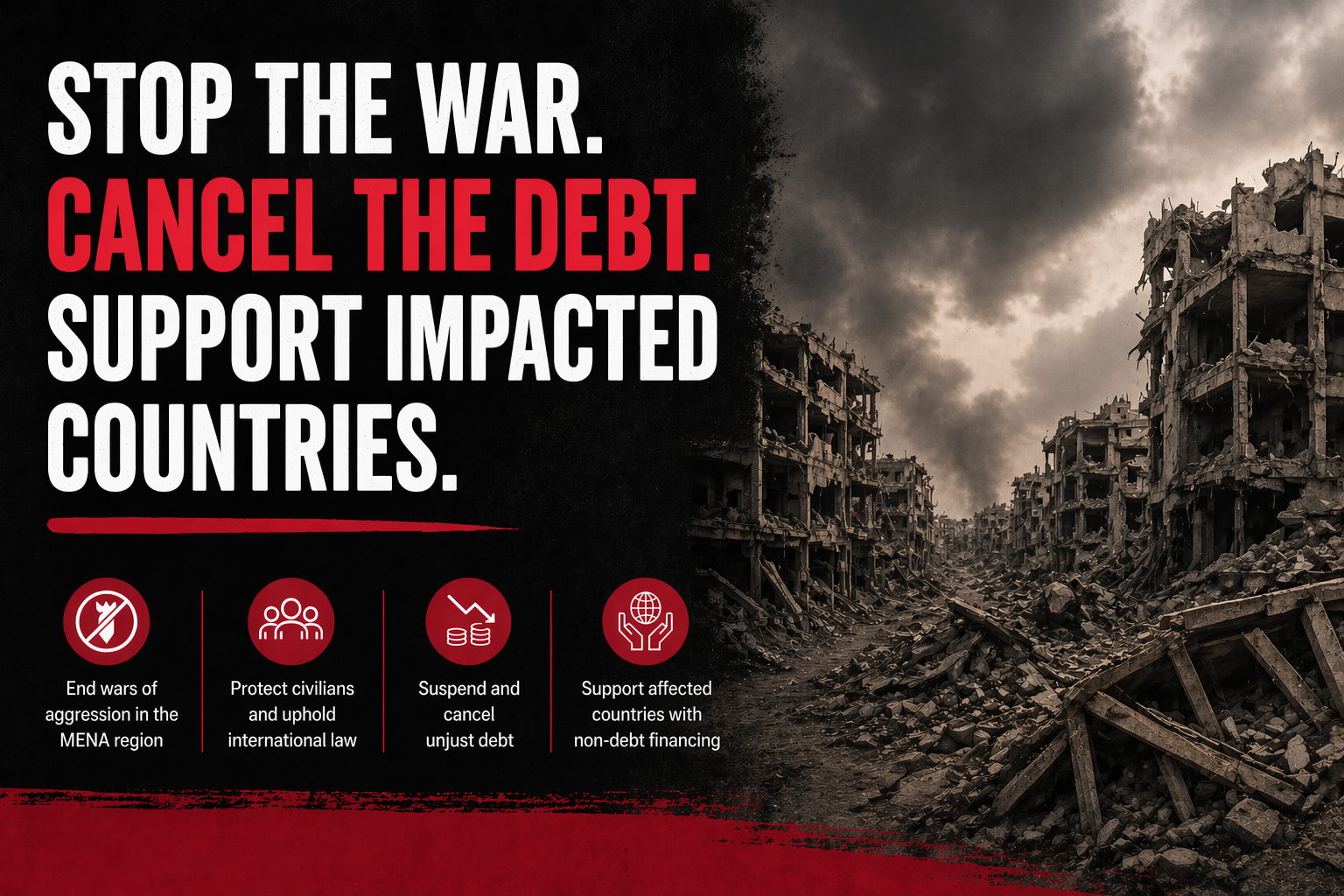
The illegal attack by the US and Israel in Iran and Lebanon, and the deepening conflict in the Middle East and North Africa (MENA) region, has become the ultimate escalation of the economy of war and a new threat to the rule of law. The war is causing massive destruction, claiming thousands of civilian lives, and putting countless more at risk. Even as the genocidal violence in Palestine continues, this new war is a profound breach of international law and an escalation of imperialist foreign policy by the US and Israel.
The wars and genocide, as unlawful acts of aggression and breach of the UN Charter, must stop. We urge all parties to pursue a peaceful and negotiated outcome that preserves peace and stability in MENA. We call on governments and institutions worldwide to stand up for peace and the respect of international law, firmly and unequivocally opposing those who promote war and destruction for their own economic and geostrategic benefits. This includes not engaging with - or withdrawing from - the Board of Peace.
Beyond the immeasurable losses of life and infrastructures in the MENA region, the impacts of this war are already being felt worldwide, particularly in the Global South. The recent escalation of US and Israeli military violence has sharply intensified disruptions across energy, fertilizer, and commodity markets, with cascading effects on economic prospects, and energy and food security across the globe. The International Energy Agency has characterised this disruption as the ‘greatest global energy and food security challenge in history,’ and the largest supply disruption to the oil market since the energy crisis of the 1970s - which led to the debt crisis of the 1980s-90s.
Skyrocketing oil, gas and fertilizer prices are causing food prices to rise, leading to higher inflation. This means energy and food insecurity for millions of people in the Global South. It means a rising cost of production and transportation, energy cuts - and therefore hospitals not working properly and schools closing - and disruptions in the supply route for critical goods, including fertiliser, grains and other food supplies. Ultimately, it means famine.
As a whole, these interconnected shocks will make it even more difficult to pay for external debt service, which was already at record high levels before this new shock. Countries with both high external debt service and low reserves will be especially at risk. Global South countries dependent on imported energy and agricultural commodities will face a double burden, as escalating import costs risk depleting foreign reserves and triggering widespread hunger, impoverishment, and economic contraction. To sustain essential imports and basic economic functioning, many will not only be unable to make existing debt repayments but will also be forced to take on additional debt. Under these conditions, the continuation of existing debt obligations will only deepen the crisis and push these economies into a spiral of stagflation.
The threat of inflation will likely lead to increasing interest rates that, together with markets’ aversion to risk, is already increasing capital outflows, spreads and therefore borrowing costs for Global South countries. They will have to reach out to lenders of last resort like the IMF and the World Bank, with conditionalities attached, and increase their debt stocks even further. Furthermore, there will probably also be a reduction in remittances from workers in the Gulf countries targeted by strikes. This not only affects households in these workers’ countries of origin, but also their economies and US dollar reserves.
Such impacts are exacerbated by structural imbalances that have historically deepened dependencies in the Global South. Dependencies that make the economic spillovers of the war even more impactful.
In this bleak outlook, the IMF and World Bank seem to be waiting to see how the situation unfolds. While highlighting the challenging situation, the Bretton Woods Institutions, whose major shareholder is the US, have limited their offerings to the usual toolkit of capacity development, neoliberal policy advice and more lending. The uneven response of the IMF and World Bank to global conflicts also raises serious concerns about double standards. While they reacted swiftly and with clarity to the Russian invasion of Ukraine, their delayed and muted response to the current crisis in the Middle East and Asia - despite warnings from the International Energy Agency - undermines their credibility and surveillance mandate.
We, the undersigned civil society organisations, demand that governments around the world and international financial institutions:
| ● | Take immediate action to stop wars of aggression against Iran and the MENA region and stop the genocide in Palestine. |
| ● | Support countries impacted by the war and spillovers with unconditional non-debt creating finance. |
| ● | Suspend all debt payments to all lenders from countries directly impacted by the military attacks and those affected by the increase of energy, fertilizers and food prices, at least until the conflict is over and prices are stabilised. Any debt relief initiative must be enforced for all lenders, including private, bilateral and multilateral, in order to avoid bailing out private creditors. |
| ● | Assess the debt sustainability, taking into account the impacts of the war and spillovers in the borrowing countries’ economies, and considering the financing needs for reconstruction and recovery, and unconditionally cancel all unsustainable and illegitimate debts. |
| ● | The IMF and World Bank could make use of existing tools, such as the IMF Catastrophe Containment and Relief Trust (CCRT) or sales of gold reserves, to provide multilateral debt cancellation. |
| ● | Suspend the IMF surcharges. |
| ● | Agree on a new Special Drawing Rights (SDR) allocation to support countries in need including by re-channeling SDRs through non-debt creating mechanisms. |
| ● | Fundamentally overhaul the international multilateral system to make it truly inclusive and rights-based. This requires, above all, reforming economic decision-making processes and shifting them away from exclusive and unequal institutions toward more inclusive and democratic formats. This includes advancing towards the UN Tax, Debt and ODA conventions. |
| ● | Looking forward, and ahead of future shocks, governments must commit to the establishment of an automatic debt payments cancellation mechanism, to offer relief in the wake of external catastrophic events, followed by enhanced debt stock restructuring and cancellation*. This mechanism should be created, under UN auspices, in parallel to the establishment of a multilateral debt resolution mechanism**. A UN Framework Convention on Sovereign Debt*** could facilitate discussions and decision-making on both mechanisms, with both creditors and debtors participating on an equal footing. |
Click here for the list of signatories
Recent publications
Oct 25, 2026