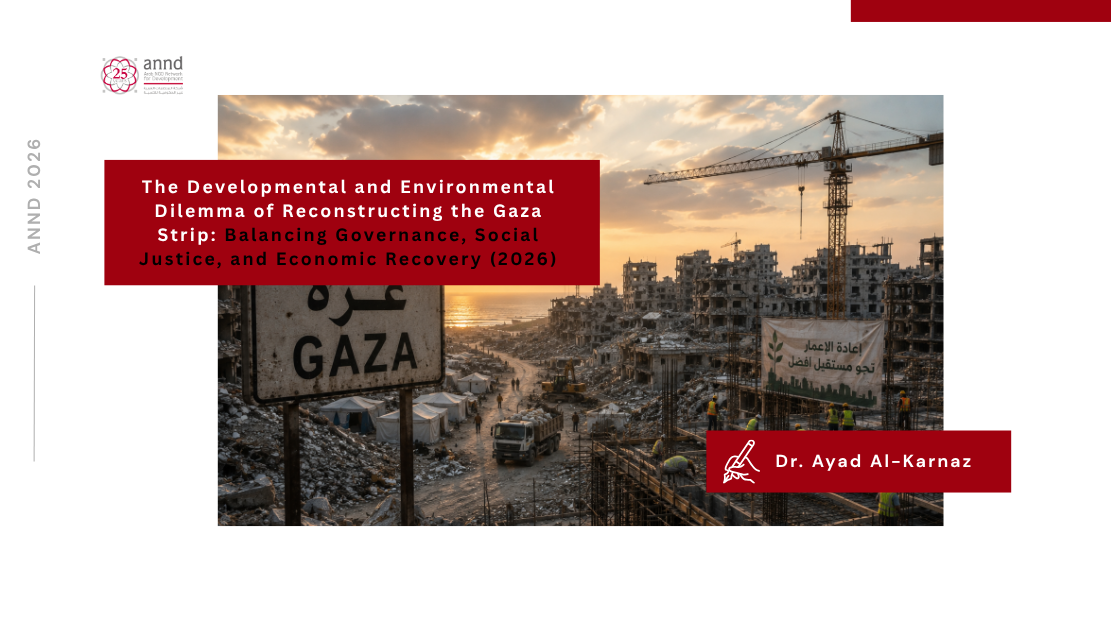
The Developmental and Environmental Dilemma of Reconstructing the Gaza Strip: Balancing Governance, Social Justice, and Economic Recovery (2026)
Dr. Iyad Al-Karnaz
The Developmental and Environmental Dilemma of Reconstructing the Gaza Strip: Balancing Governance, Social Justice, and Economic Recovery (2026)
Introduction
The reconstruction of the Gaza Strip has become one of the most complex developmental and humanitarian dilemmas in contemporary international and regional debates since the outbreak of the latest war. The enormous scale of destruction affecting infrastructure, housing, and essential services is no longer merely a temporary humanitarian crisis. It has become a structural developmental setback that has pushed the Strip's social and economic indicators back by decades. This unprecedented level of devastation has created material and institutional challenges that require a critical perspective extending beyond financing mechanisms and technical procedures to address the core issues of governance, resource management, social justice, the rights of affected populations, as well as sustainable urban planning and environmental sustainability.
In this context, reconstruction cannot be viewed merely as an engineering or humanitarian logistical process. Rather, it should be understood as a multidimensional political and social process that is intrinsically linked to future stability and to the capacity to build a society that is more resilient in the face of future crises.
This article aims to analyze the interrelationship between the various dimensions of reconstruction, highlight the scale of the damage, examine issues of governance and political economy, and explore the social, urban, and environmental dimensions that should be taken into account to ensure comprehensive and sustainable recovery.
Scale of Destruction and Financing Needs
The joint estimates published by the World Bank, the European Union, and the United Nations in the 2026 Gaza Rapid Damage and Needs Assessment (RDNA 2026) present figures that reflect an unprecedented urban and economic shock. The estimated value of direct physical damage to fixed assets and infrastructure reached approximately USD 35.2 billion, while the cumulative economic and social losses resulting from disrupted production and markets were estimated at USD 22.7 billion. Based on these findings, total recovery and reconstruction needs were estimated at approximately USD 71.4 billion over a ten-year period, with the largest share of these needs concentrated in the housing, health, agriculture, water, and sanitation sectors.
A sectoral breakdown of these indicators reveals that the housing sector suffered the greatest impact. Approximately 371,888 housing units were directly affected, ranging from partial to complete destruction. As a result, more than 1.2 million people were forcibly left homeless, while approximately 1.9 million internally displaced persons continue to live in extremely vulnerable conditions.
The health sector also experienced an almost complete collapse of its medical infrastructure. Thirty-four of the thirty-six hospitals in the Gaza Strip sustained damage. As of August 2025, only eighteen hospitals were partially operational, while functioning primary healthcare facilities represented no more than 39 percent of the total.
These figures demonstrate that reconstruction in the Gaza Strip extends far beyond the narrow engineering perspective of repairing physical damage. It has become a comprehensive development process aimed at rebuilding the foundations of economic, social, and public service systems. The extensive destruction of the housing and health sectors, together with the continued large-scale displacement of the population, indicates that recovery requires long-term investment and close coordination among Palestinian institutions, donor agencies, international organizations, and civil society organizations to meet both humanitarian and development needs simultaneously.
Governance of Reconstruction and the Contest Between Multiple Approaches
Governance and the institutional frameworks for managing financing and implementation oversight represent one of the most sensitive dimensions of the debate surrounding Gaza's reconstruction. The discussion extends beyond financing mechanisms and construction priorities to encompass the question of which authority should manage the reconstruction process, make decisions, and allocate resources. This issue is particularly significant given the multiplicity of actors involved in reconstruction, including Palestinian institutions, donor agencies, international organizations, and regional powers. Consequently, differing visions have emerged regarding the institutional framework that should lead the reconstruction process. Some approaches advocate strengthening direct Palestinian leadership as a prerequisite for national ownership and accountability, while others support international or hybrid arrangements on the grounds of ensuring financial transparency and attracting external funding.
Within this framework, three principal approaches to managing the reconstruction process can be identified:
The Arab-Palestinian approach
This approach is based on a political vision that emphasizes Palestinian ownership of the reconstruction process, rejects forced displacement or resettlement outside the Gaza Strip, and calls for the establishment of an international trust fund to support recovery and reconstruction efforts while preserving the leadership role of Palestinian institutions, viewing reconstruction as an integral part of national recovery and long-term development.
The Palestinian governmental executive approach
This approach, led by the Palestinian Ministry of Public Works and Housing, is based on a spatial and implementation framework extending through 2030. It relies on geographic information systems and spatial analysis to identify intervention priorities, manage debris removal, plan temporary housing sites, and rehabilitate infrastructure and essential services, with the objective of reorganizing the urban landscape in a manner that reduces pressure on limited land resources.
The internationalization and hybrid governance model
This approach represents the international effort to structure reconstruction management through more rigorous governance arrangements, as outlined in the Board of Peace initiative. It proposes the establishment of an international Board of Peace and an executive structure supervised by the Office of the High Representative, headed by Nikolay Mladenov, alongside the Gaza Reconstruction and Development Fund (GRAD), to be administered by the World Bank in its capacity as a limited trustee, providing a unified framework designed to strengthen donor confidence.
These approaches reflect clear differences in visions concerning the balance between Palestinian leadership and international oversight. While the Arab and Palestinian approaches prioritize national sovereignty and the role of local institutions, the international model focuses on establishing multilateral oversight structures to strengthen financial accountability and ensure the continuity of funding flows. This divergence highlights a fundamental dilemma: how to reconcile the requirements of national ownership with the need for international resources, expertise, and support. It is evident that the success of reconstruction depends upon the existence of a clear governance framework that ensures coordination among all stakeholders, strengthens accountability and transparency, and directs resources toward the actual needs of the affected population.
The Political Economy of Structural Collapse and the Labor Market
The challenges of reconstructing Gaza extend beyond rebuilding damaged homes and infrastructure. They also encompass addressing a profound economic crisis resulting from the widespread destruction of productive activities and the disruption of markets and supply chains. In this context, reconstruction is closely linked to the political economy of the Gaza Strip, namely the economic, institutional, and political conditions that determine society's capacity for recovery and the restoration of long-term economic activity.
Data published by the World Bank reveal an unprecedented economic collapse. Gaza's gross domestic product contracted by a dramatic 83 percent during 2024, followed by an additional decline of 12 percent during the first quarter of 2025. As a result of this rapidly accelerating structural deterioration, Gaza's contribution to the overall Palestinian economy declined from approximately 17 percent before the war to less than 3 percent, despite the Strip accounting demographically for nearly 40 percent of the Palestinian population. These indicators illustrate the magnitude of the deterioration affecting the local economic base and demonstrate that reconstruction will not be limited to rebuilding physical assets, but will also require revitalizing the productive economy, creating employment opportunities, and restoring commercial and investment activity.
This economic collapse has had a direct impact on labor market conditions and living standards. According to the World Bank, unemployment in Gaza rose to approximately 69 percent by the end of 2024, compared to 22 percent before the war, while female unemployment reached 73.2 percent. Poverty rates across the Palestinian territories also increased to approximately 40 percent by early 2025, while the majority of households in the Gaza Strip came to live in poverty and rely, to varying degrees, on humanitarian assistance to meet their basic needs.
The crisis has been further aggravated by the significant decline in Palestinian Authority public revenues resulting from increasing Israeli deductions from clearance revenues, which exceeded NIS 450 million per month during 2025. This situation led to a sharp reduction in the Authority's principal source of public revenue and forced salary reductions for public sector employees to between 50 and 70 percent during certain periods. Consequently, the capacity of public institutions to finance essential services and contribute to recovery and reconstruction efforts has been substantially diminished. Under these circumstances, financing is expected to depend heavily on international assistance, making it essential to establish a stable institutional environment that strengthens productive sectors and reduces long-term dependence on external aid.
Social Justice and the Rights of Vulnerable Groups
Social justice represents one of the fundamental prerequisites for the successful reconstruction of Gaza because the impacts of the war have affected people's ability to access safe housing, healthcare, education, and social protection. Reconstruction should therefore not be understood merely as a process of material compensation, but as a process of restoring fundamental rights and ensuring that the groups most affected are not excluded from the path of recovery. The issue of displacement and housing stands out as one of the most critical concerns. With approximately 1.9 million displaced persons, housing and compensation policies must be based on the principles of safe and voluntary return, the protection of property rights, and the avoidance of turning temporary shelter arrangements into permanent alternatives that could deepen social marginalization.
Data concerning children further illustrate the social and human rights dimensions of reconstruction. The United Nations Children's Fund (UNICEF) has reported that more than 64,000 children have been killed or injured since the outbreak of the war, while more than 56,000 children have lost one or both parents. Approximately 658,000 school-age children also require the restoration of educational opportunities following the extensive damage sustained by educational facilities. These indicators demonstrate that reconstruction extends beyond rebuilding schools to include the provision of psychosocial support and remedial education programmes for affected children.
War-related injuries and disabilities also present a long-term social and public health challenge. According to the World Health Organization's May 2026 update, at least 172,043 people in the Gaza Strip have been injured since October 2023, and an estimated 43,011 individuals, approximately one quarter of all injured persons and equivalent to 2 percent of the Strip's pre-war population, have sustained life-changing injuries. Estimates further indicate that between 49,462 and 55,914 individuals will require prolonged rehabilitation services, while the number of amputations has exceeded 5,000 cases, with approximately one fifth of amputees being children. These figures underscore the urgent need to develop rehabilitation and long-term care services and to integrate the needs of persons with disabilities into the design of buildings and essential services, particularly given the continued severe shortage of rehabilitation services, with no rehabilitation facility operating at full capacity as of 2026.
Resilient Urban Planning and the Challenge of Debris Management
Rebuilding the urban environment in the Gaza Strip represents one of the most complex dimensions of recovery. The challenge extends beyond reconstructing damaged buildings to reorganizing the urban fabric in a manner that responds to demographic changes and the growing needs of the population. Development literature views urban planning as a tool for restoring urban functions. As noted earlier, approximately 371,888 housing units have been destroyed or damaged, accompanied by widespread destruction of water, sanitation, electricity, and road networks. Consequently, housing reconstruction is intrinsically linked to the rehabilitation of infrastructure and essential urban services.
The urban challenge extends beyond damaged structures to include the management of the enormous quantities of debris. According to the United Nations Environment Programme, the war has generated more than 61 million tonnes of rubble and debris, approximately twenty times the total amount of debris produced by all previous rounds of conflict in Gaza since 2008, representing an increase of 57 percent compared with the initial environmental assessment issued in 2024. The complexity of this issue is further compounded by the possibility that portions of the debris contain hazardous materials, including asbestos, industrial chemicals, and unexploded ordnance. Consequently, the removal, sorting, and recycling of debris constitute essential prerequisites for protecting public health and the environment and for ensuring the success of the reconstruction process.
In addressing these challenges, particular importance is attached to the vision proposed by the Palestinian Ministry of Public Works and Housing through its 2030 framework, which is based on reorganizing land use and prioritizing urban interventions according to levels of damage and population density. This vision seeks to use reconstruction as an opportunity to address accumulated urban imbalances while enhancing the efficient use of the Strip's limited land and resources through the adoption of sustainable planning principles and urban resilience.
Environmental and Climate Considerations and Resource Sustainability
Environmental dimensions constitute one of the central issues in reconstruction efforts, as the effects of the war have extended to the natural resources and ecosystems upon which the population depends. In this context, water resources, soil, marine ecosystems, and debris management emerge as some of the most significant challenges that must be addressed to ensure that recovery efforts do not further intensify existing environmental pressures.
According to estimates by the United Nations Environment Programme, the water and sanitation sector has sustained extensive damage. By 2025, only nine out of fifty-four water reservoirs and pumping stations remained operational, of which only three facilities had escaped damage altogether. This represents a decline of approximately 84 percent in the operational capacity of these facilities. The remaining desalination capacity has also fallen to approximately 31 percent of pre-war levels, while all wastewater treatment plants have ceased operating, resulting in deteriorating water quality and increasing risks of groundwater contamination and coastal environmental degradation.
Agricultural land has likewise suffered extensive damage, directly affecting food security. Approximately 97.1 percent of trees and perennial crops, 82.4 percent of annual crops, 95.1 percent of shrublands, and 89 percent of grasslands and uncultivated lands have been damaged. Estimates indicate that large-scale food production has become impossible under these conditions because of soil degradation and the accumulation of pollutants originating from munitions and untreated wastewater. Restoring agricultural production will therefore require long-term soil rehabilitation programmes.
The marine environment has also been severely affected. The discharge of untreated wastewater and the accumulation of pollutants associated with military operations have degraded coastal and marine ecosystems, virtually destroying the livelihoods of the fishing sector while increasing the risks associated with contamination of the marine food chain. Taken together, these findings demonstrate the necessity of integrating environmental and climate considerations into every stage of reconstruction, including improving the efficiency of water and energy use, strengthening recycling practices, and developing infrastructure that is better able to adapt to future environmental risks.
Conclusion
A comprehensive reading of the various dimensions of reconstructing the Gaza Strip demonstrates the need to move beyond the logic of temporary humanitarian assistance and purely engineering solutions toward a rights-based approach grounded in comprehensive sustainable development. The principal challenge does not lie in selecting a particular institutional model for managing reconstruction financing, but rather in developing a flexible mechanism that combines administrative efficiency, financial oversight, and effective Palestinian leadership capable of ensuring national ownership.
Achieving long-term recovery also depends upon addressing the structural contraction of the economy through support for productive sectors, ensuring social equity by protecting vulnerable groups and the injured while integrating their needs into the new urban environment. Finally, addressing the accumulated environmental impacts, managing the 61 million tonnes of rubble, and rehabilitating damaged water networks and degraded soils are not secondary considerations. They constitute the essential and unavoidable prerequisites for building a sustainable and resilient society.
References
• World Bank, European Union, and United Nations. (2026). Gaza Rapid Damage and Needs Assessment (RDNA 2026)
• State of Palestine, Ministry of Public Works and Housing. (2025). Gaza Recovery and Reconstruction Plan.
• Arab-Palestinian Plan for Recovery, Reconstruction, and Development in Gaza. (2025).
• World Bank. (2025). Gaza Reconstruction and Development Fund (GRAD).
• The White House. (2026). Board of Peace Initiative and Proposed Governance Arrangements for the Post-War Phase in Gaza.
• World Bank. (2025). Palestinian Economic Update.
• United Nations Children's Fund (UNICEF). (2026). Children in Gaza Need Life-Saving Support.
• World Health Organization (WHO). (2026). Estimating Trauma Rehabilitation Needs in Gaza: May 2026 Update.
• United Nations Environment Programme (UNEP). (2025). Environmental Impact of the Escalation of Conflict in the Gaza Strip: Second Assessment of Environmental Damage.
Disclaimer:
The views and opinions expressed in this article are those of the author and do not necessarily reflect the official position of the Arab NGO Network for Development (ANND).
Recent publications