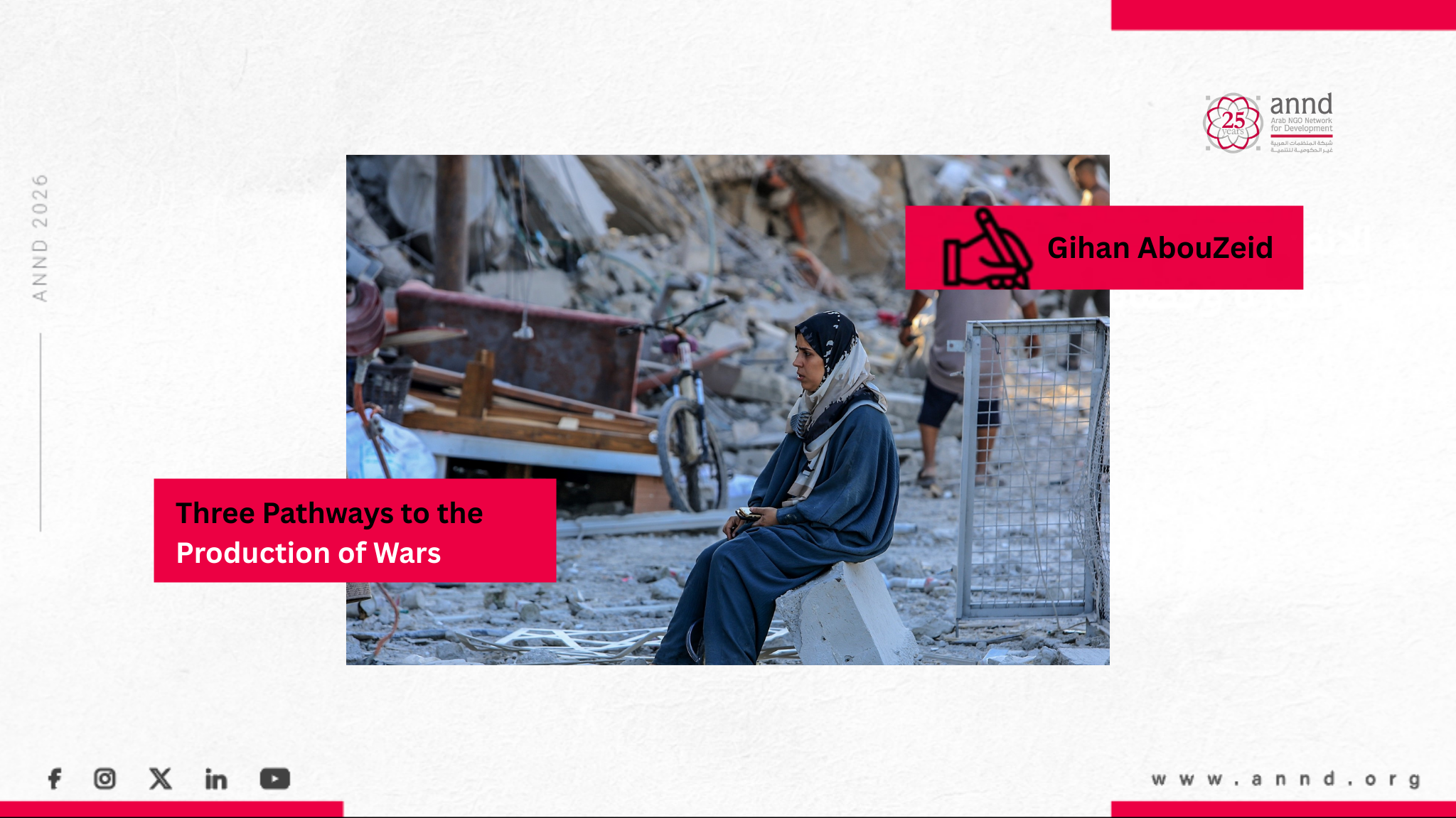
Three Pathways to the Production of Wars
The situation of women in the Arab region today cannot be understood as an isolated phenomenon. Rather, it represents another chapter in an ongoing narrative of structural exclusion. What links the Egyptian, Tunisian, and Moroccan rural women whose labor remains absent from property records, the Iraqi parliamentarian trapped in the web of sectarian politics, and the Lebanese or Syrian feminist accused of “betraying priorities,” is a dense thread of historical and political transformations that have reproduced systems of guardianship in modern forms.
Today, however, this thread tightens amid the smoke of the major wars sweeping the region. These wars no longer merely fragment geography; they have effectively collapsed all rights over the heads of entire populations—from Gaza and Lebanon to Iran—placing the region as a whole in the grip of comprehensive militarization that leaves neither citizenship nor women any safe space.
This dossier is being issued at a moment when families are being uprooted from their homes, villages from their borders, and nations from their histories. The articles in this issue emerge in a decisive historical moment in which international dominance has shed its masks and appears openly, challenging international law, humanity, and the inhabitants of the planet in a moment of arrogance that will not last. The contributions in this file connect three interrelated dynamics whose interaction ultimately builds bridges that lead to the furnace of war and the hell of protracted conflict
First Pathway: Occupation and the Militarization of Existence
“Independence” as a Cover for DependencyBetween classical colonialism and the later interventions of the United States lie decades marked by weak states, internal conflicts, and deep social and sectarian divisions. The interaction between internal and external factors has shaped the trajectory of Arab states.
As state institutions collapse, tribes, sects, and militias emerge as alternative systems of protection—structures that are themselves built upon rigid patriarchal hierarchies.
At the moment when wars erupt and the public sphere is transformed into a battlefield, the rubble does not fall only on buildings; it also falls on decades of struggle to secure even limited rights. What the Arab region is witnessing today—from Gaza to Lebanon, Sudan, Yemen, and Syria—is not simply a set of border conflicts, but a systematic dismantling of citizenship in favor of primary identities.
With this deliberate erosion, sectarianism and tribalism have re-emerged not as organic social choices but as instruments of domination, deployed by international and regional powers to fracture national cohesion and maintain regional dependency. The logic of sectarian politics requires rigid internal cohesion that leaves little space for rights-based debates that might threaten the group’s cohesion or disturb the balance of power among competing sects.
This dynamic is particularly evident in post-2003 Iraq, where the system of sectarian power-sharing was not merely a local outcome but part of a broader political project that fragmented national identity.
What is unfolding today in Syria, Yemen, and Sudan follows the same trajectory. Women are increasingly pushed to define themselves through political or tribal trenches, fragmenting feminist solidarity across social and political divides. The militarization of public space and the instrumentalization of sectarianism by global powers to dismantle the concept of the state have created what can only be described as a deadlock in rights.
In this context, women are not only victims of “local culture.” They are also victims of international political engineering that has turned identity-based conflict into a tool of domination—and women’s rights into a negotiable casualty of maintaining this system.
Second Pathway: Legal Patriarchy
When Colonialism Codified MarginalizationThe story of women’s exclusion in our region begins with a quiet moment in history: the moment when social custom was transformed into binding legal text. Successive colonial systems—from the Ottomans to the British and the French—were not merely military powers passing over territory; they acted as legal engineers, reshaping the relationship between individuals and the state.
Colonial rule established what might be called “mediated citizenship”—a legal philosophy in which the state does not engage with individuals directly but rather with male heads of households as intermediaries.
This legacy did not disappear with the withdrawal of colonial armies. Instead, it became embedded in national legislation. Land reform laws and personal status laws adopted after independence remained faithful to this colonial logic, which views women as dependents rather than full partners in citizenship. Marginalization thus shifted from a changeable social custom into a rigid legal structure through which the state grants rights primarily to men, leaving women with fragments of promises.
During the Ottoman period, tax registers were designed to record only the names of male household heads. Women’s labor in both the fields and the household remained invisible, translating into no property or ownership rights. European colonial rule did not dismantle this system; it reinforced it, relying on local patriarchy as a mechanism of governance.
Colonial powers thus created a distorted form of welfare state in which men were recognized as producers and citizens, while women were treated either as dependents or as individuals requiring guardianship.
This legal patriarchy did not vanish with independence. It was inherited almost entirely by the new national states. The exclusionary mindset moved from the colonial tent into the corridors of modern parliaments, leaving us today with a vast body of legislation that speaks the language of equality in its preambles while reproducing discrimination in its procedural details.
This legacy is particularly visible today in the situation of agricultural women workers and seasonal laborers in countries such as Egypt, Yemen, and Morocco.
Consider the paradox between law and reality. A state may pass labor legislation—such as recent amendments in Egypt in 2025—that formally remove the exclusion of agricultural workers from legal protection. Yet the underlying legal philosophy remains incapable of seeing them. Labor law is designed around the idea of a fixed workplace and a written contract—conditions that rarely apply to rural women who leave their homes at dawn in a contractor’s vehicle to work on land they do not own.
When a worker attempts to claim rights such as health insurance or maternity leave, she collides with the law’s institutional invisibility. Within tax and insurance systems she effectively does not exist, because her employment relationship still passes through a male intermediary—the contractor—much as it once passed through the Ottoman tax collector centuries ago.
She works, produces, and contributes to the national economy, yet in the ledgers of rights she remains a legal zero.
This example demonstrates that the problem is not simply a lack of legislation. Rather, the legal imagination itself continues to resist recognizing women as autonomous individuals. The struggle, therefore, is not only about new laws but about recognition—about dismantling the historical legacy that positioned men as the sole channel through which rights flow from the state to society.
Third Pathway: “Symbolic Feminism” as a Mask for Forced Modernization
While the region is burdened by militarization and the erosion of state institutions, another more subtle phenomenon has emerged: the appropriation of feminist discourse.
Exclusion is no longer practiced solely through overt prohibition; it increasingly operates through co-optation. Governments and international institutions adopt the appealing language of “women’s empowerment” and “equality,” yet strip these concepts of their political and rights-based substance, transforming them into cosmetic tools for international audiences or for fulfilling the conditions of funding and economic modernization.
This dynamic produces what might be described as symbolic feminism—a situation in which women’s presence in high political positions or parliamentary seats is celebrated while the laws that govern the lives of millions of women, such as labor legislation and personal status laws, remain unchanged or even regress.
It is a strategy of modernist display: a polished façade concealing a fragile and unequal rights structure beneath. Within this framework, women are encouraged to serve as ambassadors of modernization in international forums while being deprived of the tools for genuine mobilization on the ground, including the ability to form independent unions or feminist movements capable of reshaping the social contract itself.
This dynamic is visible in many of the region’s new development visions, which emphasize women’s economic participation, entrepreneurship, and digital transformation while drawing firm red lines around civil and political rights.
Consider the paradox of the “productive woman.” Women are encouraged to enter the labor market and innovate. Yet when these same women demand stronger workplace protections against harassment, the right to pass nationality to their children, or protection from domestic violence, such demands are often dismissed under the language of cultural specificity or national priorities.
This discourse fragments women’s rights—embracing what contributes to economic growth and the image of a modern state, while rejecting what challenges patriarchal power structures or long-standing alliances with conservative forces.
During moments of war or economic crisis, this co-optation becomes a tool to suppress independent feminist mobilization. Feminists who refuse such cosmetic modernization are accused of advancing “foreign agendas,” while the real agenda is the one that reduces women to economic indicators and denies them the right to exist as political actors with their own independent voice.
Reading these three pathways together reveals that the struggle of Arab women is not only a struggle against the past. It is also an engagement with a complex colonial and political present.
The central challenge today lies in reclaiming both language and agency, and in reaffirming that women’s rights are not an optional appendix to be discussed once states achieve stability. Rather, they are the very foundation upon which any sovereign and democratic national state must be built.
Recent publications
Who Enters the Age of Electricity? And Who Pays the Price? - Habib Maalouf