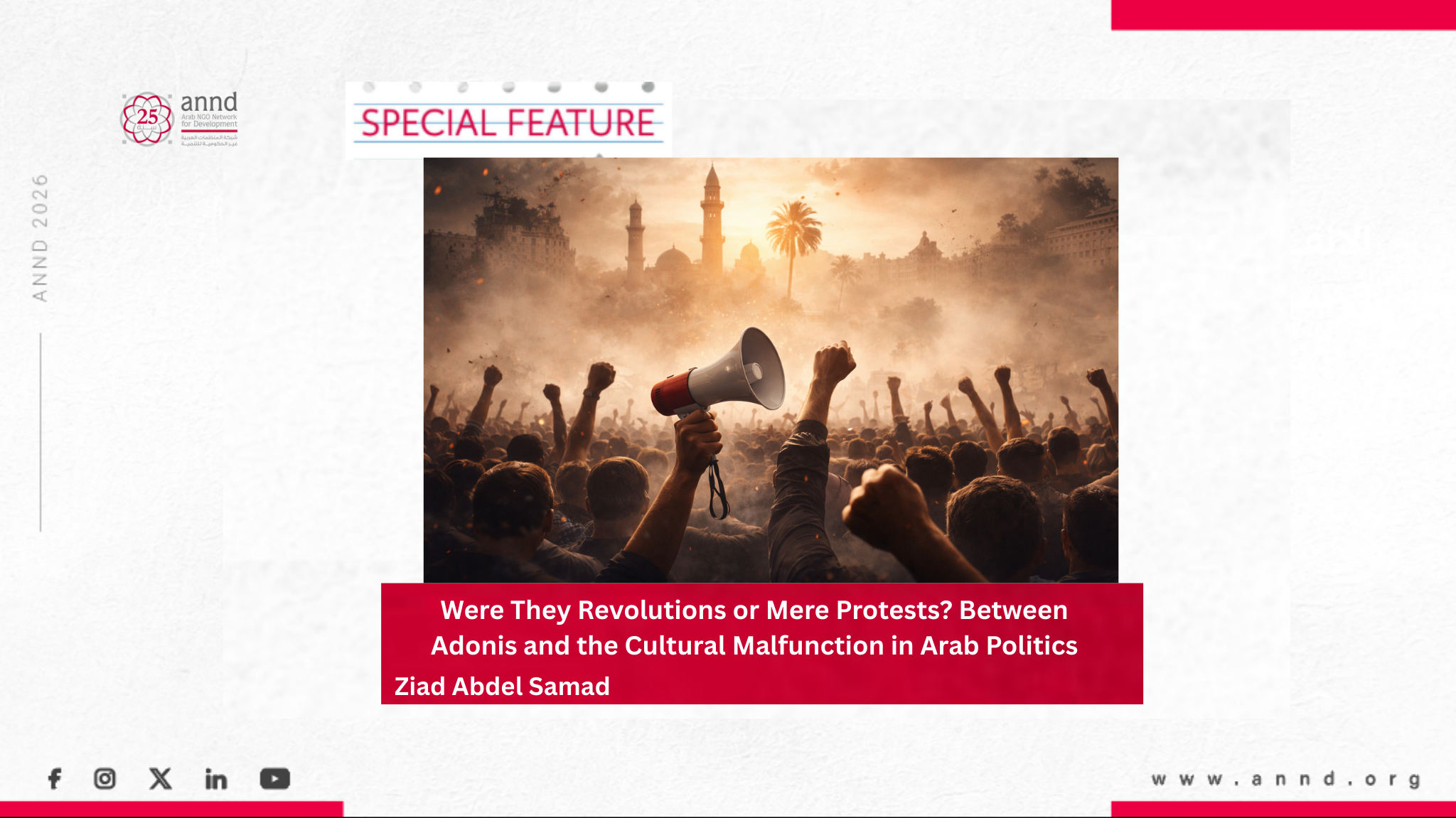
Were They Revolutions or Mere Protests? Between Adonis and the Cultural Malfunction in Arab Politics - Ziad Abdel Samad
Were They Revolutions or Mere Protests?
Between Adonis and the Cultural Malfunction in Arab Politics
For years, the Syrian poet and intellectual Adonis has reiterated his view that what the Arab region witnessed after 2011 were not “revolutions” but rather “protests.” At first glance, this judgment may seem shocking, yet it is not a political verdict as much as it is a cultural–sociological definition of the concept of revolution. In his view, a revolution is not the overthrow of a political regime or the replacement of one leadership with another, but rather a transformation in the deeper structure: social relations, political economy, and the cultural system that produces power and continuously reproduces it.
Some countries toppled the heads of regimes or replaced their leaders, but the social system remained intact, as did the mental and value systems that underpin authority: from obedience to group loyalty, from sanctity to rent-seeking, and from subjects to citizens suspended in a space of transition.
In most experiences, the state remained in its old form: either a deep state that reabsorbed change, as in Egypt; or a collapsed state in which no alternative was built, as in Libya, Yemen, and Syria; or a state searching for a new formula without touching the cultural root, as in Tunisia. No economic revolutions were born, nor were there changes in production patterns, redistribution of power, wealth, or symbolic capital. In other words, the “nature of power” remained the same, even if its faces changed.
Here another factor emerges, no less sensitive: Arab political culture and its historical weight. Its core—across most of its manifestations—is based on theories of obedience and allegiance rather than contract and accountability. Authority is not a function but a form of sanctity, and opposition is not a right but a departure from the collective. A long legacy of jurisprudence, power, the sultanistic state, tribe, and sect has entrenched a vertical relationship between ruler and ruled, and between the state and society. In such a context, political change without cultural change resembles repairing the roof of a house whose foundations are cracking.
Nevertheless, what occurred cannot be reduced to mere “protests,” nor can it be approached with a fatalistic tone. The transformations produced by waves of protest are not measured solely by their institutional outcomes, but also by the breaking of taboos: breaking fear of authority, normalizing the idea of overthrowing a ruler, expanding critical space toward religion and politics, and transforming the individual into a political actor after decades of forced exclusion. These were all phenomena that were impossible before 2011, and although they did not produce a complete revolution, they generated what can be described as a “fracturing of the traditional legitimacy of authority.” This is a historical effect that cannot be easily erased.
Between Adonis’s vision and the reality of the region lies a complex distance. He believes that a revolution is incomplete unless structures—not symbols—are overturned, and unless the cultural root—not merely the political surface—is addressed. This is a philosophical position more than a political assessment. Yet major historical experiences—from France to Iran—demonstrate that revolutionary paths are not measured by a single moment, and that political change may precede cultural change or follow it, advancing one step and retreating two before settling into a new form.
2026: Tasks of the Next Phase
More than a decade after the launch of the first wave of protests, the Arab world reaches 2026 facing a dual scene: regimes that have entrenched traditional tools of control and deep-state structures, and societies that have lost illusions of rapid change but not the legitimacy of their questions. The confrontation today is no longer between “revolution” and “regime,” as it appeared in 2011, but between a reality slowly collapsing and societies searching for a new meaning of politics beyond the language of crowds and within the language of cumulative action.
In this context, the tasks of the current phase come to the forefront—what may be considered the conditions for the next wave of transformation:
- • Deconstructing the cultural structure of authority in a way that allows a shift from obedience to citizenship, and from sanctity to accountability.
- • Liberating the economy from rent and clientelism, as there can be no revolution without change or reform in the economy.
- • Rebuilding the public sphere between repression from above and fragmentation from below.
- • Transforming the individual from a subordinate and member of a subject population into an active political citizen through participation and accountability, not through symbolism and slogans alone.
- • Linking the national with the regional and global, as the boundaries of the nation-state alone are no longer capable of producing solutions.
These tasks may not constitute a revolutionary project in the classical sense, but they are the conditions for any future transformation capable of breaking the vicious cycle between eruption and retreat. Perhaps here lies the paradox: what began more than a decade ago as “protests,” in Adonis’s terminology, may not be completed until the delayed cultural revolution finally matures. History does not move in a straight line, but it also does not linger for long at the same point.
Recent publications