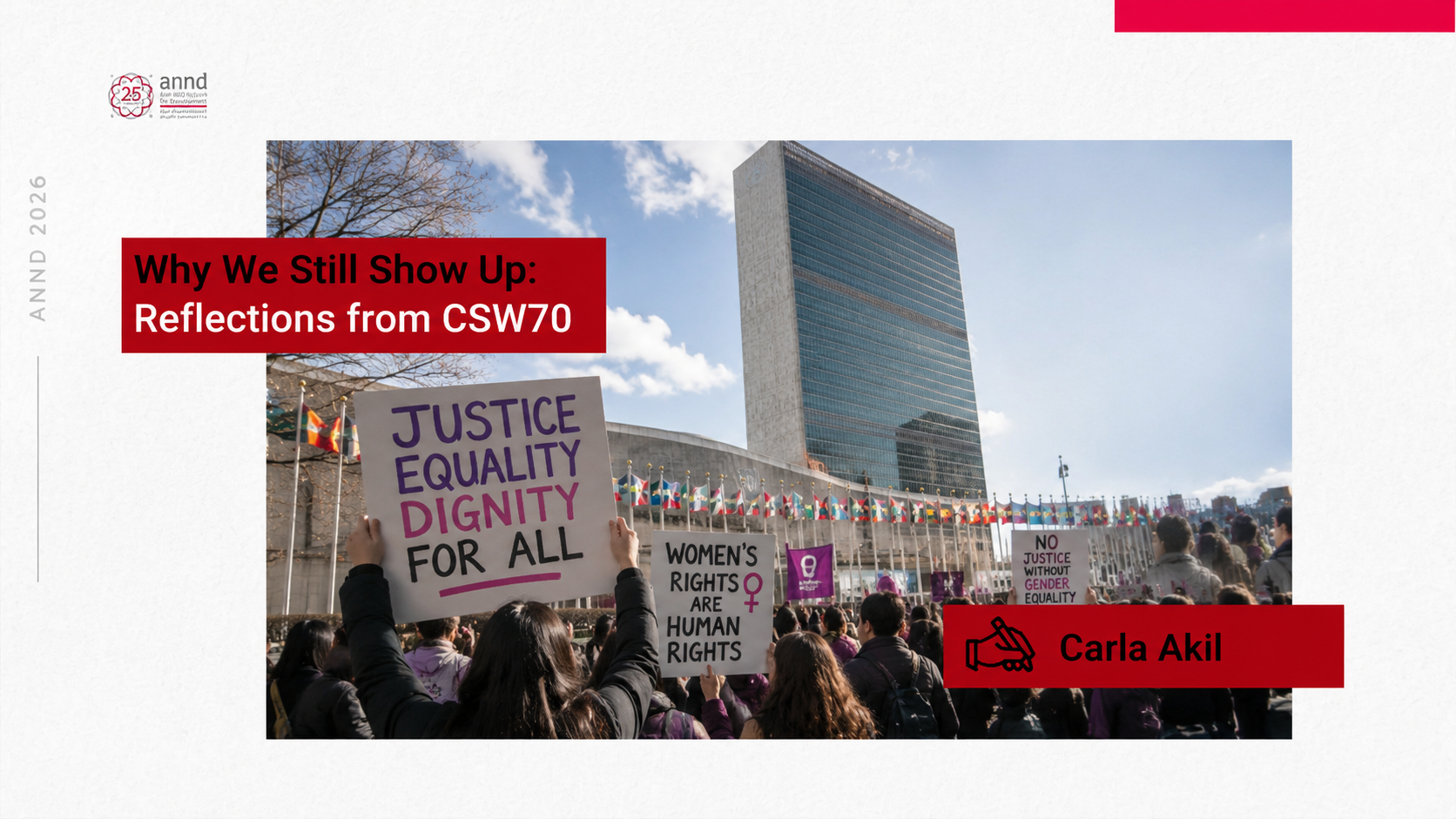

Why We Still Show Up: Reflections from CSW70
This year marked my fourth participation in the Commission on the Status of Women (CSW), the United Nations’ largest annual gathering dedicated to gender equality and women’s rights. Every year, governments, UN agencies, civil society organizations, and activists convene in New York to assess progress, negotiate priorities, and advocate for women’s rights globally. This year’s session, CSW70, focused on ensuring and strengthening access to justice for all women and girls, including through inclusive and equitable legal systems, the elimination of discriminatory laws, policies, and practices, and addressing structural barriers. The review theme also revisited women’s participation in public life and the elimination of violence against women and girls.
The theme felt particularly urgent at a moment when many women across the world, especially in conflict-affected regions such as ours, are confronting shrinking civic space, attacks on rights, weakened legal protections, and growing barriers to justice and accountability. Across the SWANA region specifically, discussions on women’s rights cannot be detached from the realities of war, displacement, occupation, economic collapse, and authoritarianism. These crises shape women’s everyday lives, access to safety, mobility, healthcare, livelihoods, and political participation in profound ways.
As usual, representation from our region was extremely limited. In fact, over the years, I have noticed participation from the SWANA region steadily decreasing. This decline is understandable for many reasons. First, obtaining a US visa has become increasingly difficult, expensive, and unpredictable for many activists, researchers, and civil society actors from our region. Beyond visa refusals and delays, there is also a growing fear among many of being stopped, interrogated, or denied entry at US airports. These concerns are not hypothetical; they shape whether people are even willing to attempt the journey.
At the same time, our region has been experiencing ongoing war, displacement, and instability. In my own case, the night before I was supposed to travel to New York, a bombing struck at the end of my street, in an area that is considered “safe” compared to other areas in Beirut. We had to change our tickets at the last minute, and finding alternatives became nearly impossible. Prices had tripled overnight. For many others, attending CSW was simply not feasible financially, logistically, or emotionally. Nonetheless, despite everything, we made it there. In many ways, that reality itself shaped how many of us experienced the space this year.
One of the most striking observations from this year’s CSW was the visible difference between the official UN side events and the parallel events organized by civil society organizations. While both formally exist within the CSW framework, they often operate very differently politically.
The UN side events, typically organized by member states and UN agencies, felt noticeably depoliticized, which is unsurprising. Discussions often remained highly technical, cautious, and disconnected from the urgency of the political moment. There was significant emphasis on policy language, institutional commitments, and development frameworks, but far less willingness to directly confront the realities undermining women’s rights globally. Conversations around militarization, attacks on civic space, state violence, repression, and the rise of anti-rights movements were often diluted or absent altogether.
In contrast, many of the parallel events organized by feminist organizations and civil society actors were far more direct, urgent, and politically grounded. These spaces openly addressed attacks on sexual and reproductive health and rights (SRHR), the criminalization of feminist organizing, the protection of women human rights defenders, digital surveillance, and the coordinated rise of anti-rights actors globally. These discussions felt significantly more reflective of the realities many feminists are navigating today.
This growing tension between institutional discourse and grassroots feminist realities has become increasingly visible over the years. One incident from last year’s CSW remains particularly telling. During an SRHR-focused event, individuals affiliated with anti-abortion groups deliberately disrupted the session through the Mentimeter platform used for audience participation. They flooded the screen with statements accusing participants of promoting “baby killing” and other inflammatory rhetoric. When organizers confronted them and requested security intervention, they denied responsibility despite the disruption being clearly coordinated.
What stood out most was not only the disruption itself, but the level of organization behind it. Anti-rights groups today are highly strategic, transnationally connected, and extremely well-funded. They invest heavily in advocacy, lobbying, digital campaigns, and coordinated interventions within international spaces such as the UN. Feminist and progressive movements cannot afford to underestimate this reality. While our politics and values are fundamentally different, there is something important to learn from the level of coordination, long-term planning, and resource mobilization these groups have developed.
Another major reflection emerging from this year’s CSW concerns the broader question many activists raised around the purpose and effectiveness of the space itself. Many individuals and organizations chose to boycott CSW this year altogether. Their reasons were varied and understandable: visa restrictions, the inaccessibility and cost of participation, frustration with the limitations of UN processes, and growing skepticism regarding the ability of international institutions to meaningfully respond to ongoing atrocities and rights violations.
These critiques are valid. There is increasing frustration with multilateral spaces that often appear disconnected from realities on the ground, particularly for communities experiencing war, occupation, forced displacement, and economic devastation. Many activists question whether these forums still hold transformative potential, or whether they risk becoming symbolic exercises disconnected from material political change.
At the same time, this year, I left CSW convinced that abandoning these spaces entirely would be a mistake. We are operating within a context of rapidly shrinking civic and political space globally. Feminist organizing is under attack in many parts of the world. Human rights defenders are being criminalized. Funding for feminist and rights-based work is becoming increasingly precarious. Anti-rights actors are aggressively expanding their influence within international institutions and policy spaces.
Under these conditions, we cannot afford to vacate the few global platforms where feminist voices can still intervene, organize, document, resist, and build solidarity. These spaces are imperfect, unequal, and often deeply frustrating. But if feminist movements withdraw completely, we leave these arenas open for anti-rights actors to dominate uncontested.
That, perhaps, is one of the most important lessons I carried with me from this year’s CSW. In a moment of shrinking civic space and growing attacks on feminist organizing, abandoning these platforms entirely would mean surrendering them to anti-rights actors. These spaces would not exist without decades of feminist struggle, advocacy, and organizing. We cannot simply hand them over. Remaining present, contesting these spaces, and refusing to leave them behind is itself part of the struggle.
Recent publications