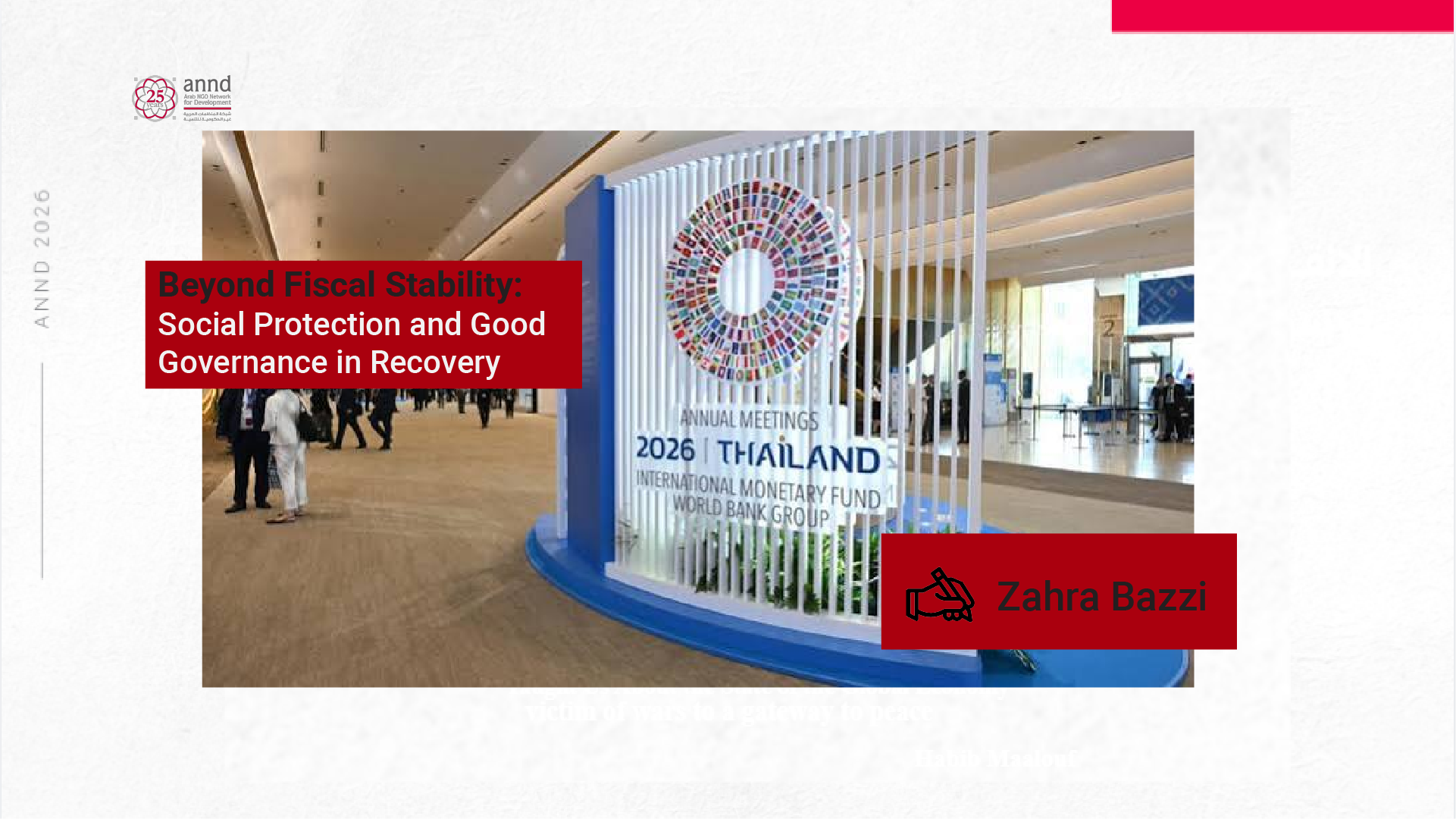
Beyond Fiscal Stability: the Social Agenda and Good Governance at the Heart of Recovery and Reconstruction - Zahra Bazzi

Beyond Fiscal Stability: the Social Agenda and Good Governance at the Heart of Recovery and Reconstruction
Reflections from the 2026 IMF–World Bank Annual Meetings in Bangkok
As I prepared for my participation in the 2026 IMF–World Bank Annual Meetings in Bangkok, two developments in Lebanon particularly stood out. In September 2026, the International Monetary Fund (IMF) welcomed the draft 2027 budget’s target of a balanced fiscal position and measures to strengthen tax compliance. In the same month, a UNICEF assessment revealed a starkly different reality: four in five households were struggling to afford basic necessities.
These assessments expose the gap between macroeconomic stabilisation and social recovery. A country may improve its fiscal position while its population continues to struggle to meet basic needs. Another dimension that help understand those gaps in governance. In June 2026, the IMF published its Governance and Corruption Diagnostic for Lebanon, highlighting structural weaknesses in public financial management, oversight, accountability and the functioning of state institutions. These weaknesses have direct social consequences, they affect how resources are collected and spent, who benefits from public policies, and whether citizens can hold decision-makers accountable.
These issues shaped my participation, on behalf of the Arab NGO Network for Development (ANND), in the Annual Meetings. Through sessions at the Civil Society Policy Forum (CSPF), which ANND co-hosted with national and international civil society organisations, and exchanges with civil society representatives and international financial institutions (IFIs), we examined the political economy of fiscal decisions, governance and accountability, social protection, and the challenges of recovery and reconstruction.
Governance and the political economy of fiscal decisions
Fiscal balances and debt ratios matter, but they do not tell the whole story. The central question is not simply whether a country can meet its financial obligations, but how it mobilises and distributes resources, which interests its policies serve, and who ultimately bears the costs of economic crises and adjustment.
Fiscal decisions reflect power relations and institutional arrangements. They determine which economic activities are taxed, which interests benefit from exemptions, which public services receive investment, and how public spending is monitored. Where oversight is weak and accountability mechanisms are ineffective, public resources can be mismanaged and the costs of institutional failure transferred to households.
Lebanon’s electricity crisis illustrates these dynamics. Years of inadequate public electricity supply have forced households and businesses to rely on private generators, adding substantial costs to already strained budgets. As the state fails to provide reliable and affordable essential services, private actors fill the gap. Over time, these arrangements can become entrenched, creating economic interests that benefit from persistent public-sector failures and may resist reforms that threaten their position.
The IMF’s governance diagnostic provides an important starting point for addressing such institutional weaknesses. But governance reform must go beyond technical improvements. Transparent budgets, effective oversight, access to information and public accountability are essential to ensuring that resources serve collective needs and that reforms deliver equitable outcomes.
Fiscal adjustment, debt and social rights
Fiscal consolidation is often presented as necessary to restore stability, manage public debt and rebuild confidence. Yet its consequences depend on how adjustment is designed and how its costs and benefits are distributed.
Across the Arab region, governments face growing financing pressures alongside immense social needs. In Egypt, civil society budget analysis estimated that interest payments on domestic and foreign debt would absorb approximately 87% of expected tax revenues in the 2025/26 fiscal year. Such pressures illustrate the difficult choices governments face when debt servicing absorbs resources also needed for healthcare, education, social protection and productive investment.
Debt sustainability must therefore be assessed not only in terms of a country's capacity to repay creditors, but also its capacity to fulfil its economic and social rights obligations. This requires greater attention to progressive taxation, tax evasion, unjustified exemptions and inequitable spending priorities, rather than relying disproportionately on expenditure cuts or measures that increase the cost of living.
Social protection as a foundation of recovery
The consequences of economic decisions become especially visible when households lose livelihoods, public services become inaccessible and living costs rise. In Lebanon, the AMAN cash assistance programme provides important support to eligible households, but its monthly assistance ceiling of USD 125 illustrates the limitations of relying on targeted transfers alone when families face multiple and rising costs.
Social protection is a right and a public responsibility, not merely compensation for fiscal adjustment or expenditure conditional on available fiscal space. Universal, rights-based systems require sustained public investment, progressive domestic resource mobilisation and international financing that strengthens national institutions and ensures long-term coverage.
Cash assistance cannot substitute for accessible healthcare, income security, quality public services and protection throughout people's lives. In conflict-affected countries, humanitarian assistance remains essential, but it should contribute to strengthening national systems rather than perpetuating fragmented programmes dependent on short-term funding.
Reconstruction must not reproduce the inequalities of the past
Recovery and reconstruction are not simply about restoring infrastructure, economic activity and investor confidence. They also shape the economic model that emerges from crisis.
The World Bank Group has a new 2026–2030 Strategy for Engaging in Fragility, Conflict and Violence (FCV)-Affected Settings. It places considerable emphasis on job creation and private-sector-led recovery in fragile and conflict-affected situations. Employment and investment are essential, but the number of jobs created alone does not determine the success of recovery. Job quality, wages, working conditions, labour rights and access to social protection matter just as much.
Lebanon illustrates why job creation and social protection must be addressed together. Programmes such as AMAN provide essential cash assistance to vulnerable households, but targeting the poorest cannot compensate for a dysfunctional contributory social protection system. The National Social Security Fund (NSSF), which is intended to provide social insurance coverage for workers in the formal sector, faces significant challenges in ensuring effective access to benefits. In this context, creating jobs does not automatically translate into greater social protection: workers may enter employment without gaining effective access to social insurance. This highlights the limits of an approach that focuses on targeted transfers and job creation without addressing the institutions that connect employment to social protection.
For the World Bank, policy coherence should therefore mean more than financing job creation alongside targeted assistance. It should also involve supporting the recovery and strengthening of contributory social insurance systems, including the NSSF, while expanding effective coverage and addressing barriers that exclude workers, particularly those in informal and precarious employment.
Reconstruction financing also shapes who benefits from recovery. In Lebanon and Syria, prioritising projects that offer quick returns while neglecting public infrastructure, essential services and local productive capacities could reinforce existing inequalities and deepen dependence on private provision. Reconstruction should instead strengthen the foundations of a more inclusive and resilient economy, ensuring that its benefits extend beyond investors and economic growth to workers, households and communities.
From financial stability to a just recovery
ANND’s participation in the Annual Meetings reaffirmed the importance of connecting global economic debates with the realities experienced by people across the Arab region. Civil society engagement is essential to ensuring that economic decisions reflect social needs and public responsibilities, and that governments and IFIs are held accountable for their commitments and outcomes.
Economic recovery cannot be measured primarily through fiscal balances, debt indicators and investment volumes. It must also be assessed through access to essential services, the quality of employment, the reduction of inequalities, the accountability of public institutions and the state's capacity to fulfil its obligations.
For the Arab region, where conflict and economic crises continue to place immense pressure on people and public institutions, recovery cannot mean simply restoring financial stability or attracting private investment. It must strengthen public institutions, expand social protection, support productive transformation and ensure that the benefits of recovery are shared fairly.
Governance, social protection and economic justice are interconnected foundations of a just recovery.These are not objectives to be postponed until stability has been achieved; they are essential to achieving it sustainably.
Recent publications
Resilient for Whom? The IMF's October 2026 Outlook and the Poor of MENA - Khalil Gebara