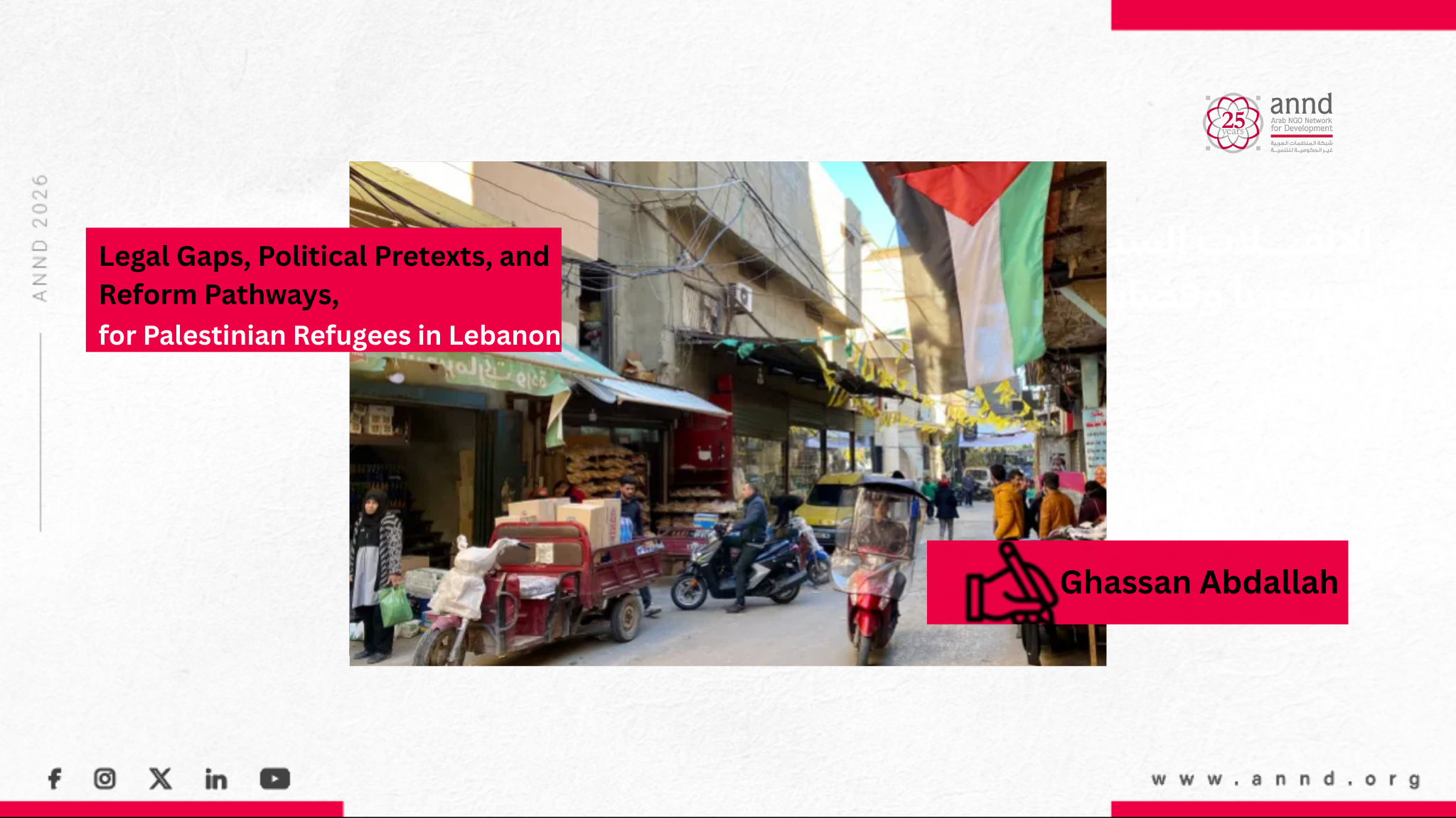
From Prolonged Institutional Discrimination to Legal Reform: Legal Gaps, Political Pretexts, and Reform Pathways for Palestinian Refugees in Lebanon in the Fourth UPR Cycle
From Prolonged Institutional Discrimination to Legal Reform: Legal Gaps, Political Pretexts, and Reform Pathways for Palestinian Refugees in Lebanon in the Fourth UPR Cycle
Palestinian Refugees in Lebanon for decades, after they have been arbitrarily exiled of their homeland, their descendants in Lebanon continued to face systematic and compounding institutional discrimination. They are denied basic civil, political, and socioeconomic rights, including the right to work, to own property, and to access public services, among others.
This discrimination persists in the absence of a clear legal definition of the status of Palestinian refugees; absence of clear unified definition of a term always comes up whenever Palestinian refugees issues discussed “TAWTIN” in confusing of its meaning with (settlement - resettlement - citizenship - naturalization); and through the absence of legislation and implementing decrees regulating their rights and duties in Lebanon.
These policies are often justified under the pretexts that: Lebanon is a transit, non-settlement country; Granting the rights leads to “Tawtin”, which would threaten the sectarian and religious balance; preventing “Tawtin” for the matter of protecting Palestinian national identity.
Believing in the important of the Universal Periodic Review (UPR) as an opportunity to reaffirm a genuine commitment to human rights rather than a mere procedural obligation. It should function as a critical mechanism for accountability and advocacy, generating practical, implementable recommendations that serve as a roadmap for reforming public policy, strengthening the rule of law, ensuring accountability, and advancing social justice and substantive equality for all citizens and residents of Lebanon.
Despite the ongoing uncertainty in Lebanon and the wider region, we have no choice but to hold on to every glimmer of hope. Today, several developments have created a ray of hope, such as: The new era and the oath; The new government and ministerial statement; The Lebanese–Palestinian summit and its outcomes; the good willingness of the Lebanese–Palestinian Dialogue Committee (LPDC); And the most important ones, Lebanon being under increased international scrutiny and pressure to implement reforms.
Emphasizing the important role that civil society aspires to in the process of enforcing and monitoring human rights conventions, the stakeholder organizations took this opportunity to provide comments and contribute to the universal periodic review UPR process within the four review cycles of the Lebanese state, continuing the efforts of the coalition of civil society organizations and associations and all key partners leading the thematic sectors coordinated by ANND.
Palestinian Human Rights Organization PHRO, submitted the 4th joint UPR report in July 2025, in partnership with alliance of 15 international, regional, and national (Palestinian /Lebanon’s), organizations and networks, concerned with the promotion and protection of human rights development for Palestinian refugees in Lebanon.
During the preparation of the national consultation, PHRO and its Palestinian CSOs partners , whom it represents, agreed on the: key recommendations, advanced question, and the messages to be delivered in the upcoming advocacy phases.
In that regard, PHRO attended a couple of dialogue panels on the social and economic rights at the Lebanese Parliament coordinated by ANND; participated in the UPR session organised by the EU Delegation on the side of the monthly meeting with member States; participated along with CLDH and EuroMed Right in a ten bilateral meeting with influential embassies in Lebanon coordinated by the EuroMED Right; and prior to the PHRO participation in the UPR Pre-session, PHRO in partnership and support of FIDH, EuroMed Right, CIHRS, organised and participated in an another ten bilateral meeting with an influential UN permanent missions in Geneva.
Prior to Lebanon UPR review at HRC on January 19th 2026 in Geneva, PHRO in coordination with the partners, ANND; FIDH; CIHRS; GCHR; CCLS; and Adyan, organised and participated and delivered a statement in behalf of its Palestinian CSO’S partners that included the agreed upon key recommendations, advanced questions and messages (Annex 1).
Based on PHRO’s follow-up and direct observation of the review process in Geneva, and despite the clear interest demonstrated by the international community throughout our advocacy efforts and bilateral meetings, the recommendations delivered during Lebanon’s UPR review did not reach the level required to adequately address the situation of Palestinian refugees in Lebanon. With the exception of the constructive and welcomed recommendations put forward by Norway, Sweden, and the Palestinian delegation, the review notably lacked explicit and targeted recommendations concerning the longstanding and systematic discrimination faced by Palestinian refugees in Lebanon.
Nevertheless, the commitment expressed by the representative of the LPDC, as part of the official Lebanese delegation, to advance a rights-based approach to the situation of Palestinian refugees and to revive a unified Lebanese vision toward their status and rights constitutes a significant political development. This commitment, if translated into concrete policies, legislation, and implementation measures, provides an important foundation for sustained, rights-based advocacy and continued engagement with both Lebanese authorities and the international community in the post-UPR phase.
Recent publications