In the Davos 2026, Climate Change Has Become a New Investment in Disasters - Habib Maalouf

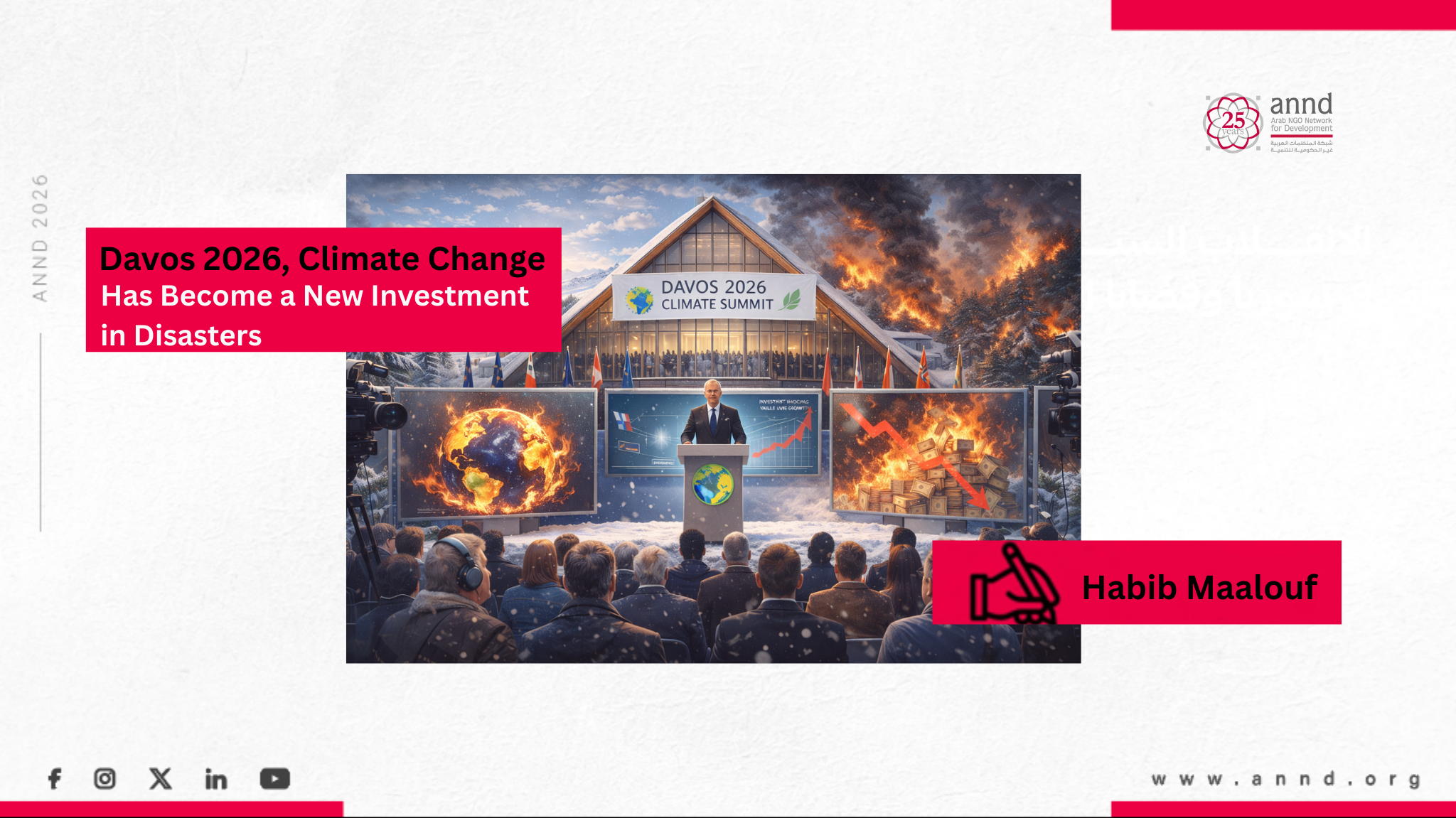
In Davos 2026, Climate Change Has Become a New Investment in Disasters
The presence of the American president dominated this year’s Davos Forum. It was as if he imposed his rhythm and his agenda on the meeting, as well as on the world. Naturally, following his withdrawal from the Paris Climate Agreement, the issue of climate change became the first victim of this meeting. It was clear that his mere participation in the forum left a large, significant, and historic imprint on this gathering that brings together the world’s economic leaders. However, this imprint will be nothing more than a hole in the Greenland ice sheet, which will quickly dissolve as the ice melts due to global warming, a phenomenon that he had previously denied.
The Davos meeting is an annual meeting of the world’s economic leaders in what is known as the “World Economic Forum in Davos.” This year (between January 19 and 23), it was held at a critical moment marking by major transformations in almost every domain, transformations whose outcomes could change or threaten the future of humanity as a whole. The choices made today regarding energy, finance, and cooperation will not only determine the future of the climate, but will also determine economic resilience and global stability for decades to come.
This year, climate issues were not presented as a separate file or from the background of saving the planet, but rather they were integrated into a broader discussion on the global economy, or more precisely, framed from the perspective of climate as an economic and investment issue—whether in terms of green investment opportunities and renewable energy, or in terms of energy transition and geopolitical security. This framing requires reexamining energy security, supply routes and chains, and related global and trade conflicts, especially given that major industrial countries have realized that the emerging conflict revolves over rare minerals used to produce high technology and renewable energy, as well as military technology and artificial intelligence.
Based on these new data, the American president’s denial of the issue of climate change and his mockery of the large imports of wind turbines from China, turbines that China itself does not use, can only be interpreted as evidence that his aggressive position toward climate negotiations and related international agreements is not so much denial as it is a delayed reaction to catch up with the renewable energy market by putting his hand on rare minerals and acquiring the ability to compete with China, which monopolizes more than 70% of their production, refining, and mining.
Evidence is no longer a matter of dispute, as some might believe. There is near international consensus that the continued expansion in coal, oil, and gas production is incompatible with the stability of the planet, and that fossil fuels remain the main driver of global warming and ecosystem degradation, creating tangible risks to food systems, public health, infrastructure, and national economies.
These risks are no longer merely theoretical. Climate disasters and the losses and damages resulting from extreme weather conditions have led to sharp increases in insurance premiums which are no longer sufficient to cover the scale of destruction. Recent disasters in the United States itself, especially the summer wildfires and winter hurricanes, have demonstrated that costs rise year after year in line with the increase in disasters, and that climate risks are increasingly reflected in how countries are rated by financial markets and in corporate calculations.
At the same time, the global transition in the energy sector has entered a decisive phase. Renewable energy technologies have become more competitive, cheaper, faster to spread, more flexible, and more accessible than fossil fuels in most regions of the world… It is no exaggeration to say that they can be a substitute for fossil fuels if the world remains on its current civilizational model that consumes energy in a massive, escalating, and unlimited way.
Nevertheless, despite the increased reliance on renewable energy and the growth of employment opportunities in the sector, the fossil fuel economy continues to exert enormous political and financial influence. This was clearly evident at the 30th Conference of the Parties (COP30) in Belém, where negotiations once again failed to reach a clear and binding commitment to phase out fossil fuels, due to the overwhelming presence of fossil fuel interest holders within the official negotiating delegations. The gap between what science demands and what politics delivers remains dangerously wide.
Davos has long been a center for discussing and shaping the future of the economy. In the 2026 edition, it did not appear that there were alliances similar to those that emerged in Belém adopting the cause of exiting fossil fuels, such as the initiative led by Colombia and the Netherlands to develop a roadmap for this transition and save the climate. The economic concerns, as always, outweigh all others, especially since the main objectives of such meetings is to find common denominators and resources, and manage trade and resource-related conflicts among major economic powers. For business and financial leaders, the question is no longer whether the fossil fuels era will end, but how it will end, who will lead, who will fall behind, and in what new direction investments will flow.
and compensation for those affected, or to engage any discussion on the moral obligation of countries that accumulated wealth through increased development, exploitation, and depletion of resources. Instead, they focus on how disasters and their consequences can be considered as new economic opportunities—despite the widespread understanding that it is no longer possible to address global and local crises in food systems, health, and economic stability separately from addressing climate change issues.
The World Economic Forum has long served as a platform for showcasing climate ambition, yet in this latest edition, it h became more focused on how to deal with damages rather than preventing them. While past panels timidly addressed how to phase out fossil fuels and limit global temperature rise, this year this topic was excluded in order to avoid angering U.S. President Donald Trump. As a result, the Davos program shifted this year towards building systems capable of withstanding damages and enhancing nature’s ability to absorb the impacts of climate change, instead of discussing how to mitigate emissions. The organizers of the World Economic Forum even chose the title “How can we build prosperity within the limits of our planet?” in order to avoid explicitly mentioning “climate change.”
It is true that the forum considered that “the energy sector transition is an economic opportunity,” and that “the transition toward an environmentally friendly economy would open commercial horizons worth $10 trillion annually and create nearly 395 million jobs by 2030, showing how sustainability can drive inclusive growth.” However, it implicitly acknowledged that major industrial countries competing for markets will continue to rely on the cheapest types of fuel, such as coal, to produce at lower costs and compete in markets—especially in renewable energy.
The World Economic Forum publishes an annual survey of expert opinions on the factors that could ignite a global crisis in the coming year. in 2024, this survey revealed that “extreme climate phenomena” were ranked as the top risk to stability. In 2025, this risk fell to second place after armed conflicts between states. This year (2026), it has fallen to third place by a wide margin, behind concerns over ongoing geo-economic confrontation—despite the fact that extreme climate phenomena have increased and new record levels of heat and climate disasters of all kinds have been recorded.
In conclusion, at the Davos 2026 conference, climate change is no longer a global moral crisis, but rather a new driver for restructuring global capitalism according to market logic and competitive advantages by those actors often accused of causing climate disasters.!
Recent publications
Who Enters the Age of Electricity? And Who Pays the Price? - Habib Maalouf