Iraqi Civic Space: Transformations of the Concept, Crises of Freedoms, and Prospects for Democratic Transition
Iraqi Civic Space: Transformations of the Concept, Crises of Freedoms, and Prospects for Democratic Transition
By Dr. Saad Salloum
The concept of civic space in Iraq has undergone significant transformations over the past two decades, reflecting the profound changes experienced by the state and society since 2003. These transformations have not been linear or stable. Rather, they have been shaped by the interaction of political transition, armed conflict, sectarian polarization, the weakness of state institutions, the expansion of civil society organizations, and the emergence of new forms of civic and political activism.
The change of the political system in 2003 opened a wide space for the establishment of civil society organizations after decades in which independent civic action had been severely restricted. Thousands of organizations, associations, initiatives, and networks emerged in different parts of the country, working in fields that included human rights, humanitarian assistance, development, women’s rights, youth, minorities, peacebuilding, transitional justice, election monitoring, and the promotion of democratic participation.
This rapid expansion created a new reality in which civil society became a visible actor in Iraqi public life. However, the numerical growth of organizations did not necessarily translate into the consolidation of an independent, effective, and sustainable civic sphere. The environment in which these organizations operated remained affected by political instability, insecurity, weak institutions, corruption, and competition among political forces over influence and resources.
From the Emergence of Civil Society to the Question of Civic Space
In the first years following 2003, much of the discussion focused on the emergence and development of civil society organizations. Over time, however, the debate expanded beyond the existence of organizations themselves to encompass the broader concept of civic space: the political, legal, social, and institutional environment within which citizens can organize, express their views, assemble peacefully, establish associations, participate in public affairs, and hold authorities accountable.
This conceptual shift is important because civic space cannot be measured simply by counting the number of registered organizations. A country may have thousands of civil society organizations while citizens and activists continue to face restrictions on freedom of expression, assembly, association, access to information, and participation in decision-making.
The real question therefore concerns the quality of the environment in which civil society operates and the extent to which individuals and groups can exercise their rights independently and safely.
A Constitutional Framework and a Complex Reality
The Iraqi Constitution provides a framework for a number of fundamental rights and freedoms related to civic space. These include freedom of expression, freedom of the press, freedom of assembly and peaceful demonstration, and freedom to establish associations and political parties.
However, the practical exercise of these rights has often been affected by the gap between constitutional guarantees and legislation, administrative practices, security considerations, and the balance of political power.
This gap has produced an environment in which rights may be formally recognized while remaining vulnerable to restriction in practice. The challenge is therefore not merely to recognize freedoms in constitutional and legal texts, but to create institutional guarantees capable of protecting their exercise.
Freedom of Expression and the Boundaries of Criticism
Freedom of expression represents one of the most sensitive dimensions of Iraqi civic space. The expansion of traditional and digital media has provided Iraqis with unprecedented opportunities to express opinions, criticize public authorities, expose corruption, and participate in public debate.
At the same time, journalists, activists, bloggers, and human rights defenders have faced different forms of pressure, including threats, intimidation, legal proceedings, defamation campaigns, and, in some cases, violence.
The boundaries between legitimate regulation and restriction of expression therefore remain contested. Broad or ambiguous legal provisions can create uncertainty and may be used in ways that restrict criticism, particularly when political or social issues are considered sensitive.
Freedom of Assembly and the Experience of Protest
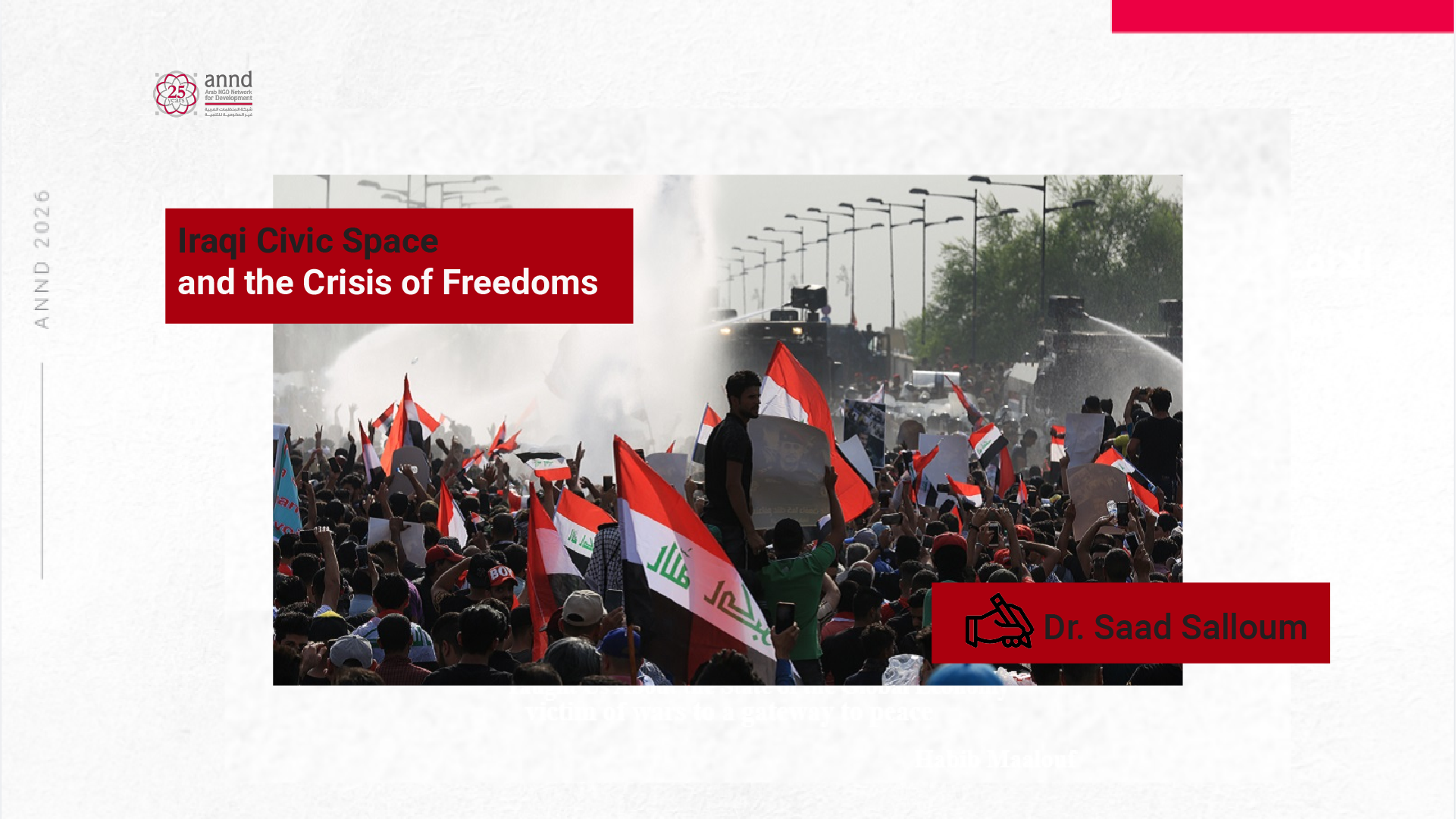
Peaceful protest has played an important role in reshaping the meaning of civic participation in Iraq. Different waves of protest have expressed demands related to public services, unemployment, corruption, political reform, social justice, and the nature of the political system.
The October 2019 protest movement represented a particularly important moment in this process. It brought large numbers of young Iraqis into public space and articulated demands that went beyond improvements in services to include broader questions concerning citizenship, accountability, political representation, corruption, and the relationship between society and the political system.
The protests also demonstrated the potential of forms of civic mobilization that operate outside traditional political and partisan structures. Young people organized through informal networks, public squares, digital platforms, volunteer groups, cultural initiatives, and other forms of collective action.
At the same time, the violence, killings, injuries, arrests, kidnappings, and intimidation associated with the protest period revealed the vulnerability of civic space when citizens attempt to challenge established political structures.
Civil Society Between Independence and Political Polarization
The independence of civil society remains another central challenge. Iraqi civil society operates within a highly polarized political environment in which political parties, state institutions, religious actors, economic interests, and armed forces exercise different forms of influence.
Some organizations have succeeded in maintaining a significant degree of independence and professional credibility. Others have faced accusations of affiliation with political parties or external actors, while some organizations have in fact been established or supported by political forces.
This complex landscape affects public perceptions of civil society and raises questions about legitimacy, representation, transparency, and accountability. It also makes it important to distinguish between genuinely independent civic action and organizations that function as extensions of political or other interests.
Funding and Sustainability
Funding represents one of the structural challenges facing Iraqi civil society. Many organizations depend on international funding because domestic sources of independent financing remain limited.
International support has enabled organizations to implement important programs, develop expertise, and respond to humanitarian and development needs. At the same time, dependence on external funding can create challenges related to sustainability, priorities, public perceptions, and the relationship between organizations and the communities they seek to serve.
The issue is not simply whether funding is domestic or international, but whether organizations have transparent governance, clear missions, diversified resources, accountability mechanisms, and the capacity to build long-term relationships with their constituencies.
Civil Society and Public Trust
The relationship between civil society and Iraqi society itself also requires attention. Civil society organizations cannot perform their democratic role effectively if they remain disconnected from the communities whose interests and rights they claim to represent.
Building public trust requires organizations to demonstrate transparency, independence, accountability, and tangible social impact. It also requires moving beyond project-based approaches toward deeper engagement with communities and their priorities.
This is particularly important in a context in which the concept of civil society itself has sometimes been misunderstood, politicized, or associated exclusively with organizations funded by international donors.
Civic Space and Democratic Transition
The future of civic space in Iraq is closely linked to the future of democratic transition. Democracy cannot be reduced to elections or formal institutions. It also requires an environment in which citizens can express themselves, organize, assemble, participate in public affairs, defend their rights, and hold those in power accountable.
The protection of civic space is not a secondary issue in the process of democratic transition; rather, it is one of its fundamental conditions. Without freedom of expression, association, peaceful assembly, and access to public debate, democratic institutions risk losing their social foundations.
At the same time, civil society itself must continue to develop its internal governance, strengthen its independence, expand its social base, and build relationships of trust with citizens.
The experience of the past two decades demonstrates that opening civic space is not an irreversible process. Rights and freedoms may expand during certain periods and contract during others according to political, security, and social circumstances.
The challenge is therefore to transform civic freedoms from temporary opportunities dependent on political circumstances into stable rights protected by law, institutions, and democratic practice.
The consolidation of Iraqi civic space requires an integrated approach that combines legal reform, institutional protection of rights, accountability for violations, the independence of civil society, sustainable resources, and broader citizen participation.
Ultimately, the strength of civic space will depend not only on the number of organizations operating in Iraq, but on the ability of citizens to participate freely and safely in shaping public life. A democratic transition that does not protect this ability remains incomplete and vulnerable to reversal.
Recent publications