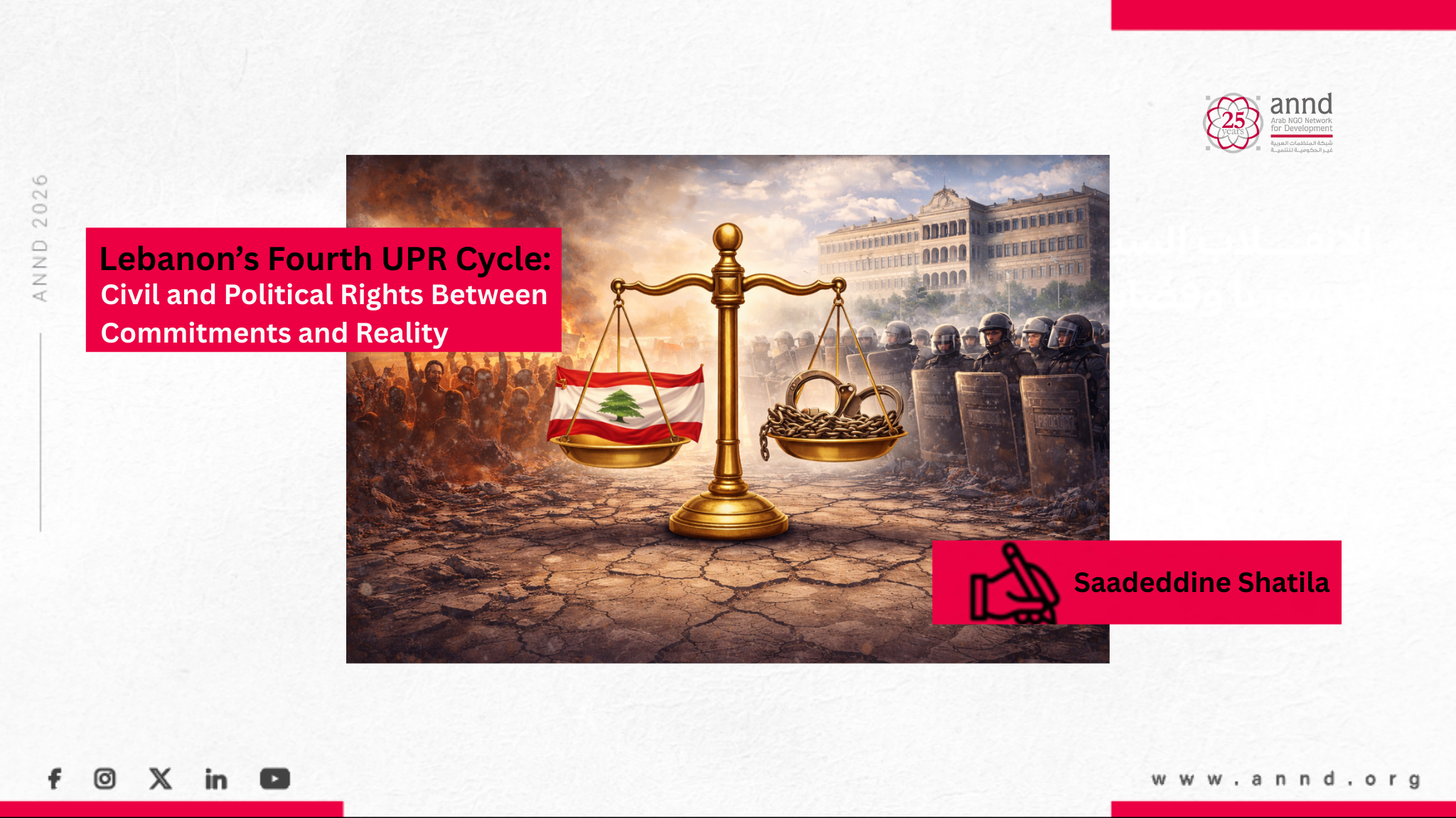
Reflections on Lebanon’s Fourth UPR Cycle: Civil and Political Rights Between Commitments and Reality - Saadeddine Shatila

Reflections on Lebanon’s Fourth UPR Cycle: Civil and Political Rights Between Commitments and Reality
Lebanon’s fourth cycle under the Universal Periodic Review (UPR) took place amid a profound political, economic, and institutional crisis that has severely weakened public institutions and deepened patterns of human rights violations. My engagement in this cycle — through individual and three joint civil society submissions, advocacy around the review, participation in the national consultation organized by OHCHR and UNDP on 12 September 2025 in Beirut, participation as a speaker on behalf of the Cedar Centre for Legal Studies (CCLS) in a side event in Geneva on 19 January 2026 organized by ANND and other civil society organizations, and attendance at the review session later that day — once again demonstrated both the importance of the UPR as an accountability mechanism and its limitations in the absence of genuine political will. This fourth cycle confirmed that Lebanon’s civil and political rights challenges are neither new nor unknown. What remains unresolved is the persistent gap between international commitments and their implementation in practice.
Civil Society Engagement in the Fourth Cycle
Civil society participation in Lebanon’s fourth UPR cycle was active, well coordinated, and evidence-based. Concerning civil and political rights, different local and international organizations submitted individual and joint reports documenting violations related to torture and ill-treatment, arbitrary detention, restrictions on freedoms, lack of judicial independence, and the use of military courts against civilians.
From a civil society perspective, there was an expectation that the national report would be shared in advance, or at least that its main priorities and key headlines would be communicated, as part of a meaningful consultation process. This would have allowed for informed engagement and ensured that the consultation went beyond a formal exercise.
The national consultation held in Beirut in September 2025, jointly organized by OHCHR and UNDP, nonetheless provided a formal space for dialogue between civil society and state institutions. While such consultations cannot replace inclusive policymaking or genuine co-drafting, they remain important for placing concerns on record and reiterating civil society expectations regarding transparency, accountability, and follow-up.
Limitations of the National Report
A key concern during this cycle relates to the national report submitted by the Lebanese authorities. While the report reaffirmed Lebanon’s commitment to international conventions and referenced existing legal frameworks, it relied largely on repetitive narrative rather than on concrete, measurable indicators of progress — particularly regarding civil and political rights.
Most notably, the report did not include numerical data on torture complaints received by the Ministry of Justice, the judiciary, or the security forces, despite the existence of complaint mechanisms within several security agencies. It also failed to clarify how many complaints resulted in investigations, prosecutions, or disciplinary measures, or what procedures were followed in response to alleged violations. This absence of data makes it impossible to assess the effectiveness of these mechanisms.
Similarly, issues such as arbitrary detention, restrictions on freedoms, lack of judicial independence, and military trials of civilians were addressed in broad terms, without benchmarks, timelines, or acknowledgment of persistent implementation failures. Overall, the report appeared more focused on restating legal commitments than on demonstrating tangible progress on the ground.
Key Civil and Political Rights Issues raised during the Review
During Lebanon’s fourth UPR cycle on 19 January 2026, civil and political rights featured prominently in the recommendations put forward by a wide range of States, reflecting persistent and well-documented structural concerns. Torture and ill-treatment, in particular, remained a central issue. Several States—including Croatia, Denmark, Sierra Leone, Switzerland, Ghana, and South Africa—called for the effective implementation and amendment of Anti-Torture Law No. 65/2017, the operationalization of the National Preventive Mechanism against Torture, independent investigations into allegations of torture, and improved detention conditions in line with the Nelson Mandela Rules.
Arbitrary detention, prolonged pretrial detention, and prison overcrowding were also repeatedly raised. Lesotho, Gambia, Libya, and Ukraine urged Lebanon to reform its criminal justice system by reducing excessive pretrial detention, expanding alternatives to detention, strengthening judicial oversight of detention facilities, and ensuring legal safeguards for detainees.
Judicial independence emerged as another core civil and political rights concern. A broad group of States—including France, Spain, Japan, Norway, Switzerland, Colombia, Romania, and Thailand—called for the adoption and implementation of laws guaranteeing the independence and impartiality of the judiciary, free from political and sectarian interference.
The use of military courts to try civilians was specifically addressed by Canada, Germany, and Sierra Leone, which recommended restricting military court jurisdiction to military personnel only and transferring all civilian cases to ordinary courts.
Freedom of expression, media freedom, and the protection of journalists and human rights defenders were raised by a wide range of States, including France, Germany, Canada, United Kingdom, Switzerland, Portugal, Austria, Ecuador, and Ireland. Recommendations focused on decriminalizing defamation, ending harassment and summonses by security agencies, adopting a media law aligned with international standards, and ensuring accountability for attacks against journalists and dissenting voices.
Implementation Gaps and the National Human Rights Action Plan
Lebanon adopted a new National Human Rights Action Plan in December 2025, a step that was referenced during the fourth UPR cycle as a positive development. In principle, such a plan should serve as a roadmap for translating international obligations into concrete reforms. However, experience with previous action plans raises serious concerns.
Earlier human rights action plans were not effectively implemented and were largely disconnected from legislative and policy-making processes. Laws adopted in recent years, including those directly affecting civil and political rights, did not reflect or respect the objectives of the action plan. Awareness of the plan itself remains extremely limited, even among members of Parliament, undermining its role as a guiding framework.
The newly adopted plan risks facing the same shortcomings if it remains a non-binding document. For it to be implemented, it must be given a clear legal and institutional status, including adoption through binding instruments such as a decree or legislation. This would allow for the assignment of responsibilities, timelines, and accountability mechanisms. Without such measures, the plan risks remaining declaratory and detached from decision-making processes.
Conclusion: From Commitments to Political Will
Lebanon’s fourth UPR cycle was not merely a procedural exercise; it was a reflection of a prolonged civil and political rights crisis. While the review demonstrated that commitments, strategies, and legal frameworks formally exist, it also made clear that the country’s core challenge lies in the persistent lack of political will to implement them. Civil society engagement throughout the cycle ensured that violations were documented, evidence was placed on record, and long-standing concerns were reiterated at the international level.
With a new government and a new president in place, Lebanon has an opportunity to demonstrate a genuine shift from rhetoric to action. This requires acknowledging shortcomings, publishing reliable data, ensuring independent and effective investigations, and holding perpetrators accountable regardless of rank or affiliation. Respect for human rights cannot remain confined to reports submitted in Geneva; it must be reflected in institutional practice, legislative choices, and the protection afforded to individuals exercising their civil and political rights.
The challenge now is follow-up. Without real implementation, accountability, and meaningful protection of civic space, future UPR cycles will continue to repeat the same concerns. Civil society will continue to document, advocate, and insist that human rights in Lebanon be respected in reality — not only in theory and in words.
Recent publications