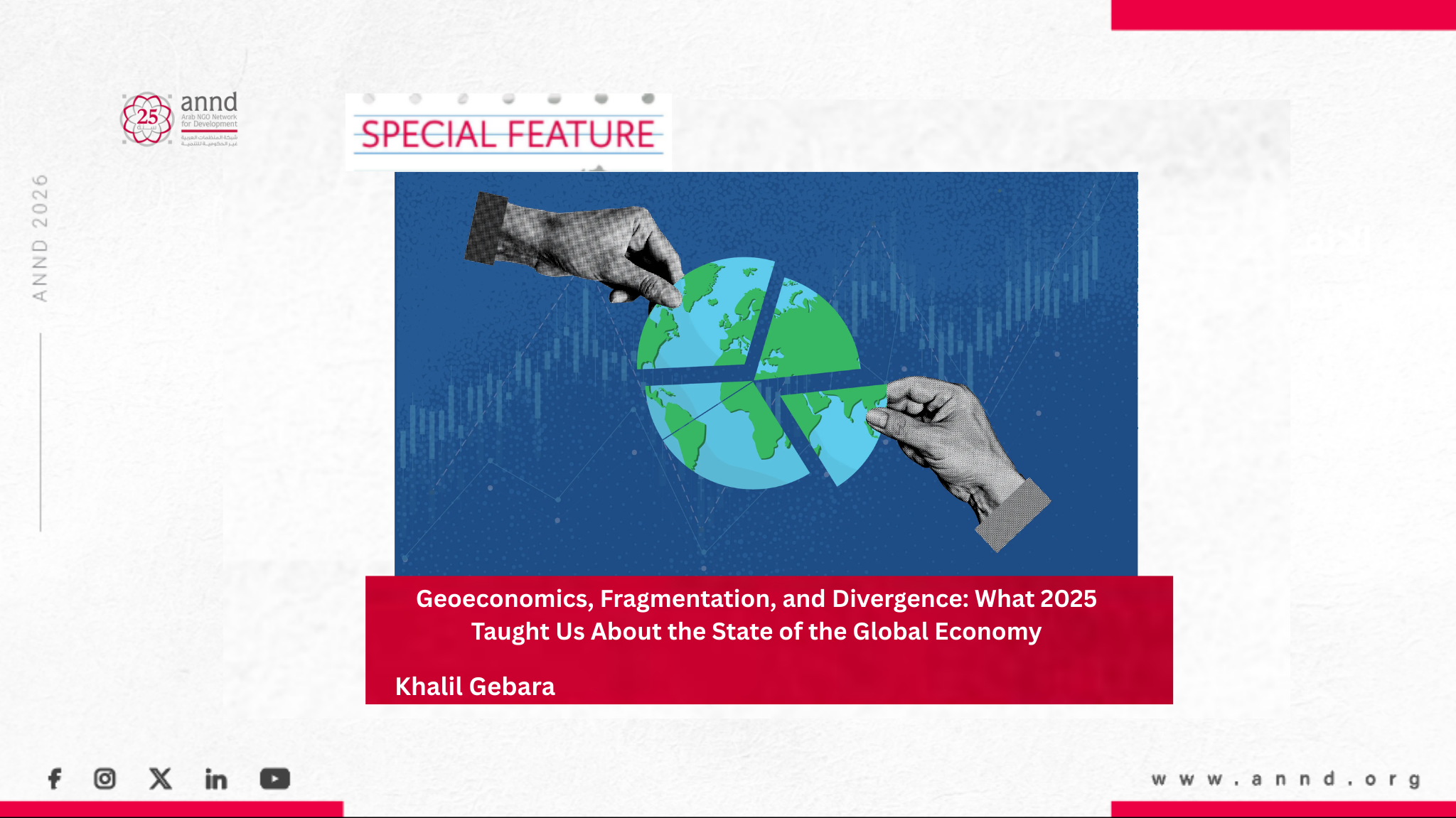
Geoeconomics, Fragmentation, and Divergence: What 2025 Taught Us About the State of the Global Economy - Khalil Gebara

Geoeconomics, Fragmentation, and Divergence: What 2025 Taught Us About the State of the Global Economy
Introduction: The World in 2025
By the end of 2025, it had become clear that the global economy was not simply recovering from a sequence of shocks; it was reorganizing itself around a different logic. The premises that underpinned the end-of-history moment (open trade, ever-deeper globalization, expanding development assistance, and a technocratic multilateral order) came under sustained strain. The year 2025 consolidated four structural shifts:
| ● | The return of geoeconomics as the primary organizing principle of international economic relations, with trade, technology, and finance increasingly subordinated to geopolitical rivalry (IMF 2025a, 1–4). |
| ● | The quiet dismantling of the post–Cold War development architecture, as aid volumes contracted, conditionality hardened, and multilateral agencies confronted funding and political constraints (World Bank 2025a, 5–8). |
| ● | A new phase of technological evolution, in which artificial intelligence (AI) remained a major source of potential productivity gains but raised unresolved questions about employment, distribution, and national AI preparedness (World Bank 2025b; IMF 2025a, 15–17; World Bank 2025c). |
| ● | A deepening divergence within the Arab region, with Gulf economies consolidating their position as digital, AI-integrated hubs while countries like Lebanon and Syria moved further into crises of financial management, governance, and reconstruction (World Bank 2025a; Khattab 2025; Al Tamimi 2025). |
Macroeconomic Resilience Amidst Turbulence
The defining global macroeconomic narrative of 2025 was not stagnation but resilience under stress. In 2025, despite elevated policy uncertainty, tariff hikes, and contentious politics in major economies, global growth recorded a rate of 3.2% compared to 3.3% in 2024 (IMF 2025a, ix–x; World Bank 2025a, 5–6). Yet this surface stability masked a profound re-politicization of trade. Trade policy is being explicitly used to pursue geopolitical and industrial objectives, rather than to expand aggregate welfare.
In this environment, geoeconomics, the strategic use of economic instruments for geopolitical ends, became the dominant frame. The rules-based system did not disappear, but it became increasingly conditional and bilateral.
For oil-exporting Arab economies, 2025 was a year of managed stability. Brent crude averaged around 69 dollars per barrel in 2025, down from about 80 dollars in 2024, as OPEC+ expanded supply through a phased unwinding of its previous voluntary production cuts and non-OPEC supply remained robust (World Bank 2025a, 6–8; Al Tamimi 2025). The strategic implication is clear: the Gulf’s resilience in 2025 was the product of both prudent macro management and acceleration of structural diversification, but its fiscal and external positions remain sensitive to oil prices and to global energy policy.
The Changing Landscape of Aid and Multilateralism
The COVID-19 pandemic and its aftermath led to unprecedented fiscal expansions in advanced economies. By 2025, many of these countries were grappling with high public debt, rising interest payments, and domestic political constraints, including the rise of populist parties hostile to foreign aid (World Bank 2025a, 5–8). The consequence for the Global South, and particularly for fragile and conflict-affected states in the Arab region, was a structural tightening of concessional finance.
The World Bank’s October 2025 MENAAP update documented a moderate increase in poverty from 7.4 to 8.4% at the 3.0-dollar (2021 PPP) poverty line between 2018 and 2023, against a global trend of poverty decline at similar thresholds (World Bank 2025a, 13–15). Much of this deterioration was concentrated in conflict-affected economies (Yemen, Syria, parts of Sudan, Gaza) and reflected the combination of conflict, inflation, and constrained aid flows (World Bank 2025a, 15, 22–24).
Lebanon and Syria are concrete examples. Lebanon’s humanitarian and reconstruction needs remain large, but donor fatigue and distrust of domestic governance have sharply limited new commitments (Khattab 2025; World Bank 2025a, 22–24). Syria, following the ousting of the Assad regime in December 2024, faces reconstruction needs estimated at $216 billion, but the basic question related to who will pay remained unanswered in 2025 (World Bank 2025a, 22–24).
The multilateral system itself showed signs of strain. The UN and its various agencies faced both budget constraints and the politicization of key mandates. UN humanitarian agencies operating in the region repeatedly warned of funding shortfalls for basic operations in Yemen, Gaza, Sudan, and Syria (World Bank 2025a, 22–24; WMO 2025, 2–4).
What distinguished 2025 from earlier periods was not simply the level of resources but the erosion of the assumption that multilateral institutions will scale up in response to a crisis. For low-income, fragile, and conflict countries in the Arab region, the implications for 2026 are clear. In the absence of a positive shock to donor sentiment, domestic resource mobilization, governance reform, and regional financial arrangements will determine whether basic development or even humanitarian objectives remain reachable.
AI, Demographics, and the Labor Market
In 2025, the empirical literature on AI moved beyond speculative exercises toward field-based evidence. Projections foresee a cumulative GDP boost from AI of 1.5–3.0% over the next decade, but with significant transitional dislocation (World Bank 2025c, 64–66; IMF 2025a, 16–17).
The Arab region’s exposure to AI-related automation is substantial but heterogeneous. A World Bank flagship on global megatrends estimated that approximately 45% of current work activities in selected Arab countries (including Egypt, Bahrain, Kuwait, Oman, Saudi Arabia, and UAE) could be automated with existing technologies, with the most exposed sectors being those intensive in routine tasks (World Bank 2025b, 21–22; 63–68). Yet the same report emphasizes that the region’s current economic structure, which is characterized by high informality and low-productivity services, means it is less exposed to frontier AI than advanced economies, raising the risk of missing out on AI-driven productivity gains (World Bank 2025b, 21–23).
The 2025 MENAAP Economic Update places this in a demographic context. The region’s working-age population is projected to expand by about 220 million between 2025 and 2050, a roughly 40% increase (World Bank 2025a, 26–28). Without a major acceleration in job creation, especially for women, the region faces a compound challenge: absorbing new entrants while workers in existing roles contend with skill obsolescence and task reconfiguration (World Bank 2025a, 26–28; 36–41).
Across the Arab region, female labor force participation remains near 20%, the lowest globally, and norms, legal barriers, and lack of childcare and safe transport sharply constrain women’s ability to participate in an AI-augmented labor market (World Bank 2025a, 26–36).
In other words, for most of the Arab region, the binding constraint to long-term growth in 2026 and beyond is not AI per se, but the failure to mobilize human capital into productive, AI-complementary activities.
Currency, Commodities, and Policy Dilemmas
Geopolitical factors, the political pressure that undermined the US Federal Reserve, and the continued threat of using tariffs as a weapon have put pressure on the US dollar and accelerated the erosion of its main comparative advantage as a strategic asset. Gold has been appreciating to historical levels, and it is estimated that, since 1979, the US dollar has lost more than 90% of its value against gold. Central banks have continued net purchases of gold, reflecting concerns over sanctions risk, dollar weaponization, and long-term inflation (World Bank 2025a, 6–8; IMF 2025a, 11–12).
For Arab economies pegged to the dollar, 2025 underscored how US interest rate decisions and US inflation are transmitted directly into domestic conditions, tightening the constraints on monetary policy and amplifying imported inflation. The strategic question for 2026 is whether currency peg strategies, reserve composition, and domestic monetary frameworks in Arab economies are sufficiently robust to manage volatile global interest rates, commodity prices, imported inflation, and geopolitical shocks.
Climate Crisis: From Margins to Mainstream
While climate may have been downgraded in donor politics in 2025, this does not change the fact that the Arab region faces a systemic threat from a warming rate of 0.43°C per decade, which is approximately twice the global average (World Meteorological Organization, 2025, pp. 7–9). This heating exacerbates a critical water crisis in a region where 15 of the world’s 20 most water-scarce nations are located and where about 66% of water resources across international borders, complicating regional stability (World Meteorological Organization, 2025, p. 5).
In 2024, climate disasters affected an estimated 3.77 million people, with impacts split between a six-year drought in Northwest Africa and unprecedented flash floods that destroyed around 4 million hectares total, with 1.7 million hectares of cropland alone (World Meteorological Organization, 2025, pp. 11–13). Furthermore, sea levels in the Red Sea are rising at about 4.1 mm per year, significantly exceeding the global mean (World Meteorological Organization, 2025, pp. 10–11). These physical risks are compounded by an underestimation of economic costs, as current disaster reporting often fails to capture the full scale of non-economic losses, such as human displacement and the degradation of essential services (World Meteorological Organization, 2025, pp. 16–18).
In this context, 2026 should be treated as a pivotal year in which coping and adaptation move from peripheral projects to the core of economic policy, with climate risk fully integrated into fiscal planning, infrastructure investment, and social protection systems (World Meteorological Organization, 2025, pp. 16–18).
Lebanon and Syria: The Anatomy of Crisis
By 2025, Lebanon’s crisis is no longer a cyclical downturn but a systemic breakdown of the monetary-financial governance nexus. The Beirut I conference, held in November 2025, crystallized international skepticism. Donors and investors signaled clearly that without credible loss recognition, governance reform, and an empowered, independent judiciary, large-scale capital inflows and reconstruction support would not materialize (Khattab 2025). 2025 was also another missed opportunity to move from ad hoc management of collapse to a transparent recognition and allocation of financial losses. The government did not discuss and approve a draft Gap Law until 27 December 2025. This gap law was intended to serve as a compromise among the depositors, the International Monetary Fund (IMF), and the commercial banks, but ultimately failed to satisfy any of these parties. This draft law was not based on exact numbers and figures and did not clearly clarify how the revival of commercial banks would occur, how the state would finance its share, or how the Central Bank's recapitalization would proceed.
For 2026, Lebanon’s primary constraint remains the missing political will to accept losses and restructure institutions, not the unavailability of external financing per se. Without it, the country will remain locked into a cash economy, a dysfunctional commercial banks sector, and chronic distrust that deters external investment.
For Syria, the challenge in 2026 is to move beyond saying the right thing to launch a concrete reconstruction program that can facilitate the return of internally displaced persons and refugees from neighboring countries. This physical reconstruction, which requires more than $216 billion, cannot rely solely on foreign direct investment (FDI) or on shifting the country’s economic structure toward a purely private-sector-based economy. It requires significant donor funding because the objective is to rebuild the country as a whole, not just its economically competitive sectors. At the same time, any economic plan needs to be anchored by a proper social protection strategy to combat poverty and to ensure that the economic transformation is inclusive rather than just structural.
In conclusion, 2025 showed that geoeconomics, AI, and climate pressures are structural, not cyclical. For some countries, this creates both opportunities and responsibilities: to leverage their financial and technological lead in ways that support regional stability. For Lebanon, Syria, and other countries, 2026 should not simply be another year of drift. Without concrete moves on governance, financial resolution, and social protection, they risk sliding from protracted crisis into permanent stagnation.
References
- Al Tamimi, A. Z. (2025, December 24). Diversification and growth: How Gulf economies fared in 2025. Al Majalla.
- International Monetary Fund. (2025a). Regional economic outlook: Middle East and Central Asia—Resilience amid uncertainty: Will it last? International Monetary Fund.
- International Monetary Fund. (2025b). Boosting economic recovery after conflict: Patterns and policies. In Regional economic outlook: Middle East and Central Asia—Resilience amid uncertainty: Will it last? (pp. 26–41). International Monetary Fund.
- Khattab, A. (2025, December 22). Crisis and success: How Arab economies fared in 2025. Al Majalla.
- World Meteorological Organization. (2025). State of the climate in the Arab region 2024. World Meteorological Organization.
- World Bank. (2025a). Middle East, North Africa, Afghanistan, and Pakistan economic update, October 2025: Jobs and women—Untapped talent, unrealized growth. World Bank.
- World Bank. (2025b). Global megatrends and human development in the MENA region: Preparing for demographic, climate and technological change. World Bank.
- World Bank. (2025c). Gulf economic update: The Gulf’s digital transformation—A powerful engine for economic diversification. World Bank.
Recent publications
What Are the Impacts of War on Energy Security? And Could It Accelerate the Energy Transition?