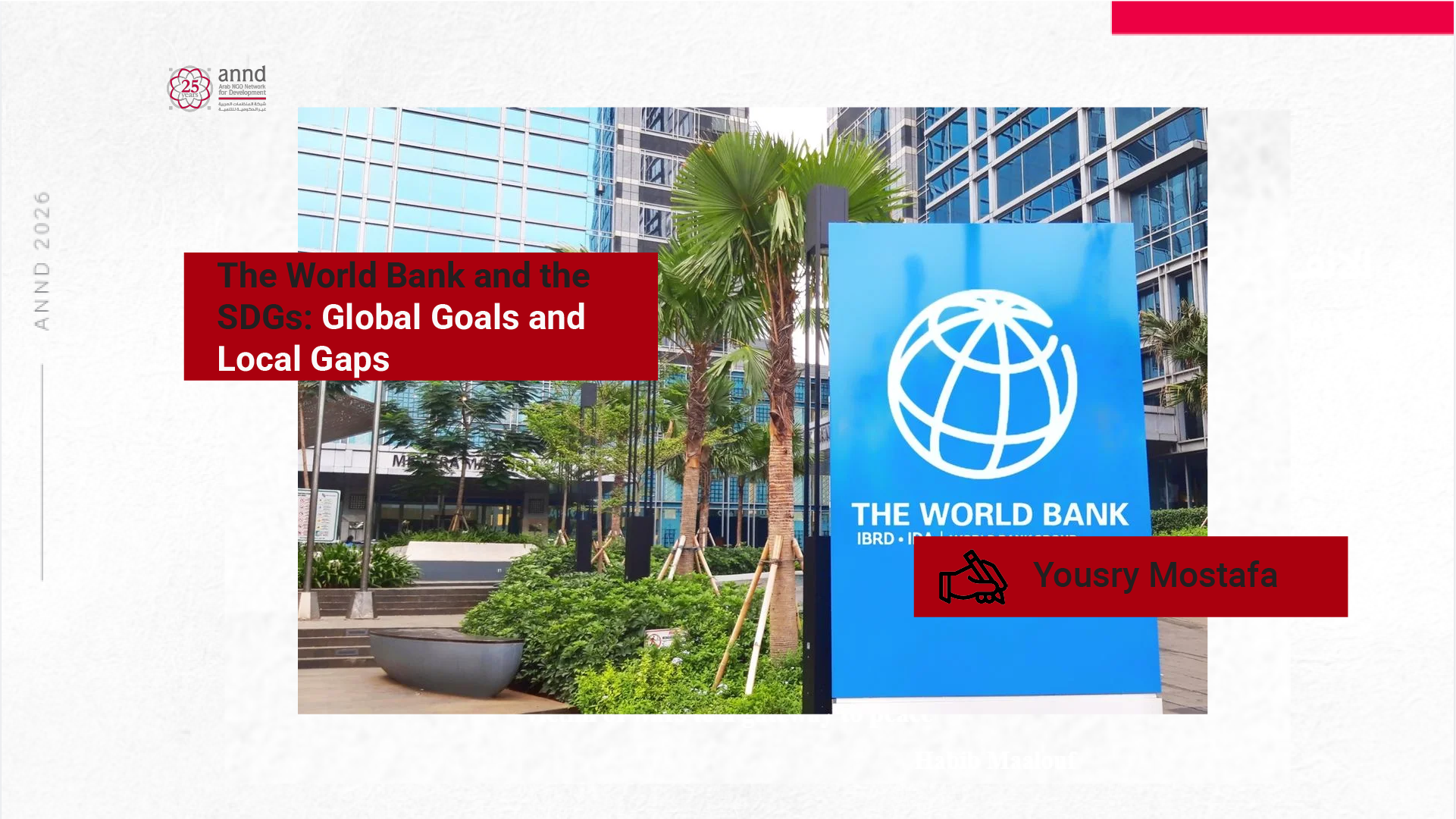
The World Bank and the Sustainable Development Goals: Global Goals and Local Gaps - Yousry Mostafa
The World Bank and the Sustainable Development Goals: Global Goals and Local Gaps
By Yousry Mostafa
“Global Goals and Local Gaps” is the title of a critical study (read the study) that analyzed data from more than 27,000 World Bank-financed projects implemented between 2015 and 2025, with the aim of assessing the extent to which they were aligned with the seventeen Sustainable Development Goals (SDGs), in addition to analyzing financial priorities and the geographic distribution of funding.
The study concluded that there was a clear disparity in the volume of funding directed toward the different goals. Some goals enjoyed strong alignment and financing, others received a moderate level of attention, while still others suffered from relative underfunding.
The goals with the strongest financing alignment were Goal 9, related to industry, innovation and infrastructure; Goal 11, related to sustainable cities and communities; and Goal 7, related to affordable and clean energy. In contrast, goals such as health (Goal 3), education (Goal 4), and water and sanitation (Goal 6) received less attention, while goals such as zero hunger (Goal 2) and peace, justice and strong institutions (Goal 16) remained relatively underfunded.
Funding Disparities Across Development Goals and Regions
The picture is completed by geographic priorities. Latin America, Sub-Saharan Africa, and Europe and Central Asia received the largest shares of financing. At the same time, the study revealed an imbalance between the scale of development needs and the volume of funding directed toward them. Some regions suffering from high levels of poverty and acute development needs, such as West and Central Africa and South Asia, received less financing relative to their population size and needs.
As for the Middle East and North Africa, the region received around 1,817 projects during the same period, representing nearly 6.7% of the total number of projects. Goal 9, related to industry, innovation and infrastructure, ranked first among the areas of financing in the region, followed by Goal 11 on sustainable cities and communities and Goal 7 on affordable and clean energy. Financing for areas such as health, education, water and sanitation, and climate action followed.
Beyond Funding Figures: Is Development Delivering Results?
However, any reading of the World Bank’s relationship with sustainable development cannot stop at the number of projects or the volume of financing. Two dimensions must be considered together: a quantitative dimension related to the distribution of financing across goals and regions, and a qualitative dimension concerning whether the nature of the interventions and the policies accompanying them actually improve living conditions and reduce poverty and inequality.
From a quantitative perspective, the results point to a financing strategy that places substantial emphasis on infrastructure, energy, and cities, raising a question about the balance between investment in physical infrastructure and investment in people. Issues such as eliminating poverty and hunger and building fair and effective institutions do not appear to receive the same level of financing priority.
The geographic distribution of financing also raises another question about the relationship between actual development needs and the financing priorities, economic considerations, political factors, and geographic considerations that shape them.
Social Protection in Egypt: Expanding Assistance or Addressing Poverty?
On the other hand, there are clear indications of World Bank contributions in areas such as poverty reduction, social protection, education, health, infrastructure, and climate.
One example is its support for Egypt’s Takaful and Karama programmes as a model of social protection (IEG, 2026). This support contributed to the development of a national cash-transfer system targeting the poorest groups, and to improving targeting criteria, registration systems, and payment mechanisms.
Quantitatively, a substantial expansion can be observed in the number of households covered by the social protection system. However, the World Bank Group’s most recent independent evaluation presents a more complex picture.
The gains in consumption and poverty reduction that appeared in earlier evaluations were less evident in 2024, while evidence of households sustainably exiting social protection programmes remained limited.
Likewise, a household’s exit from a social protection programme does not necessarily mean that it has escaped poverty.
More importantly, the continued dependence of poor households on cash support, not to mention the persistence of poverty despite such support, raises a question that goes beyond access to assistance and concerns the capacity of policies to address the structural causes of poverty.
The same applies to the objective of women’s empowerment, which cannot be measured simply by whether transfers reach women, but by the extent to which these programmes bring about actual changes in women’s economic independence and decision-making power.
The World Bank linked the 2030 Agenda at an early stage to its declared objectives of ending extreme poverty and promoting shared prosperity in a sustainable world. It considered financing, data, and support for the implementation of national policies among the principal tools through which it contributes to achieving the Sustainable Development Goals (World Bank, 2015).
The Bank’s connection to the 2030 Agenda is therefore no longer in question. The more important question is: what has actually been achieved, for whose benefit, and at what social cost?
Fiscal Reform and Economic and Social Rights: Competing Priorities?
The issue becomes even more complex when moving from the financing of social programmes to the economic and fiscal policies accompanying loans, including subsidy reform, tax reform, exchange-rate liberalization, and controls on public expenditure.
Even when such policies are justified on the grounds of financial stability, they can impose a high social cost, particularly on poor groups and the middle class.
Here, the fundamental paradox emerges: how can fiscal reform policies be reconciled with the requirements of rights-based development?
When controlling deficits and debt becomes a priority implemented through reducing expenditure or placing pressure on public services, fiscal policy can shift from being an instrument for stability to becoming a factor that weakens the realization of economic and social rights.
When debt burdens increase while the capacity for social spending declines, poverty becomes, in one way or another, part of the cost of financial stability.
Ultimately, the path toward closing fiscal deficits may be paved at the expense of the ability to provide a dignified life.
Debating whether the Bank is “for” or “against” the Sustainable Development Goals may lead to conflicting theoretical conclusions. What matters more is examining the gap between declared goals and actual outcomes, between allocated financing and the policies that accompany it, and between economic growth and the realization of rights.
From a human rights perspective, it is not enough for poverty reduction to be a declared objective or for social protection to form part of a project.
The real question is: are human rights at the heart of economic and financial priorities, or do they remain a margin that can be taken into consideration and then sacrificed when the requirements of financial stability demand it?
Perhaps the deeper question is this: are we destined to choose between financial stability and social and family stability? Or does the problem lie in policies that make achieving the former come at the expense of the latter?
Conclusion: Global Ambitions, Local Tests of Development Justice
In the end, the Sustainable Development Goals may be global in their ambition, but their real test takes place locally, in people’s daily lives and in their ability to access food, health, education, employment, social protection, and a dignified life.
It is precisely here that the gap emerges which financing figures alone do not reveal: the gap between global goals that appear coherent and local policies that may leave the most vulnerable communities to bear the costs of development and reform alone.
Recent publications
Lebanon’s Reform Moment: From Fiscal Repair to Rebuilding the State - Lamia Moubayyed