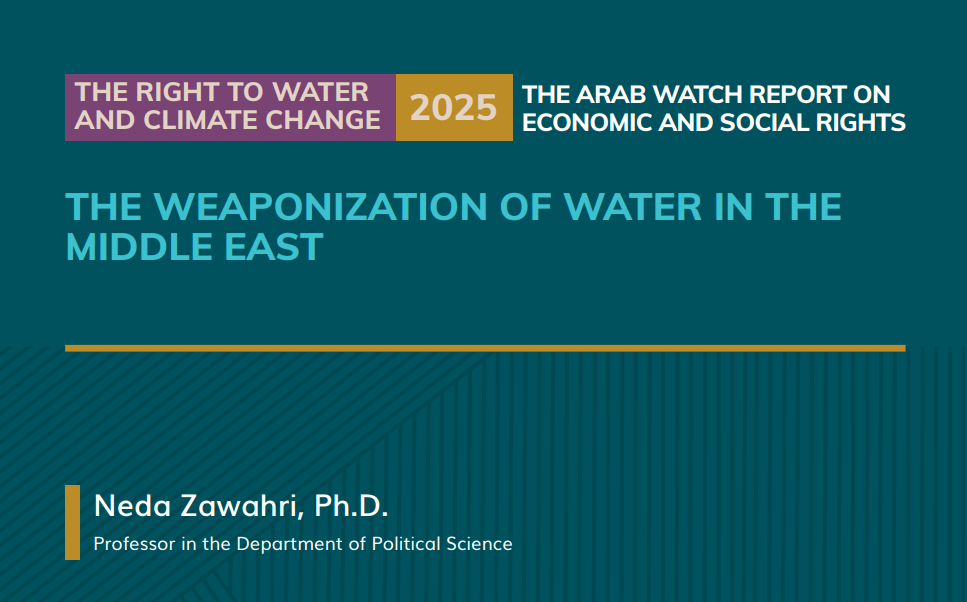
Thematic Report: The Weaponization of Water in the Middle East


Thematic Report: The Weaponization of Water in the Middle East
Introduction
By 2050, the entire population of the Middle East and North Africa will be living under conditions of extremely high-water stress, and certain portions of the region will be uninhabitable (World Resources Institute, 2023). These dire conditions are expected because of the combined impacts of natural aridity and climate change, along with population growth and mismanagement of existing water supplies. This environmental transition is occurring in a region where 60 percent of the water supply is located in transboundary rivers (i.e., the Jordan, Euphrates, and Tigris) that flow through states with a history of internal and regional conflict or animosity. Within these transboundary basins, hegemonic states tend to dominate the use and development of the basin’s water, while weaker and often downstream states suffer from significant water shortages (Zeitoun and Warner, 2006).
Given the region’s water shortage and the resource’s connection to human security, national security, and regime stability, water and hydrological infrastructure are increasingly weaponized by states, paramilitary organizations, and nonstate actors to inflict social, economic, and political losses on enemies (UNICEF, 2021a). The weaponization of water can occur during civil or regional wars, occupation, periods of tension, or even in times of peace to undermine adversaries. This weaponization can be carried out through the bombing, control, or manipulation of domestic water infrastructure (such as water treatment plants, canals, pipes, sanitation facilities, and dams) as well as through the manipulation of water in transboundary rivers. In the process, the region’s civilian population is heavily impacted by the weaponization of water, because it can inflict on them water, food, energy, and economic insecurity. Military targeting of water infrastructure can further compromise civilians’ access to safe water and sanitation, both in terms of quality and quantity, directly affecting their health, wellbeing, and livelihoods. An examination of conflicts across the world reveals an increase in the weaponization of water (UNICEF, 2021a).
While international regimes in the form of treaties, conventions, and common law exist to prohibit the weaponization of water and secure the human right to water for civilians, especially those in conflict zones or occupied land, both state and nonstate actors fail to comply. For example, the Geneva Conventions, International Humanitarian Law, and the Human Rights to Water and Sanitation all prohibit the weaponization of water. As this chapter will demonstrate, despite the heavy institutionalization within international law and the ultimate development of a norm against the weaponization of water, across the Middle East multiple regional and international states, paramilitary organizations, and nonstate actors continue to weaponize water against weaker states, territories, and civilians with minimal retribution or sanction by the international community of states and global hegemons. Using two cases from the Middle East, this chapter seeks to document this disregard for international and common law along with the breaking of norms and taboos by state and nonstate actors and paramilitary organizations, as they weaponize water to inflict negative social, economic, and political losses on adversaries and civilians. The chapter concludes with policy recommendations for non-governmental organization (NGOs), intergovernmental organizations (IGOs), humanitarian organizations, policymakers, aid agencies, and donors on approaches to challenge the weaponization of water and, in the process, enable civilians to secure access to safe and sufficient drinking water.
Recent publications